
Global flashpoints: the conflicts to watch in 2026



A CFR survey warns 2026 will remain conflict-ridden, with several flashpoints posing high risks to US interests. Analysts urge ending the Russia–Ukraine war.
The Preventive Priorities Survey (PPS), produced by the Council on Foreign Relations’ (CFR) Centre for Preventive Action (CPA), finds the world remains marked by disorder, with violence continuing in many places.
US foreign policy experts are deeply concerned about “threats” arising from conflict that could undermine US national security and international stability, with several flashpoints likely to erupt or intensify in 2026.
The PPS compiled views from more than 300 US foreign policy experts to assess which conflicts could most affect US interests, alongside how likely they are to occur or persist in 2026.
The survey aims to help US policymakers prioritise prevention and mitigation. It classifies conflicts by their potential impact on US interests—high, medium or low—and also rates the likelihood of a conflict occurring or continuing in 2026 as high, medium or low.
It then combines these assessments into overall priority levels, with Priority 1 indicating the highest level of attention for the United States.
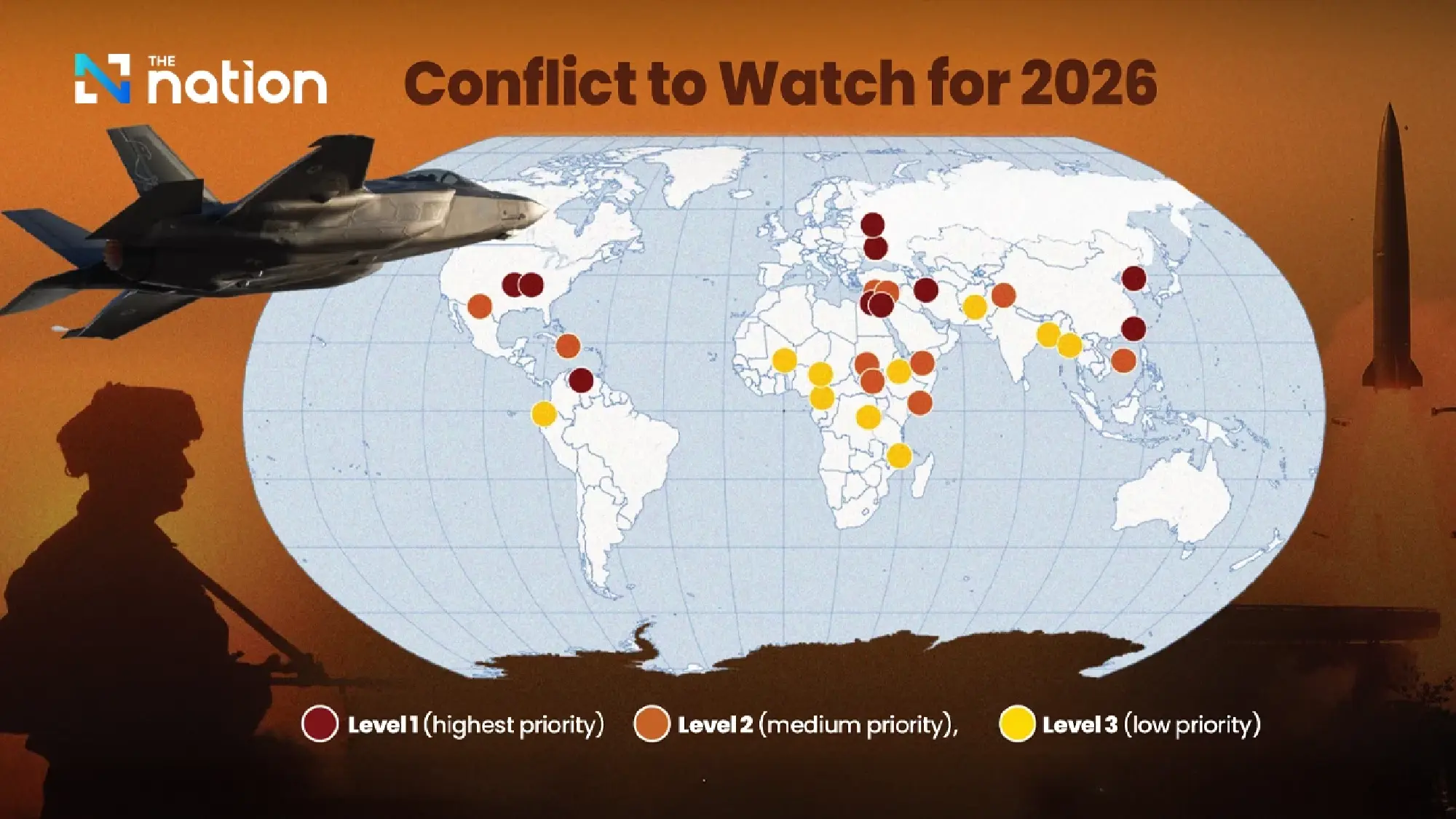

The conflicts to watch most closely
Priority 1 conflicts
High impact on US interests, high likelihood in 2026
These include escalating conflict between Israeli security forces and Palestinians in the West Bank, driven by Israeli settlement construction, Palestinian political rights, and a renewed Hamas–Israel war in Gaza—worsening the humanitarian crisis and fuelling wider regional instability.
Also listed among the top priorities are: an intensifying Russia–Ukraine war, marked by expanding attacks on each side’s infrastructure, including residential hubs; US military operations targeting transnational criminal groups that escalate to the point of direct strikes in Venezuela; and rising political violence and unrest inside the United States stemming from polarised domestic politics and the deployment of security forces in cities.

High impact on US interests, medium likelihood in 2026
These include: a renewed armed conflict between Iran and Israel, driven by Iran’s efforts to revive its nuclear programme and rebuild a regional network opposed to Israel; AI-enabled cyberattacks by states or non-state actors on critical US infrastructure; intensified Chinese military, economic and political pressure on Taiwan that triggers a severe cross-strait crisis drawing in other regional countries, including the United States; armed clashes between Russia and at least one NATO member, stemming from increased Russian provocation in Europe; and North Korea resuming nuclear weapons testing, raising tensions on the Korean peninsula and risking armed confrontation involving other regional powers, including the United States.

Priority 2 conflicts
Low impact on US interests, high likelihood in 2026
These include: an escalation of Sudan’s civil war; severe clashes between armed groups and security forces in Haiti; and delays to elections in South Sudan that spark renewed fighting between ethnic armed groups and political militias, destabilising the central government.
Medium impact on US interests, medium likelihood in 2026
These include: a US withdrawal of security assistance from Somalia that increases terrorist attacks and enables al-Shabaab and ISIS to expand territorial control; Houthi attacks on Israel and international shipping; failure to disarm Hezbollah; rising sectarian violence and an ISIS resurgence in Syria; and renewed armed conflict between India and Pakistan triggered by escalating terrorist attacks.

Low impact on US interests, high likelihood in 2026
These include: growing US concern over the production and trafficking of illegal drugs by transnational criminal organisations; and more assertive Chinese activity in the South China Sea—especially towards the Philippines—leading to a military confrontation involving China, the United States and US allies.

Priority 3 conflicts
Low impact on US interests, medium likelihood in 2026
These include: worsening insurgency across the Sahel (particularly in Mali), deepening regional instability and humanitarian suffering; increased Islamist militant attacks in Nigeria; ethnic and political conflict over territory and natural resources in the Democratic Republic of Congo involving multiple armed groups, including Rwanda-backed factions; political and religious violence in Bangladesh; intensifying criminal activity and conflict between Myanmar’s military authorities and armed groups; rising criminal violence and political repression in Ecuador; armed clashes between Ethiopia’s military and Eritrea-backed armed forces; insurgency in northern Mozambique; renewed armed conflict between Afghanistan and Pakistan; and political unrest in Cameroon.
Beyond the conflicts listed above, CPA interviewees—government officials and foreign policy experts—also highlighted additional situations they believe merit attention.
These include: increased Chinese and Russian military activity in the Arctic, potentially triggering armed confrontation involving the United States or other NATO allies; renewed fighting between Armenia and Azerbaijan over unresolved territorial disputes; border clashes between Cambodia and Thailand that destabilise regional politics; rising China–Japan tensions over sovereignty of the Senkaku/Diaoyu islands amid wider disputes linked to Taiwan; increased armed-group activity and political fragmentation in Colombia; and rising ethnic violence and political instability in the Western Balkans, potentially triggering armed confrontation that could require foreign intervention.

Where experts see room for prevention or solutions
This year’s survey, based on responses from 336 experts, also argues some conflicts still present opportunities to prevent further escalation or to reach a settlement. It groups these opportunities into two categories:
Conflicts where the United States has particular leverage or influence over one or more parties.
Experts most strongly agreed the best opportunity for US influence lies in the Russia–Ukraine war, with 112 experts urging US engagement to help resolve the conflict. Second was the Gaza conflict (49), followed by China–Taiwan (31). Other cases cited included the West Bank and North Korea’s nuclear testing.
Conflicts where the United States can work with other countries and international institutions to build peace.
Experts pointed to potential collaboration on Sudan’s civil war, an ISIS resurgence, Haiti’s crisis, and conflict in Congo.
While the PPS is intended as a warning to the United States about which conflicts require the closest attention, it also offers other countries a clearer picture of how they may need to prepare and adjust foreign policy to match risks that could emerge in 2026—risks that may not only affect the parties directly involved or major powers, but could ripple out to other countries as well.
