
Philippines starts rescue, clean-up operations in aftermath of super typhoon Doksuri


Typhoon Doksuri made a second landfall on Dalupiri islands in Aparri, Cagayan at around 10 a.m. on Wednesday, the Philippines weather bureau reported.
Based on its 11 a.m. weather bulletin, Philippine Atmospheric, Geophysical, and Astronomical Services Administration (Pagasa) said Doksuri maintains its strength while moving southwestward at 15 kilometres per hour.
The typhoon is carrying maximum sustained winds of 175 kilometres per hour near the centre and gustiness of up to 240 kilometres per hour.
Pagasa said Doksuri “may exhibit trochoidal or wobbling motion while in the vicinity of the Babuyan Islands” within the next six hours before generally turning northwestward or north-northwestward.
“The southwest monsoon enhanced by Doksuri will continue to bring occasional monsoon rains over the western portions of Central Luzon, Southern Luzon, and Visayas in the next three days,” the state weather bureau noted.
The typhoon’s first landfall occurred on Fuga Island, also in Aparri at 3:10 a.m.
It is expected to weaken by the weekend and leave the Philippine Area of Responsibility (PAR) on Thursday morning.
It will head towards Fujian, China by Friday morning after crossing the Taiwan Strait.
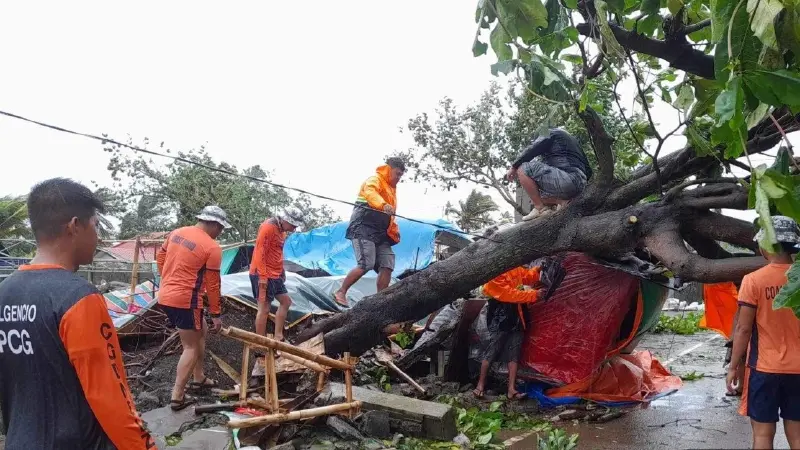
Damage and debris could be seen strewn across roads in the central Philippines mountain city of Baguio on Wednesday morning, just after super typhoon Doksuri made landfall.
Heavy rains brought by Doksuri have caused rivers to overflow and damaged power lines, leaving thousands across the Philippines without power. Storm warnings are in place in many parts of the country’s most heavily populated island of Luzon where the city of Baguio resides, and authorities have warned of storm surges, landslides, and damage to infrastructure.
Residents in coastal communities had been evacuated ahead of the storm. Categorised as a super typhoon on Tuesday, Doksuri weakened slightly on Wednesday.
The Philippine Coast Guard started rescue and clean-up operations on Wednesday after super typhoon Doksuri lashed the country’s northern coastline with gale-force winds and torrential rain, bursting banks of rivers and leaving thousands without electricity.
Doksuri pounded coastal communities, including isolated villages tucked away in tropical forests, and left at least one person dead.
The storm is nearly 900 km (560 miles) across and is expected to sustain strength as it continues its course towards Taiwan and the Chinese mainland.
China's Meteorological Administration has already raised its storm alert to the second-highest tier and the manufacturing hub of Guangdong province warned of the worst storm in a decade.
Philippine Daily Inquirer And Reuters
