
Seoul starts daily press briefings to address Fukushima fears
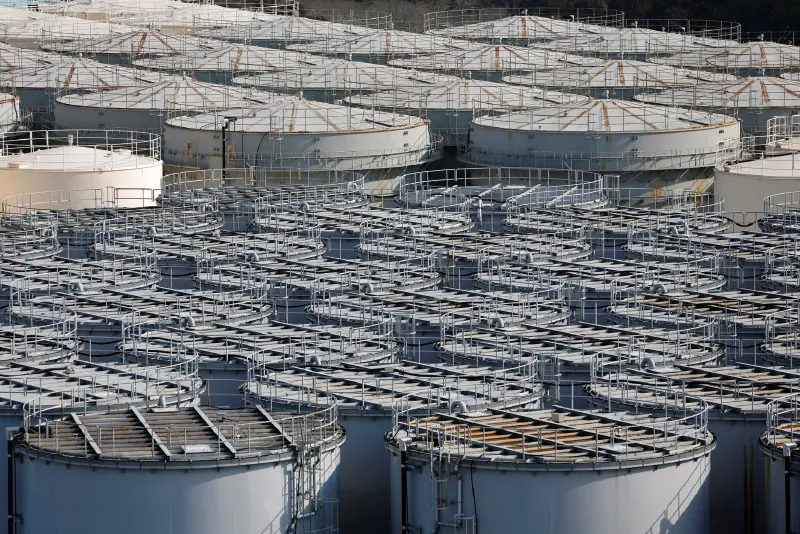


A daily briefing by the Seoul government on Japan's release of treated radioactive wastewater into the sea will be held to address fears over the toxicity and impact on marine life, officials said Thursday.
On Thursday, government officials held the first briefing over some 1.3 million cubic meters of water set to be released from the wrecked Fukushima nuclear plant. The briefing, also attended by independent experts, will take place on weekdays for the time being.
The decision came after lawmakers expressed "much graver concerns than expected" about the wastewater disposal plan during a questioning session with Prime Minister Han Duck-soo at the National Assembly this week, said Park Ku-yeon, first vice minister of government policy coordination, at a press conference at the Government Complex Seoul.
"The government is putting an utmost effort to ensure Korean people's safety, but on the other hand, we should also avoid the circumstances where the concerns arise due to a lack of information or a spread of misinformation," Park said.

"That's how we made the decision to frequently provide scientific information (about Japan's plan) and use the briefings as the medium of communication (with the public)."
Park during the briefing refuted multiple claims raised by those who opposed the wastewater disposal.
He said media reports about "poor sampling" of the wastewater by the International Atomic Energy Agency, which cited an official of Tokyo Electric Power Co., an operator of Fukushima Daiichi nuclear plant, were false. The sampling was taken from "fully blended" wastewater under the supervision of the IAEA, Park said, adding that the government had verified the information with the IAEA.
Park also refuted claims that the wastewater had shown high activity concentration of radioactive nuclide strontium-90 at 433,000 becquerels per litre. The figure indicated the radioactivity of wastewater before treatment, he explained. A preliminary report in May by a task force under the IAEA, a UN body, showed that the treated water had 0.42 becquerel per litre of activity concentration in the worst-case scenario.

Park also reiterated that Tepco's test earlier this week did not involve the disposal of the actual wastewater.
Song Sang-keun, vice minister of the Ministry of Oceans and Fisheries, said in the same briefing that seafood in Korea has been proven safe for consumption in some 75,000 inspections since 2011, despite the Fukushima meltdown and the contaminated water leakage in 2013.
Song added that none of the 286 rounds of radioactivity inspections into salts produced in Korea was found to be contaminated.
But IAEA's latest report and recent findings have failed to alleviate public fear. The May report indicated that Tepco's water treatment technology showed "a high level of accuracy" and found that Tritium is the only radionuclide that had higher activity concentration -- as expected -- than the regulatory standard.
In 2013, Tokyo acknowledged the leakage of contaminated water in August 2013 after a series of denials.
The same year Seoul imposed a ban the imports from eight prefectures -- Aomori, Miyagi, Iwate, Fukushima, Ibaraki, Tochigi, Gunma and Chiba -- and requires certificates for imports from eight others -- Hokkaido, Tokyo, Kanagawa, Aichi, Mie, Ehime, Kumamoto and Kagoshima.
The import curb prompted Japan to take legal action, which was turned down by the World Trade Organization in a ruling in 2019.
Park said such restriction is "at the toughest level in the world," reiterating the government's position not to lift the ban and blaming Japan for its failure to assure Seoul of the safety of its seafood.
In the meantime, Song opposed an attempt by the main opposition party, the Democratic Party of Korea, to ram through a bill to create legal grounds for compensation for damages by fishers in Korea, saying it is premature to introduce a law when no damages have been found yet.
As to how the wastewater disposal plan for the sea was confirmed, Heo Gyun-young, a nuclear engineering professor at Kyung Hee University in charge of Korea's independent technology review on the plan, said Japan's plan to dump the wastewater at sea was the most viable option. It was more preferred to dispose of it through the air given that radioactive element becomes harder to contain once the wastewater evaporates.
Heo added that no other options back then -- including burying the wastewater into Japan's soil -- were scientifically proven.
Son Ji-hyoung
The Korea Herald
Asia News Network
