
Restaurant survival cycle shortens, many close within a year of opening
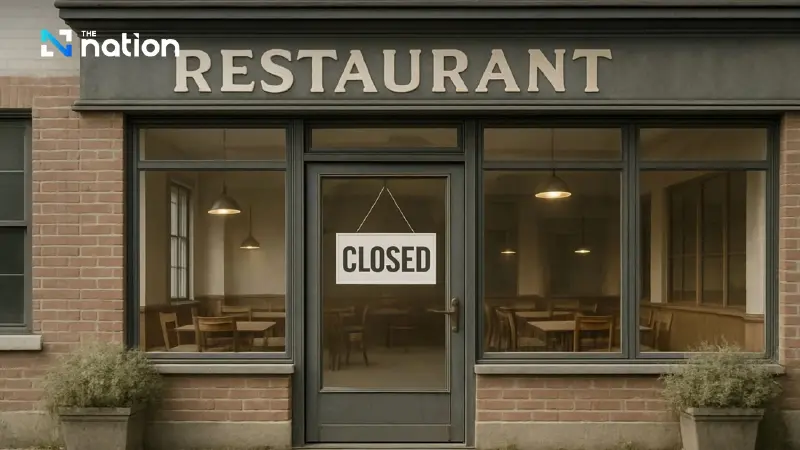


Surviving one year in today’s restaurant business is a feat. Check key risks and decide whether to push forward or call it quits.
Amid a prolonged economic slowdown, Thailand’s food and beverage industry is facing growing pressure, emerging as one of the most visibly affected sectors in 2025.
The year has been marked by what many economic research houses are calling a “triple crisis,” involving sluggish overall economic growth, cautious consumer spending, and a decline in foreign tourist arrivals.
Kasikorn Research Centre forecasts that the food and beverage market will see only modest growth in 2025, with total market value estimated at around 646 billion baht, representing a year-on-year increase of just 2.8%. This marks a sharp decline from previous growth trends.
One of the key factors weighing down the industry is weak domestic purchasing power, a direct consequence of broader economic stagnation. At the same time, operators are grappling with rising costs, particularly those catering to international tourists.
Data from the Ministry of Tourism and Sports reflects a continued downturn in international tourism. In the first five months of 2025, Thailand welcomed only 12.9 million foreign visitors—a 1% drop from the same period last year, with the downward trend expected to persist.
Although domestic tourism has shown some resilience, Thai travellers have become significantly more cautious with their spending. Many households remain burdened by high living costs and ongoing economic uncertainty.
Overall, the food and beverage industry is facing a range of challenges this year, not only fierce competition, but also shifting consumer behaviour and a difficult economic environment.
Rising operating costs remain a major concern. For restaurant businesses in particular, cost structures typically break down as follows:
- 35% – Food ingredients: still volatile and generally high
- 30% – Marketing and other expenses
- 20% – Utilities and rental costs
- 15% – Labour costs
As consumers become more diverse and complex in their preferences, food and beverage operators must adapt to five emerging pillars that now define consumer expectations: novelty, experience, quality, health, and reasonable pricing.
Hidden opportunities amid rising uncertainty
In an era of low brand loyalty, consumers are more open to trying new restaurants, offering a rare chance for businesses to attract fresh customer segments. The real challenge, however, lies in converting first-time visitors into repeat customers. This demands not only consistent quality but also a strong brand impression.
Moreover, market volatility is opening up prime locations at lower-than-usual prices. The decision to sell or sublease doesn’t always reflect poor footfall or weak demand—more often, it points to mismanagement or a mismatch with the target audience. For savvy investors and operators, this presents an attractive entry point to secure good locations at discounted rates.
Go or stop? Key signals to assess your next move
Signs you’re ready to grow:
- You can effectively manage costs and align inventory with actual sales.
- You understand and cater to the modern consumer’s demand for innovation, memorable experiences, high-quality and healthy food at fair prices.
- You specialise in a standout dish that builds top-of-mind recall—whether it’s signature chicken rice, som tam, or noodles, customers associate the dish with your brand.
Signs it’s time to exit:
- You lack a cost structure strategy. With operating expenses set to continue rising, poor planning increases your risk of financial loss.
- You don’t invest in market or consumer research. With rapidly shifting trends and preferences, not knowing your audience could cost you dearly.
- Your brand lacks a clear identity. Today’s consumers gravitate towards businesses that show expertise or specialisation. If your brand fails to stand out or lacks a defined strength, chances are it will be overlooked.
Sorathep Rojpotjanaruch, President of the Restaurant Business Entrepreneurs Association, has warned that small restaurants and independent operators continue to bear the brunt of Thailand’s economic slowdown, with the sector’s business cycle growing increasingly fragile.
“The lower end of the market sees the highest rate of closures, but also the highest rate of new openings. That tells you something: these businesses start up, struggle to sell, and are forced to shut down because they simply can’t survive,” Sorathep said.
He noted that while the overall cycle of opening and closing restaurants continues, the duration of that cycle has shortened significantly. “In the past, about 60% of restaurants closed within one year, and another 30% didn’t last beyond three years. Only around 20% could survive long-term,” he explained.
“Today, that first-year survival window has shrunk even further—restaurants are now folding within just 7 to 8 months. It’s a clear sign of the growing vulnerability in the early stages of the business,” he said.
“The cycle still exists—but now it’s so short, most don’t even make it through a year.”
Sorathep also emphasised the importance of a strong SME sector as the foundation of a healthy national economy.
“In countries with resilient economies—like Japan, Taiwan, or South Korea—you’ll find vibrant, thriving SMEs everywhere. Walk down any street and you’ll see local eateries, BBQ joints, and cafés on every corner. That’s what a strong economic base looks like,” he said.
“Unfortunately, our country’s foundation looks very different.”
