
NESDC meets Indonesia, Malaysia to draft new IMT-GT plan for 2027–2031
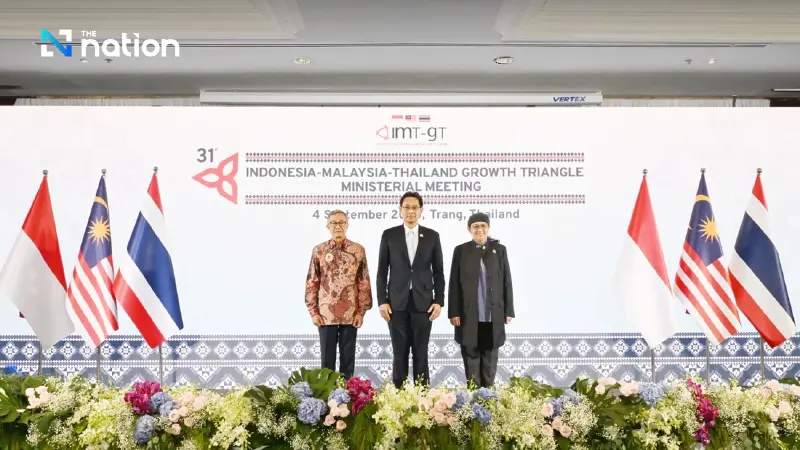


Thailand’s NESDC, representing the country, met with senior officials from Malaysia and Indonesia to push forward the new IMT-GT cooperation plan for 2027–2031, focusing on five key areas of economic collaboration.
Thailand recently hosted the 31st Indonesia-Malaysia-Thailand Growth Triangle (IMT-GT) Ministerial Meeting in Trang province, with Danucha Pichayanan, secretary-general of the National Economic and Social Development Council, serving as Thailand’s minister-in-charge for the programme and chairing the session.
Joining him were Hanifah Hajar Taib, Malaysia’s deputy minister of economy; Rahmat Budiman, Indonesian ambassador to Thailand; Nararya Soeprapto, ASEAN deputy secretary-general; and Winfried Wicklein, director general for Southeast Asia at the Asian Development Bank.
Senior officials from member countries, along with representatives from government agencies, the private sector and academic institutions across the three nations, also took part.
As the current five-year implementation plan (2022–2026) approaches its final year, discussions reflected both the future direction of cooperation and strategic priorities aligned with global trends. These are expected to form the foundation of the next five-year plan (2027–2031).

Key areas highlighted include:
- Cross-border infrastructure connectivity – enhancing transport and logistics efficiency in line with international standards.
- Sustainable cities and tourism – focusing on environmental conservation and local community participation.
- Eco-friendly agriculture – adding value to farm products through innovation, technology and food safety standards.
- Digital capability and adoption – leveraging digital technology for economic and social development in the subregion.
- Workforce development – upgrading skills to prepare for changes in labour markets and emerging global challenges.
IMT-GT meeting reaffirms regional vision, highlights clean energy cooperation
The meeting reaffirmed the commitment of member states and partners to ensure that the new IMT-GT plan reflects a shared subregional vision, capable of addressing economic, social and environmental challenges while delivering tangible benefits for people at all levels.
Ministers also discussed opportunities to deepen cooperation in the energy sector to strengthen regional energy security and support the transition to clean energy. Key priorities included renewable energy development, the expansion of smart grid systems, and cross-border power connectivity to meet rising demand while supporting sustainable economic growth.
The Asian Development Bank and the ASEAN Secretariat, as key development partners, reiterated their readiness to provide both technical and financial support for advancing clean energy and sustainable growth in the subregion.
The meeting also adopted the 31st IMT-GT Joint Ministerial Statement, which reaffirmed commitments to building an integrated, innovation-driven, inclusive and sustainable subregion under the IMT-GT Vision 2036.
Strategic areas emphasised included eco-friendly agriculture, development of the halal industry, enhanced transport integration, and measures to build resilience against climate change.
Ministers also underscored the importance of digital innovation and workforce development to address global challenges effectively.
Delegates further reviewed progress on IMT-GT projects, particularly infrastructure initiatives aimed at strengthening connectivity and competitiveness in the subregion. Updates included transport network upgrades, port development and improvements at customs checkpoints to facilitate trade, investment and cross-border travel.
The meeting also celebrated the success of the IMT-GT Tourism Year Campaign (2023–2025), which has played a vital role in reviving the tourism industry to levels surpassing the pre-COVID-19 era, while driving grassroots economic growth in IMT-GT areas and key tourism cities across the three countries.
