
Ekniti unveils 5-pillar plan to lift economy in 4 months
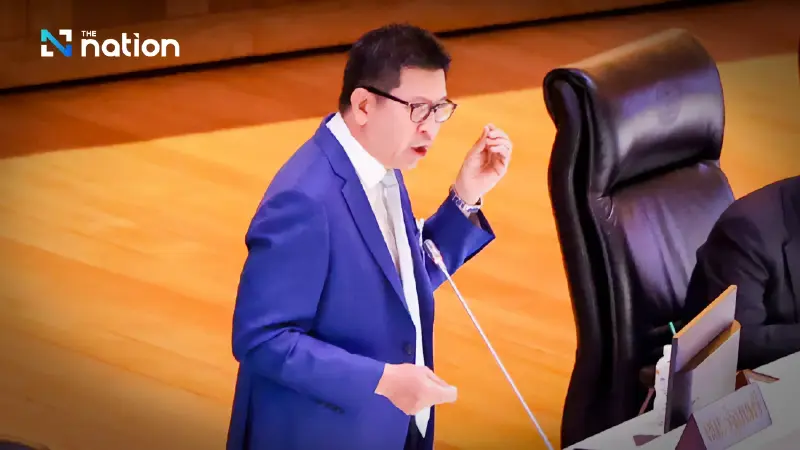


Core policy: “Short-term stimulus, Long-term gain, Broad distribution”, centred on five pillars: boosting the economy and tourism, tackling household debt, strengthening SME liquidity, expanding savings, and building future industries.
Deputy Prime Minister and Finance Minister Ekniti Nitithanprapas, in his capacity as head of the government’s economic team, presented the government’s economic concepts and policy framework during the joint parliamentary session on Tuesday (September 30). The session was convened to consider urgent business, with the cabinet delivering its policy statement under Section 162 of the Constitution.
Ekniti said the government’s economic policy rests on the principle of “short-term stimulus, long-term gain, broad distribution”. Stimulus measures will be designed with Thailand’s long-term potential in mind, ensuring benefits are spread nationwide. The aim is to achieve “quick big wins” in five key pillars to tackle the severe economic slowdown, with measurable results targeted within the first four months of the administration.
He likened the Thai economy to a “vehicle stuck in the mud.” The first engine to stall has been exports, followed by a decline in private consumption, which posted its first contraction in July 2025. Private investment remains sluggish, with industrial capacity utilisation falling below 60%. This leaves government spending as the sole remaining engine driving growth.
According to the latest forecasts from economic agencies, GDP growth is estimated at around 1.7% in the third quarter and only 0.3% in the fourth quarter. “The question is how the government will respond in such a situation, especially amid concerns about fiscal discipline,” Ekniti said.
He stressed that if the government does not fully utilise the only engine left, the economy will not just remain stuck but will “plunge off a cliff,” making recovery far more difficult.
He concluded that the administration’s strategy is to pursue short-term stimulus with a four-month window to generate immediate impact, while also enhancing long-term potential. “The Thai economic vehicle is old, and its driver lacks new skills; we must account for this reality as we chart the way forward,” he said.
Five-pillar plan grounded in fiscal discipline
Ekniti stressed that the government’s five-pillar plan would be implemented under strict fiscal discipline, using existing budget frameworks rather than new borrowing. Funding will come from a 25-billion-baht economic stimulus budget and a 19-billion-baht central budget. The pillars are as follows:
1. Stimulating the economy and tourism
The centrepiece is the “Let’s Go Halves Plus” scheme, designed to provide short-term stimulus while spreading benefits to small-scale vendors. The Cabinet will be asked to approve an increase in government co-payments from 150 baht to 200 baht. Under the scheme, individuals in the tax system will receive over 2,400 baht, compared with 2,000 baht for the general public, to incentivise long-term participation in the tax net.
The Finance Ministry is also discussing with financial institutions how to link digital spending data with accounting systems, enabling banks to use this information when extending credit.
On tourism, the government will introduce a tax incentive for secondary cities, allowing hotel operators to deduct renovation expenses at double the rate. Although this is expected to cost the state about 300 million baht in lost revenue, it is aimed at ensuring wider distribution of benefits across the country.
2. Tackling household debt
The government plans to use about 26 billion baht remaining in the Financial Institutions Development Fund to set up an asset management company in partnership with commercial banks. This entity will buy non-performing loans (NPLs) to restructure debt, extend repayment periods, and reduce interest rates, easing the burden on debtors.
The Finance Ministry has also developed a risk-based lending model (ARI Score) to expand access to formal credit for small borrowers and reduce reliance on loan sharks.
3. Strengthening SME liquidity
The Thai Credit Guarantee Corporation (TCG) will provide guarantees, with an initial budget of at least 50 billion baht. In addition, a supply chain financing initiative (“big brother helps little brother”) will encourage large firms to support smaller ones within supply chains, with the incentive of tax deductions.
Furthermore, the Revenue Department will accelerate the refund of about 160 billion baht in outstanding tax credits to inject liquidity directly into SMEs.
4. Expanding household savings
Given that Thai citizens have insufficient savings, the government will link savings mechanisms to online lottery purchases. A portion of each purchase will be set aside as long-term savings, to be redeemed at age 55 with a minimum holding period of five years. Contributions will be partly supported by reallocating marketing expenses from the Government Lottery Office.
In addition, retail investors will gain regular access to government savings bonds issued monthly, offering an alternative long-term savings vehicle. The government highlighted that the yield on 10-year bonds is higher than bank deposit rates, making them more attractive for ordinary savers.
5. Building future industries and boosting competitiveness
The government will support investment in emerging industries such as bio-agriculture, smart farming, digital technologies, artificial intelligence, and electric vehicles (EVs). Workforce development will be accelerated through the Board of Investment (BOI), which manages a 10-billion-baht Competitiveness Enhancement Fund to align labour skills with private sector demand.
The administration also aims to unlock more than 470 billion baht in BOI-approved projects that have yet to commence. Under the “Fast Pass Plus” programme, approval processes for utilities such as water and electricity, as well as labour permits, will be expedited to ensure timely project launches.
Ekniti said the government’s clear objective is to pull the Thai economic “vehicle” out of the mud. Key measurable targets include raising fourth-quarter GDP above the forecast 0.3%, reducing household debt from its current 87.4% of GDP to below 87%, and ensuring that BOI-approved investments translate into real capital inflows.
