
Thailand unveils plan to cushion oil and power bills, cap diesel prices
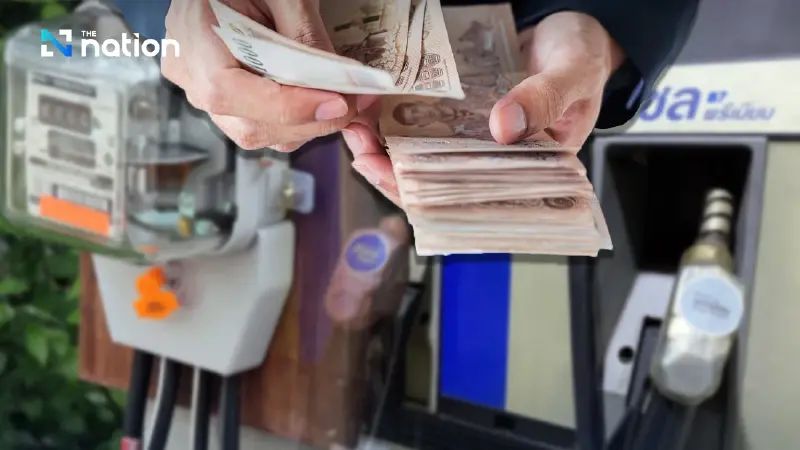


The Energy Ministry is preparing a three-tier response using the Oil Fuel Fund and potential tax cuts, while regulators weigh options to hold down electricity tariffs amid rising LNG and crude prices.
- Thailand will use its Oil Fuel Fund as the primary mechanism to cap diesel prices at THB 30 per litre to reduce the impact on transportation and inflation.
- If global prices surge further, the government has a multi-level plan that includes gradually raising the diesel price cap and potentially cutting fuel excise taxes.
- To address rising power bills, regulators may use excess-benefit funds from the country's main power utilities to cap the upcoming electricity tariff.
- The plan also involves continuing the price cap on LPG for households and establishing a "war room" to monitor the energy crisis and seek alternative import sources.
The war involving Iran in the Middle East remains protracted, with the United States and Israel continuing to strike Iran, while Iran insists it will exercise its right to self-defence to the fullest extent.
The impact on energy prices has become clearer after the announcement of the closure of the Strait of Hormuz, affecting shipments of crude oil and natural gas from Kuwait, Qatar and Saudi Arabia.
On the latest impacts, Bloomberg reported that liquefied natural gas (LNG) prices in Asia surged to their highest level in three years, or since 2023, due to the Middle East conflict.
Spot prices jumped to US$25.40 per million Btu in Asian trading on March 4.
Oil prices also rose further.
West Texas Intermediate stood at US$74.56 per barrel, up 3.33% from the previous day, while Brent was at US$81.40 per barrel, up 3.66% on March 3.
A report from the Ministry of Energy said the Oil Fuel Fund would be a key mechanism, with Energy Minister Auttapol Rerkpiboon setting it as the main tool to manage fuel prices as global market prices rise.
For the fund’s current status as of March 1, 2026, it posted a surplus of THB2.459 billion, comprising an oil account surplus of THB40.313 billion and an LPG account deficit of THB37.854 billion.
A source at the Ministry of Energy told Bangkokbiznews that the energy minister had ordered all agencies to closely monitor global crude-oil price trends, including Singapore refined-product prices, the marketing margin and the tax structure, to prevent short-term “price spikes”, and to prepare three levels of proactive measures as follows:
Three plans to handle the energy crisis
- Base case: cap diesel at THB30
Under the diesel price structure as of March 4, 2026, the Oil Fuel Fund is subsidising diesel by an average of THB3.51 per litre to keep the retail price within the THB30-per-litre ceiling, to reduce impacts on the transport sector, goods costs and inflation.
If price caps exceed the fund’s capacity, an “Exit Strategy” would be used, gradually raising prices by THB0.50 to THB1 at a time.
The diesel ceiling could be lifted from THB30 to THB33 and up to THB35, to reduce the psychological shock.
If global diesel prices average US$100 to US$110 per barrel, the Oil Fuel Fund can shoulder the burden for at least one month without significantly affecting financial stability, keeping diesel prices within the policy framework.
- Cutting fuel taxes
This would be discussed with the Ministry of Finance in a crisis scenario where crude oil is US$120 to US$130 per barrel, which the Oil Fuel Fund can absorb for the first 15 days.
The fund would provide full subsidies initially to stabilise the situation, giving businesses and the public time to adjust.
Previously, during the Russia–Ukraine war, the Ministry of Finance reported that the diesel excise tax was reduced by THB1 to THB5 to ease the burden on the public and businesses, with the government losing total tax revenue of THB100 billion.
- Setting up a war room to track the situation and seek alternative supply sources for imports
Currently, Thailand imports 57% of its crude oil from the Middle East.
The next-largest share comes from the Far East, such as Australia, at 12%, with other sources accounting for 24%.
In terms of shipping time, crude from the Far East takes a minimum of five days, followed by the Middle East at 15 days, Africa at 21 days, and the United States at 40 days.
Dubai crude oil prices as of March 3 stood at US$81 per barrel, while global diesel was at US$115 per barrel, still within the US$120 threshold that the Oil Fuel Fund can manage.
“In a scenario where prices surge to US$150 to US$170 per barrel due to a widening war, the government is preparing to discuss diesel excise-tax cuts with the Ministry of Finance alongside the use of the fund.”
LPG price cap to continue despite THB30bn-plus deficit
Although the LPG account of the fund is in deficit by more than THB30 billion, the existing resolution is to keep prices capped until the end of March 2026 to support households and small operators.
For gasoline, the Oil Fuel Fund will help as far as it can.
Initially, prices would largely be left to the market mechanism, but if the situation intensifies and the fund has sufficient liquidity, it may intervene on a case-by-case basis.
“The government confirms it is ready to intervene immediately if an abnormal marketing margin or price is found, and asks the public to cooperate by using energy sparingly.”
The government assesses that the Middle East situation could be prolonged.
While it hopes it will not last as long as the Russia–Ukraine war, it acknowledges there is a chance global oil prices could reach US$150 to US$170.
However, the Ministry of Energy reiterated that the Oil Fuel Fund still has the capacity to act as a “buffer” to help the public get through this crisis, with all measures prepared on both reserves and pricing to prevent the Thai economy from being heavily disrupted by global energy shocks.
Iran war expected to push up power bills for the May–August period
In late March 2026, the Energy Regulatory Commission (ERC) will announce the electricity tariff for May to August 2026, after the January to April 2026 tariff was set at THB3.88 per unit.
The Middle East situation will affect costs in the next tariff period, especially due to rising LNG and crude oil prices.
Four factors driving up electricity costs are:
- The Middle East war reduces LNG volumes in the system, requiring additional sourcing elsewhere, where prices are already higher.
- Spot LNG prices immediately rose to US$14 to US$15 per million Btu, from about US$10 per million Btu purchased for the current period, with the increased difference to be calculated into the new tariff.
- Higher Dubai crude-oil prices will be passed through to power bills over the next three to six months. If not considered in the new tariff, the costs will be passed through in the September to December 2026 tariff.
- Even with long-term LNG contracts at relatively stable prices, they can still fluctuate with global oil and gas prices, depending on whether the contract is indexed to oil, LPG, or both oil and LNG.
Using utility funds to cap the power tariff
Another factor pushing up electricity costs comes from coal fuel volumes falling by 1,000 million units, despite coal being a cheaper fuel.
The ERC has the option to cap the new tariff period by considering the use of “claw back”, or excess-benefit funds, from three power utilities: the Electricity Generating Authority of Thailand (EGAT), the Metropolitan Electricity Authority (MEA) and the Provincial Electricity Authority (PEA).
The end-of-2025 balance is expected to be at the tens-of-billions-of-baht level.
After reductions in the “adder”, or government support payments used as incentives for solar power plants in the past, the adder component in the base electricity cost has fallen by 20 to 30 satang.
