
Commerce Ministry unveils Resilience strategy to balance Thai exports
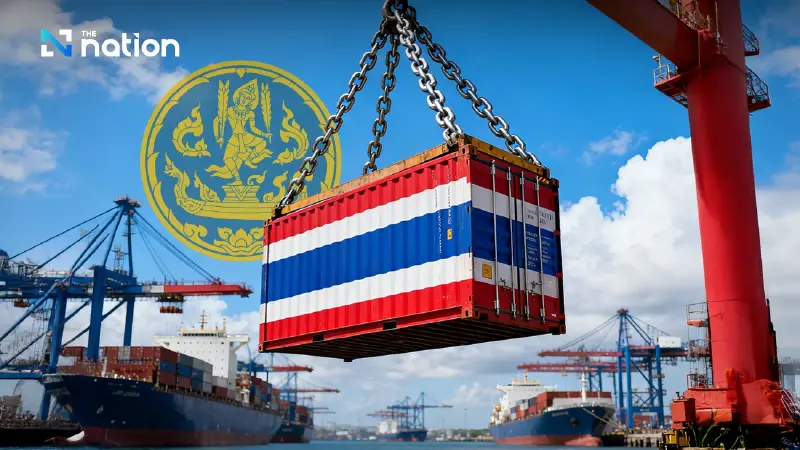


The Commerce Ministry has outlined a three-pillar strategy to strengthen Thailand’s export resilience, reduce trade risks and maintain stability amid rising geopolitical tensions and global market uncertainty.
- Thailand's Commerce Ministry has launched a "Resilience" strategy to manage risks to its export sector, including geopolitical conflicts and trade polarization.
- The strategy involves diversifying export destinations into new markets like the Middle East, Africa, and South Asia to reduce over-reliance on a few key partners.
- It also focuses on accelerating Free Trade Agreement (FTA) negotiations with key partners like the EU and UAE to gain tariff advantages and attract investment.
- A third pillar is adapting to the new economy by promoting exports in growing sectors such as Future Food, environmentally friendly products, and digital commerce.
Thailand’s international trade, or (Thai exports), in 2025 reached USD339.635 billion, or THB11.138 trillion, the highest value on record, and expanded by 12.9% compared with 2024, the strongest growth in four years, against a target of only 2-3%.
Most recently, in January, Thai exports continued to grow strongly, with a value of USD31.5731 billion, the highest on record, rising by 24.4% and marking the 19th consecutive month of growth.
Although Thailand’s exports have had to face geopolitical polarisation, or Extreme Polarization, as well as the retaliatory tariff measures of US President Donald Trump, Thai exports have still performed well.
In 2026, the Trade Policy and Strategy Office (TPSO) under the Ministry of Commerce assesses that Thai exports face both risks and opportunities, with key risks stemming from geopolitical conflict, which could reshape global production and trade chains, as well as the appreciation of the baht.
However, opportunities remain if the economy recovers, geopolitical tensions do not intensify, and the electronics cycle continues to expand. Full-year exports are projected to range from a 3.1% contraction to 1.1% growth compared with 2025, with a midpoint of -1.1%, equivalent to a total value of USD329.1063-343.371 billion.
However, based on the latest situation, the outbreak of war in the Middle East between the United States and Iran has severely affected the global economy and trade, including maritime shipping and logistics costs caused by the closure of the Strait of Hormuz.
Surging oil and natural gas prices, together with volatility in financial markets and the broader macroeconomy, have become additional factors compounding the fragility of global trade.
TPSO has also analysed that in 2025, Thailand’s export structure remained strongly and continuously linked to its main markets.
The five key markets, the United States, China, Japan, India and Malaysia, accounted for a combined 48.6% of total export value, up from 38.8% in 2016.
The share of the top three markets alone increased from 31.9% to 40.0%, confirming close trade relations with large markets, which are an important foundation for further market diversification strategies.
Geopolitical conflict, global polarisation, US retaliatory tariffs, and the Middle East war are all major challenges for Thai exports.
Nantapong Chiralerspong, Director of the Trade Policy and Strategy Office, said that in an era of Extreme Polarization, a medium-sized country such as Thailand is facing pressure to define its policy position amid competition among the major powers.
As an exporter, Thailand needs to pursue a proactive strategy to strengthen resilience and upgrade the structural foundations of its exports.
The Commerce Ministry has therefore laid out a “Resilience” strategy as an important tool for dealing with global trade in an increasingly polarised world, particularly the challenges posed by Geopolitics and trade polarisation (Decoupling/De-risking).
This strategy consists of three main pillars.
Diversification: reducing excessive reliance on any single market by expanding the export base into new markets such as the Middle East, Africa and South Asia, while also seeking new sources of raw materials to prevent supply chain disruptions.
Leveraging FTAs: accelerating free trade agreement (FTA) negotiations with key partners, such as Thailand-EU and Thailand-UAE, to create tariff advantages and attract investment from countries seeking to relocate their production bases.
Adapting to the new economy: focusing on exports that align with global trends, such as Future Food, environmentally friendly products under the BCG Model, and the use of Digital Commerce to reach consumers directly.
“Maintaining economic balance among the major powers and ensuring that exports continue to serve as a strong and sustainable engine of the Thai economy over the long term,” Nantapong said.
