
Thai exports hit by war as costs and delays surge
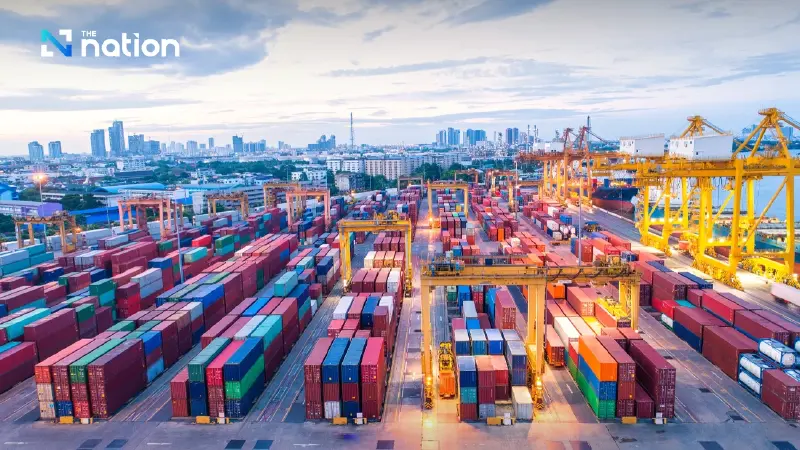


Thai exports face mounting disruption as war drives up freight and insurance costs, leaving 32 billion baht of goods stuck in transit
- The war in the Middle East has directly affected Thai exports, leaving goods worth about 32 billion baht stranded in transit.
- Exporters are facing sharply higher costs, with freight rates nearly doubling and war-risk insurance premiums surging several times over.
- Some shipping lines have stopped accepting cargo and rerouted vessels away from conflict zones, causing delays and container shortages.
The war involving the United States and Israel against Iran has begun to directly affect Thai exports, as shipping routes in the Middle East face mounting risks.
Some shipping lines have stopped accepting cargo, while war-risk insurance premiums have surged, leaving some Thai export shipments delayed and stranded in transit.
Exporters are now being forced to choose between bringing goods back to Thailand or storing them temporarily at hub ports such as Singapore while they assess the situation.

Visit Limlurcha, vice-chairman of the Thai Chamber of Commerce, told Thansettakij that the impact of the war in the Middle East is now being clearly reflected in Thailand’s export sector, particularly through higher transport costs and rising logistics risks, after some shipping lines began suspending cargo services for Middle East-bound shipments.
“At the moment, the main impact is still on Middle East routes, because some shipping lines are not accepting cargo for shipment there during this period.
Businesses that have already sent out goods therefore have two options: either bring the goods back first, or store them at a major port such as Singapore and wait to forward them to the final destination,” he said.
However, storing goods at a hub port also carries risks, because it remains impossible to assess how long the conflict will last.
As a result, some exporters have chosen to bring their goods back to Thailand and wait for another export window.
The factor placing the greatest pressure on costs at present is the war-risk insurance premium, which has risen sharply.
At present, the war-risk insurance premium for a 20-foot container is about US$2,000 per container, around US$3,000 for a 40-foot container, and roughly US$4,000 for a reefer container.
These levels are significantly higher than the normal range of only a few hundred dollars, or about US$300-1,000 per container.
This insurance cost is also an additional burden on top of freight charges, which have already started to rise in line with shipping-route risks.
On some routes, freight rates have increased by nearly double compared with the period before tensions escalated.
The growing insecurity along shipping routes, particularly in the Red Sea and the Strait of Hormuz, one of the world’s most important routes for energy and goods transport, has led shipping operators and insurers to tighten their risk assessments significantly.
Although export routes to Europe and the United States are still operating as normal, businesses must continue to monitor the war closely, because if tensions spread more widely, this could affect the stability of the global maritime transport system and drive up international trade costs further.
Thanakorn Kasetsuwan, chairman of the Thai National Shippers’ Council, said the tensions in the Middle East are severely affecting supply chains and the mechanisms of global trade.
This crisis has caused an immediate disruption to shipping traffic in the Persian Gulf, forcing shipping lines to avoid the Strait of Hormuz and other high-risk areas by rerouting via the Cape of Good Hope around Africa.
This has caused freight costs to double. It is estimated that the freight charge for a 40-foot container has risen from the normal US$3,500 per container to US$7,000 per container, with exporters also having to absorb war-risk surcharges and higher fuel charges linked to the longer shipping distance.
Thai exports to the Middle East account for around 5% of the country’s total global exports, or approximately 400 billion baht a year.
Estimates suggest that the disruption is causing damage worth around 33.3 billion baht per month, or roughly 8.3 billion baht per week.
At present, Thai goods worth about 32 billion baht are estimated to be in transit and stranded within the transport system, unable to reach destination ports on schedule.
On the container side, export cargo that has already left Thailand cannot return and re-enter the circulation system on time.
The standstill in both imports and exports has created bottlenecks in container allocation at major ports.
Smaller exporters may be unable to secure vessel slots, as shipping lines prioritise larger clients with greater ability to pay the higher freight charges.
Ong-art Veerachartyanukul, general manager of Copeland (Thailand) Ltd, a compressor manufacturer and provider of air-conditioning and refrigeration solutions, said the company has a production base in Rayong and exports 80% of its output.
Its main market is the Middle East, followed by ASEAN, with additional exports to Brazil, the United States, Europe, Australia, China and India.
The Middle East remains the company’s largest export market.
He said there is now panic buying of consumer goods in Dubai, with shelves emptied amid concerns over port closures.
Although customers are currently in a wait-and-see mode, he remains confident that once the war ends the market will recover quickly, as the construction of cities and buildings in very hot climates requires air-conditioning systems and compressors as essential infrastructure.
Associate Professor Dr Aat Pisanwanich, an independent academic and expert on international and ASEAN economics, said Thailand exports goods to 15 Middle Eastern countries worth as much as 400 billion baht per year, or about 4% of total exports.
About 70% of this goes to the six Gulf Cooperation Council (GCC) states: the UAE, Saudi Arabia, Qatar, Bahrain, Kuwait and Oman.
He said exports over the next one to two months face very high risks if the situation does not end, because both shipping and aviation routes could remain disrupted.
If Thai exports to the Middle East average around 33 billion baht per month, then a two-month disruption could result in damage of as much as 60 billion baht.
Commerce Minister Suphajee Suthumpun said the war in the Middle East has implications for global economic and trade stability.
Although Thailand’s direct trade share with the countries involved in the conflict is not especially high, Thailand exported goods worth US$12,475.58 million to the Middle East in 2025, accounting for 3.67% of its total exports.
However, the main impact is likely to be transmitted through logistics systems and the wider global economy rather than direct trade alone.
Unsafe conditions along the region’s key shipping routes have forced many shipping lines to adjust routes and increase voyage times, causing freight charges, insurance costs and logistics expenses to rise.
At the same time, container availability and sailing schedules have tightened on some routes, directly affecting Thai exporters.
In addition, energy prices in global markets remain volatile, which could feed through into production costs and transport expenses in the period ahead.
As a result, even if the direct impact on Thai trade remains limited for now, the indirect effects through energy and logistics costs will need to be closely monitored.
The Commerce Ministry has therefore introduced six proactive measures to cope with the situation.
These are:
- monitoring product prices and preventing opportunistic price hikes;
- securing backup sources of raw materials and diversifying import sources;
- helping exporters manage higher logistics and insurance costs;
- coordinating closely with shipping lines and logistics providers to monitor transport developments;
- instructing commercial counsellors to report on trade conditions and advise businesses;
- and assessing impacts on inflation and price stability in order to formulate timely policy responses.
