
Hat Yai floods hit property market, recovery expected to take at least 6 months
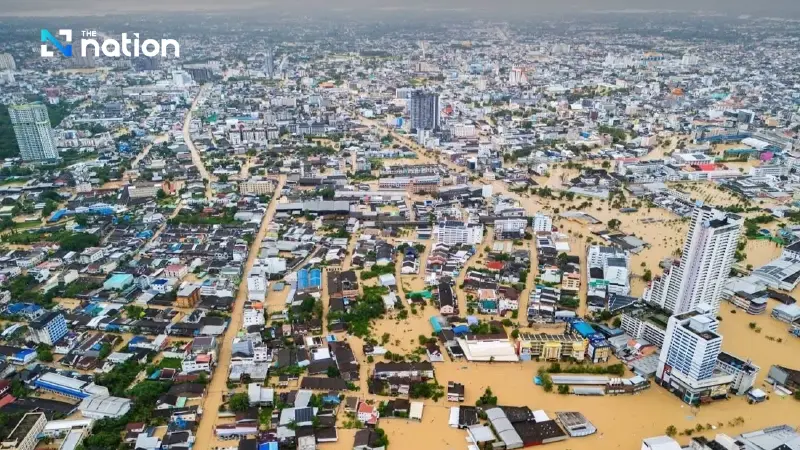


Hat Yai’s floods have disrupted property market, with a recovery expected to take at least six months and experts urging stronger climate-risk readiness.
- The floods in Hat Yai are described as a "major shockwave" for the region's already fragile property market, with initial damage estimates around THB25 billion.
- Recovery of the real estate sector is expected to take a minimum of six months, with the disaster predicted to negatively impact sales, confidence, and new investments.
- In response, industry leaders are calling for future property developments to prioritize disaster resilience through better site planning and water-management systems.
- A faster recovery could be possible if the city accelerates improvements to its drainage system, following precedents set by recovery from previous disasters in the region.
Tritecha Tangmatitham, Managing Director of Supalai Public Company Limited, said the company had mobilised its executives and staff across all departments to prepare more than 2,500 relief bags, delivered directly to a safe zone at the Palm Springs Bennett @Airport Hat Yai project.
The site has been turned into a temporary “storage and relief centre” to distribute aid to surrounding communities.
Urgent assistance also includes delivering essential supplies to residents across 14 affected projects, while ensuring the welfare of security guards, cleaners and on-site personnel who have continued working throughout the flooding.
Support teams from Surat Thani, Nakhon Si Thammarat and Phuket have also been deployed to reinforce operations and expand the reach of assistance to as many people as possible.
Pornnarit Chuanchaisit, president of the Thai Real Estate Association, said the sector has faced multiple headwinds this year, with the southern floods, particularly in Hat Yai, becoming a “major shockwave” that has further strained an already fragile market.
If the situation drags on, the impact could last no less than six months, weighing on sales, confidence and new investments across several provinces.
A key priority for developers, he said, is to build projects that are resilient to disasters, from site planning and material selection to water-management systems, to cope with increasingly frequent extreme-weather events.
Three strategic tiers for disaster resilience
Soonthorn Sathaporn, President of the Housing Business Association, said the crisis has inevitably affected the sector, though the exact damage will require a detailed assessment.
Initial estimates put losses at around THB25 billion, excluding the knock-on effects already slowing the property market.
He noted that the South has proven its resilience before: the tsunami-hit areas rebounded within a year, and recovery from the major 2011 floods also took roughly the same time.
If Hat Yai accelerates improvements to its drainage system, this disaster could follow a similarly quick recovery path.
He outlined three strategic levels for coping with climate-era disasters:
1. City level: urban planning must start with disaster risk
- Update density regulations to ensure evacuations and emergency assistance can be carried out quickly.
- Avoid resisting natural conditions by reducing density in high-risk zones.
- Expand large natural water-retention areas to hold excess runoff.
2. Project level: new standards for real estate development
- Disaster-resilient “water-defence structures” should become a standard requirement.
- Install underground detention tanks within buildings.
- Integrate retention areas within housing estates.
- Design emergency water-flow routes to cope with sudden extreme rainfall or “rain bombs”.
- Equip every project with fixed pumping systems.
3. Household level: behavioural shifts for a warming world
- Homeowners must also adapt, embracing green living through the 3Rs (Reduce, Reuse, Recycle), cutting waste, lowering energy use, and reducing greenhouse-gas emissions.
- Learn practical preparedness measures, as natural hazards now strike faster and more unpredictably than before.
