
Thailand Must Invest in Specialized AI Chip IP, a $2.5B Opportunity
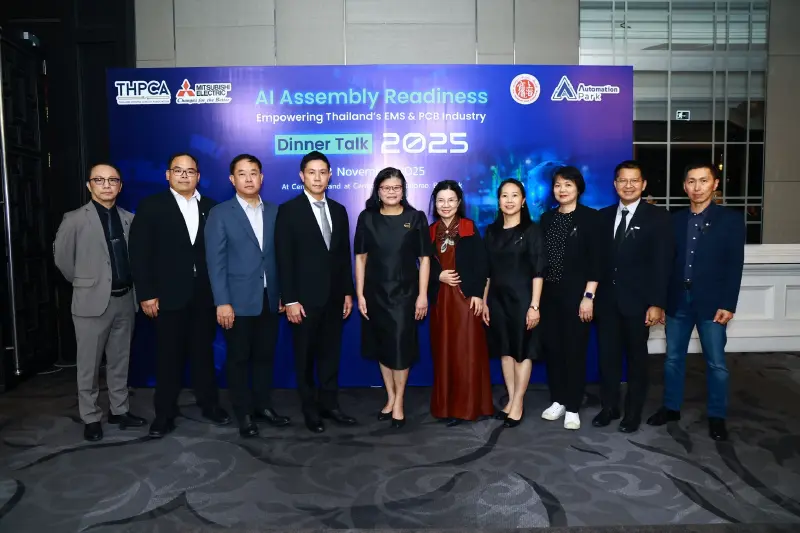


Thailand's $2.5B AI chip opportunity hinges on shedding its 'producer-only' mindset. Industry leaders call for domestic investment in specialized Lightwave, Power, and Timing ICs.
Thailand’s future in the global semiconductor supply chain depends on a swift and aggressive pivot from its established role as a major Printed Circuit Board (PCB) and Electronic Manufacturing Services (EMS) hub to a creator of its own specialized Intellectual Property (IP) in integrated circuits (ICs).

This urgent call was made by industry experts at the "AI Assembly Readiness: Empowering Thailand’s EMS & PCB Industry Dinner Talk 2025," an event organized by the Thailand Printed Circuit Association (THPCA) in collaboration with Mitsubishi Electric Factory Automation (Thailand) Co., Ltd., EEC Automation Park, and the Thai Shanghai Trade Association. The discussion centered on securing high-value positions driven by the current wave of Artificial Intelligence (AI) infrastructure buildout.
The IP Barrier: Mindset Over Difficulty
Despite a growing domestic ecosystem that includes approximately 60 PCB companies and at least six Outsourced Semiconductor Assembly and Test (OSAT) firms (like Hana Microelectronics, Stars, and UTAC), experts argue the country is missing a "golden opportunity" due to a lack of domestic IP ownership. While welcoming foreign investment is positive, relying solely on production without owning the IP is strategically limiting.
Dr. Aroonchat Chatchaikarn, CEO of Percevals, emphasized that the single largest impediment to establishing a 100% Thai-owned semiconductor company is the "mindset." He asserted that semiconductor design isn't inherently difficult; "it's just that we haven't done it."

Three Niche AI Chip Markets Totaling $2.5 Billion
To transition into an IP creator, Thailand is advised to focus on three specialized IC markets directly linked to the current "AI Phase 1" infrastructure demand. This strategy allows the nation to participate in the high-value chain without the prohibitive capital expenditure—less than $10 million per product—required for general-purpose computing chips, which can cost an estimated $720 million per GPU product.

These three niche IC categories represent a potential collective annual value exceeding $2.5 billion:
• Lightwave ICs ($1+ Billion annually): Essential for converting light signals to electricity and back (Optical Transceiver Chips) in modern AI data centers.
• Power Electronics ICs ($800+ Million annually): Crucial for power regulation, stepping down high voltages (28V or 48V) to the low voltages (0.8V) required to supply GPUs.
• Timing/Clock ICs ($700+ Million annually): Used to synchronize high-speed data flow across a data center, often utilizing new technologies like MEMS (Micro-Electro-Mechanical Systems).
A critical finding is that immediate investment in a domestic semiconductor fabrication plant (Fab) is not necessary. The initial focus must be on design and IP creation, leveraging external fabrication services until cost reduction and global competitiveness demand a domestic facility.

Government and Industry Mobilization
Ms. Sudhasinee Smitra, Deputy Secretary General of the Board of Investment (BOI), confirmed the critical importance of the PCB, EMS, and chip packaging sectors. Thailand’s National Semiconductor Roadmap now focuses on advanced packaging technologies, high-precision manufacturing, and integrating AI into operations.
The BOI is acting as an integrator and facilitator, offering strong incentives such as corporate income tax exemptions of up to 8 years for advanced PCB manufacturing and semiconductor packaging. Furthermore, the BOI is collaborating with the Ministry of Higher Education on workforce development, while private initiatives like Mitsubishi Electric Factory Automation (Thailand)'s investment in the EEC Automation Park aim to bridge the skills gap, particularly in advanced automation.
Mr. Swaek Prakitritanon, Vice President & General Secretary of THPCA, noted the substantial global investment flowing into PCB, EMS, Photonic, and semiconductor-related production in Thailand over the past two years. He stated the event’s goal was to "spark new ideas, encourage stronger partnerships, and accelerate the industry’s transition toward advanced, high-value manufacturing."
The integrated efforts signal a strong governmental and private sector commitment to ensuring Thailand achieves readiness to lead in this technological transformation.
