
Free HIV self-testing and counselling via ‘Stand by You’


Early detection of HIV enables timely treatment, helping to prevent onward transmission and reduce new infections in the future.
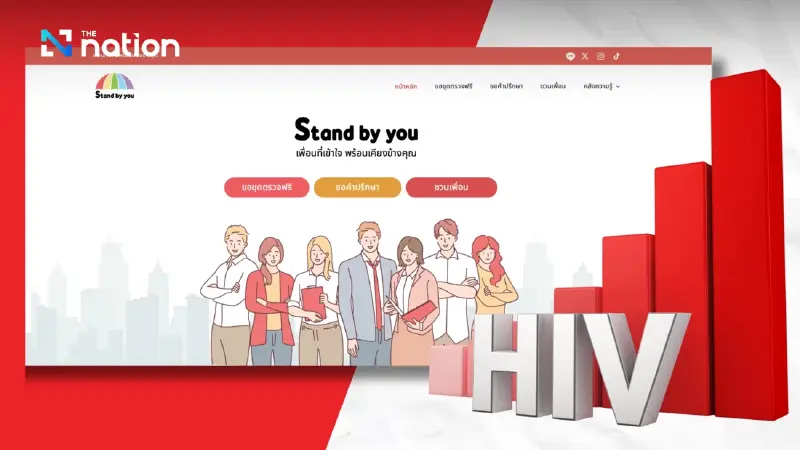
- The ‘Stand by You’ project provides free HIV self-test kits, risk assessment, and counselling via its LINE OA platform to make testing more accessible.
- Since its launch, the program has provided over 30,000 people with test kits and counselling, with two-thirds of recipients being under 30 years old.
- The project has found a 2.8% HIV positive rate among those tested, a rate three times higher than the general population, highlighting its effectiveness in reaching at-risk individuals.
- The initiative has been approved by the National Health Security Board to provide HIV counselling under the Universal Coverage for Health scheme starting in 2025.
Professor Dr Kulkanya Chokephaibulkit from Department of Paediatrics, Faculty of Medicine Siriraj Hospital, and founder of the Stand by You project, revealed that the programme offers free risk assessment, counselling, HIV self-test kits and education on HIV and sexually transmitted infections through its LINE OA platform.
The initiative has now been approved by the National Health Security Board (NHSO Board) to provide HIV counselling under the Universal Coverage for Health scheme in 2025.
Since its launch in August 2022, the Stand by You project has reached over 500,000 users on LINE, with around 160,000 people nationwide accessing its services.
More than 30,000 individuals have received counselling and self-test kits, two-thirds of them under 30 years old.

Of these, 2.8% tested positive for HIV, a rate three times higher than the general population.
“HIV testing is the most important first step,” Prof Kulkanya explained. “If the result is negative, you must continue to protect yourself. If it’s positive, you can enter treatment immediately and prevent further transmission. Everyone should know their status. But going to a hospital is inconvenient, as people may have to miss work or school. Home testing addresses that gap.”
She added that demand for self-test kits continues to rise, with around 20,000 distributed in the past year. “When HIV-related news is in the spotlight, requests for kits increase sharply,” she noted.
Dr Kulkanaya emphasised that access to counselling and self-testing is particularly vital for young people at risk. Early diagnosis, even before symptoms appear, allows patients to begin treatment immediately and stop onward transmission.
“Research shows that people who delay treatment until they are ill can spread the virus to three to six others,” she said.
“Distributing 100 test kits can help prevent about 10 new infections. To achieve the national target, we need to deliver roughly 100,000 kits per year on a sustained basis,” she said.
If no action is taken, Thailand faces around 8,000 new cases annually. “Over 50 years, that would mean an additional 400,000 people living with HIV. At an annual treatment cost of 50,000 baht per patient, the financial burden would increase by about 20 billion baht per year. That’s why early detection and immediate treatment are crucial, not only to prevent new cases but to improve the lives of those living with HIV and benefit society as a whole,” she stressed.
Challenges facing HIV testing and prevention
Despite the progress of Stand by You, several obstacles remain:
- Public awareness and acceptance of HIV testing as a routine health check, like mammograms for breast cancer screening.
- Building healthcare systems that can effectively support HIV prevention and treatment.
- Raising risk perception among vulnerable groups to encourage consistent prevention practices.
- Creating a social environment that promotes safe sexual behaviour.
- Tackling stigma and discrimination against those who take HIV tests or live with HIV.
Prof Kulkanaya added that the rising infection rate among Thai adolescents is not due to ignorance about condoms but to complacency.
“Many young people underestimate the risk, believing it won’t happen to them, so they don’t use condoms. We need to build greater awareness and normalise condom use, making it as accessible as possible, such as through vending machines in public areas and restrooms,” she concluded.
