
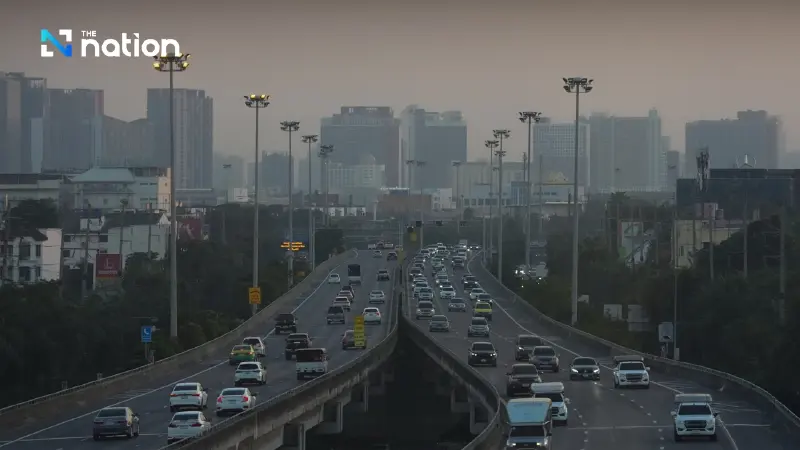
Bangkok’s air quality remains moderate overall, but PM2.5 is trending higher


Play
Fine dust levels were reported at a moderate level across Bangkok this morning, with residents, especially at-risk groups, advised to reduce strenuous outdoor activity and wear a PM2.5 mask when needed.
- Bangkok's citywide average PM2.5 level was 29.1 µg/m³, which is classified as moderate and below the safety standard of 37.5 µg/m³.
- Despite the moderate average, several districts, including Pathum Wan and Sathon, recorded PM2.5 levels that exceeded the safety standard.
- The Air Quality Information Centre confirmed that particulate matter levels are on an upward trend.
- Due to the "orange level" air quality, which is beginning to affect health, residents are advised to wear masks and limit strenuous outdoor activities.
The Bangkok Air Quality Information Centre reported PM2.5 levels in Bangkok at 7am on Friday (January 9).
The citywide average PM2.5 reading was 29.1 micrograms per cubic metre (µg/m³), below the standard of 37.5 µg/m³.
Highest PM2.5 readings (top areas)
- Pathum Wan: 43.7 µg/m³ (above standard)
- Sathon: 39.5 µg/m³ (above standard)
- Samphanthawong: 39.2 µg/m³ (above standard)
- Ratchathewi: 38.6 µg/m³ (above standard)
- Chatuchak: 37.2 µg/m³
- Bang Rak: 34.4 µg/m³
- Prawet: 33.7 µg/m³
- Bang Phlat: 33.1 µg/m³
- Phra Khanong: 33.0 µg/m³
- Bang Sue: 32.8 µg/m³
- Khlong Sam Wa: 32.2 µg/m³
- Khan Na Yao: 31.8 µg/m³

Area ranges (overall: moderate)
- North Bangkok: 25.1–37.2 µg/m³ (moderate)
- East Bangkok: 22.9–33.7 µg/m³ (moderate)
- Central Bangkok: 22.4–39.2 µg/m³ (moderate)
- South Bangkok: 23.2–43.7 µg/m³ (moderate)
- North Thon Buri: 23.7–33.1 µg/m³ (moderate)
- South Thon Buri: 24.7–31.1 µg/m³ (moderate)
The centre said particulate levels are trending upwards, with overall air quality rated “moderate”.
Health advice (orange level: beginning to affect health)
- General public: Wear protection such as a PM2.5 mask when outdoors, limit time spent on strenuous outdoor activities or exercise, and watch for symptoms such as coughing, breathing difficulty, or eye irritation.
- At-risk groups: Wear protection such as a PM2.5 mask when outdoors, avoid strenuous outdoor activities or exercise, follow medical advice, and seek medical attention promptly if symptoms occur.
