
Phumtham, Nattapon deny ordering ceasefire with Cambodia on first day of clash
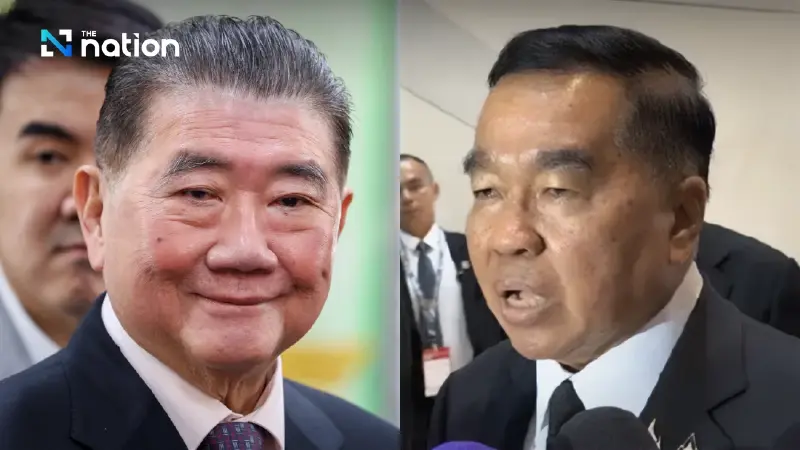


Former deputy Prime Minister Phumtham Wechayachai insisted no political figures had issued any orders, while Defence Minister Gen Nattapon Nakpanich said those questioning the ceasefire command should ask Lt Gen Boonsin Padklang himself, affirming he was not the one who gave the order as authority had already been delegated to the military chiefs.
- Phumtham Wechayachai, the acting premier during the clash, and Defence Minister Nattapon Nakpanich have both denied ordering a ceasefire on the first day of fighting.
- The denials are in response to a claim by former commander Lt Gen Boonsin Padklang, who alleged that a ceasefire order was given six hours into the fighting, which he refused to follow.
- Phumtham stated that the military had full operational authority under the Rules of Engagement (ROE), making a direct ceasefire order from political figures inconsistent with procedure.
- Nattapon corroborated this, saying he had delegated authority to commanders and confirmed that he witnessed no such order being issued by Phumtham.
A statement by Lt Gen Boonsin Padklang, former commander of the Second Army Area, has reignited public debate over Thailand’s border clash with Cambodia on July 24.
Boonsin claimed that about six hours after the fighting began, Thai troops were ordered to cease fire, a command he refused to follow, adding that this decision left Thailand at a disadvantage in certain border areas to this day.
The remark has set off a wave of speculation in Thailand, with many questioning who had given the order.
One key figure now facing scrutiny is Phumtham Wechayachai, who at the time was deputy prime minister and acting premier. He was also the one who flew to Malaysia to sign a ceasefire agreement with Cambodia on July 28.

When asked by reporters about the allegation, Phumtham denied any political interference. “I confirm that no political figures were involved in issuing any such orders,” he said, adding that he would post further clarification on Facebook soon.
Defence Minister Gen Nattapon Nakpanich also rejected suggestions that he had ordered a ceasefire on the first day of fighting. “I want to be clear, I did not order a ceasefire on July 24. I only monitored the situation. I recall telling the media that I had delegated authority to the commanders, chaired by the Supreme Commander,” he said.

When asked if he knew who gave the order to cease fire, Nattapon replied, “You’ll have to ask the person who made that claim. I don’t know who ordered it. Please ask Lt Gen Boonsin himself.”
The minister dismissed any suggestion that he was under pressure following the controversy. “I feel no pressure at all,” he said.
Asked whether Boonsin’s statement could harm the country’s image, Nattapon said he was unsure. “You’ll have to ask Lt Gen Boonsin why he said that. From what I discussed with Gen Phana Klaewplodthuk, the Army commander, he confirmed that no such order had been given,” he added.
Nattapon went on to recall a meeting in late September before Boonsin’s retirement, where he, the Army commander, and the Army chief of staff were present. “Lt Gen Boonsin kept saying he wanted to strike back. I asked if he had made preparations, reminding him that it should be completed before his retirement. But nothing happened before he stepped down,” he said.
When asked directly if Phumtham, as acting prime minister at the time, had issued the ceasefire order through him, Nattapon firmly replied, "From what I witnessed, there was no such order."
Later, in a Facebook post, Phumtham said that as the former deputy prime minister overseeing national security and chair of the National Security Council (NSC), he felt it necessary to explain the facts from that period to the public.
NSC empowered military under Rules of Engagement
Phumtham explained that after tensions escalated along the Thai–Cambodian border, the NSC convened a meeting on June 6, 2025. “The meeting carefully discussed the situation and passed a key resolution authorising the military to act in accordance with the Rules of Engagement (ROE),” he wrote.
“This meant the Royal Thai Armed Forces had full operational authority to make tactical decisions to defend the country as the situation required, without waiting for instructions from political leaders.”
Clear division between policy and operations
He noted that the national security operations were divided into two distinct levels:
Policy level (the government): responsible for setting strategic direction and political framework to protect national interests and manage international relations.
Operational level (the military): responsible for tactical actions under the ROE with full authorisation from the NSC.
“Therefore, the belief that there was a ‘ceasefire order from political figures’ is inconsistent with the facts,” he wrote. “At that time, the military operated independently under legal and international rules.”
Coordination under martial law protection
Phumtham said the NSC, Defence Ministry, and regional commands maintained close coordination throughout the situation. The NSC acted as the central body for policy guidance and information coordination, while operational units were granted legal and procedural protection under the local martial law framework to ensure they could perform their duties effectively without legal repercussions.
He added that the government of the time adhered firmly to peaceful principles and respect for national sovereignty. “Thailand never allowed a single inch of its land to be violated, and every decision was made within the legal and security framework of the state,” he stressed.
Confidence in military professionalism
Phumtham said he had worked closely and respectfully with military leaders during his tenure as defence minister, consulting them carefully before making decisions. “I have full confidence in the professionalism of all armed forces commanders. Their cooperation ensured that national security operations proceeded smoothly and in the best interests of the country,” he said.
He concluded by assuring the public that all decisions made at the time had one unified goal:
“To safeguard Thailand’s sovereignty with prudence, transparency, and a commitment to avoiding violence, minimising loss among our troops and civilians along the border.”
