
Explosive sea drones open dangerous new front in Middle East conflict
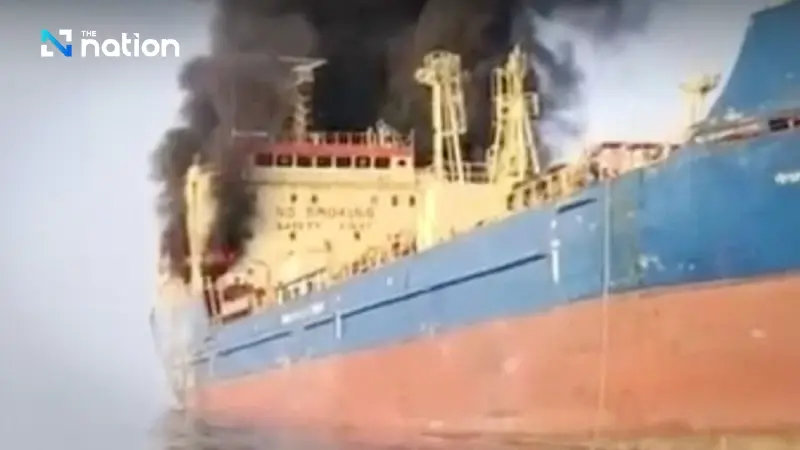


Explosive naval drones have struck oil tankers in the Persian Gulf, highlighting a new maritime threat as tensions between the US, Israel and Iran escalate
Explosive sea drones have been used to attack oil tankers in the Persian Gulf at least twice, in incidents similar to the attack on a Thai commercial vessel, highlighting a new type of threat to maritime shipping routes amid rising tensions between the United States, Israel and Iran.

Maritime security authorities and analysts say the use of uncrewed surface vessels (USVs) fitted with explosives is emerging as a new danger to one of the world’s most important energy transport routes, particularly around the Strait of Hormuz, through which roughly one-fifth of global oil trade passes.

First tanker attack leaves one dead
The first incident occurred on March 1, when the crude oil tanker MKD VYOM was attacked off the coast of Oman, about 44 nautical miles from shore, resulting in the death of one crew member.
The United Kingdom Maritime Trade Operations (UKMTO) issued a public warning stating that the object that struck the vessel was an unmanned surface drone that collided with the ship above the waterline before triggering an explosion and fire in the engine room.

Second attack near Iraq
A similar incident occurred a few days later involving the crude oil tanker Sonangol Namibe, which was anchored near Khor al Zubair port in Iraq.
Sonangol Marine Services, which represents the vessel, said all 23 crew members were safe, but the company could not yet disclose details about the object that hit the ship as the investigation is still ongoing.
However, video footage circulating online appears to show a small speedboat-like object striking the side of the vessel before exploding and sending thick black smoke into the air.

Two UK maritime security experts — Sidharth Kaushal, a researcher at the Royal United Services Institute (RUSI), and Robert Peters of the maritime security firm Ambrey — assessed the footage and said the object appeared to be a sea drone designed to detonate immediately upon impact.
Iran suspected but not confirmed
Robert Peters said Iran could likely be involved in the attack on the Sonangol Namibe, noting that Iran has previously demonstrated sea drone capabilities at several military exhibitions.
He also pointed to the timing of the incident, which occurred one day after the Islamic Revolutionary Guard Corps (IRGC) claimed it had attacked a US oil tanker in the northern Persian Gulf, causing a fire.
Iran’s Mehr news agency reported that the attack had been carried out using a missile.
However, Reuters reported that the perpetrators of the two tanker attacks have not yet been confirmed, and Iran’s mission to the United Nations in New York did not immediately respond to requests for comment.
A new weapon that could reshape naval warfare
Security experts warn that sea drones could become highly effective weapons because they can carry larger explosive payloads than aerial drones and may possess destructive power comparable to some missile systems.
Striking key areas of a vessel, such as the engine room or propulsion system, could quickly disable the ship.
“If a vessel is immobilised, it becomes extremely vulnerable to follow-up attacks,” Peters said.
Risks to global energy markets
The rising tensions coincide with warnings from Iran that oil prices could surge to $200 per barrel if the conflict escalates further.
Shipping traffic through the Strait of Hormuz, one of the world’s most critical energy corridors, has already begun slowing significantly.
On Wednesday alone, at least three vessels were attacked in Persian Gulf waters, after the IRGC said it had fired on ships that failed to comply with its orders.
Among the vessels targeted were a Thai bulk carrier, a Japanese container ship, and a Marshall Islands–flagged bulk carrier, bringing the number of commercial ships attacked since the start of the conflict to 14 vessels.
