
UAE Repels Hundreds of Iranian Missiles and Drones as Officials Vow Firm but Measured Response
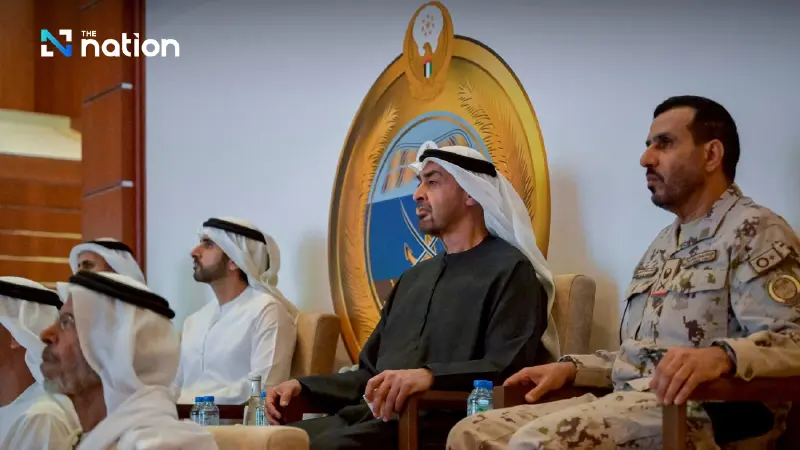


Abu Dhabi says air defences intercepted 172 ballistic missiles and 755 drones while calling for dialogue to end the worst regional escalation in decades
- The UAE's air defenses intercepted the vast majority of a large-scale Iranian attack, downing 172 of 186 ballistic missiles and 755 of 812 drones.
- As part of a firm response, the UAE has closed its embassy in Tehran, withdrawn its ambassador, and asserted its right to self-defense under the UN Charter.
- Officials also stressed a measured approach, urging Iran to return to dialogue and keeping lines of communication open to de-escalate the crisis.
- The attack resulted in three fatalities and 68 minor injuries, which were attributed to debris from the interception operations rather than direct hits.
Abu Dhabi says air defences intercepted 172 ballistic missiles and 755 drones while calling for dialogue to end the worst regional escalation in decades.
The United Arab Emirates mounted a sweeping defence against a sustained Iranian aerial assault in the opening days of March, intercepting the vast majority of ballistic missiles, cruise missiles and kamikaze drones launched at its territory, officials announced at an emergency press briefing on 4 March 2026.
Brigadier General Pilot Abdul Nasser Al Humaidi, official spokesperson of the Ministry of Defence, told assembled local and international media that since the beginning of what he termed "the Iranian aggression", UAE air defences had tracked 186 ballistic missiles, destroying 172 and allowing 13 to fall harmlessly into the sea; one struck UAE territory.
Of 812 drones detected, 755 were intercepted, while 57 came down within the country. All eight cruise missiles fired were destroyed.
"The UAE will not, under any circumstances, accept any infringement upon its sovereignty, security, or the safety of its territory," Brigadier General Al Humaidi said, adding that the Armed Forces retain "the full right to take all necessary measures."
He confirmed three fatalities and 68 minor injuries, attributing the casualties to debris from interception operations rather than direct hits on civilian targets.
The general displayed wreckage of several Iranian weapon systems, including Qiam-class tactical ballistic missiles, Paveh cruise missiles — described as among the most difficult threats to intercept — and Shahed-136 and Shahed-107/238 drones, hundreds of which were brought down over the preceding four days by UAE F-16 and Mirage 2000 fighter jets alongside ground-based air-defence batteries.

Diplomacy: Embassy Closed, Iran Summoned
Reem bint Ibrahim Al Hashimy, Minister of State for International Cooperation, outlined the diplomatic fallout. Abu Dhabi has closed its embassy in Tehran, withdrawn its ambassador and mission staff, and summoned the Iranian ambassador to receive a strongly worded protest note condemning what she called "unacceptable hostile escalation and cowardly attacks."
Minister Al Hashimy said the UAE had repeatedly affirmed that its territory would not be used in any military operations against Iran, making the attacks "blatant" and without justification.
She invoked Article 51 of the United Nations Charter, which enshrines the right to self-defence, and called upon the UN Security Council to condemn the strikes and take measures to prevent their recurrence.
"The UAE is not a state of reactive responses," she said. "It believes in preserving balanced international relations and keeping lines of communication open even in the most difficult moments, in order to avoid sliding into sharp polarisation."
Despite the gravity of the situation, she urged Iran to return to dialogue, warning that a military path "will only lead to further crises."
She also broadened the frame of concern beyond the nuclear file, calling for international action on Iran’s missile programme, which she described as a direct threat to all of Iran’s neighbours.

Economy: Six Months of Reserves, Daily Price Monitoring
Abdulla bin Touq Al Marri, Minister of Economy and Tourism, sought to reassure residents and investors that the UAE’s economy remained robust.
He said strategic stocks of essential commodities were sufficient to cover market needs for between four and six months, with supply-chain indicators showing no disruptions. A network of 627 monitored points of sale is being tracked around the clock, and 420 inspection tours were conducted in recent days alone.
"Companies are required to uphold their social responsibility toward the community, especially during times of crisis," Minister Al Marri said, warning that hoarding, price-gouging or other market violations would be met with "deterrent measures."
He urged the public to buy according to actual need and directed consumers to contact the Ministry’s hotline — 800-1-222 — to report any breaches.
On aviation, Al Marri, who also chairs the General Civil Aviation Authority, reported that emergency air corridors had been coordinated with neighbouring states and with GCC partners and the International Civil Aviation Organization (ICAO).
Current throughput stands at 48 flights per hour, with plans to increase that figure progressively. Phase one, covering the period from 1 March, has already seen 17,498 passengers returned on 160 flights operated by national carriers. Stranded passengers were being housed and fed at government expense.

Security: 4,100 Patrols, 3,200 Specialist Vehicles
Brigadier Abdulaziz Al Ahmad, official spokesperson for the Ministry of Interior, said internal security remained stable across all seven emirates.
He detailed the deployment of more than 4,100 traffic and security patrols alongside armed response units and 3,200 specialised vehicles, all coordinated with more than 25 national agencies through fixed and mobile federal operations rooms equipped with the latest monitoring technologies.
Brigadier Al Ahmad called on the public to obtain information exclusively from official sources and to adhere to safety instructions, describing community cooperation as "a national responsibility that enhances the resilience and security of the nation."

Crisis Management: Schools Remote, Flights to Resume
Dr Saif Al Dhaheri, official spokesperson for the National Emergency, Crisis and Disaster Management Authority (NCEMA), confirmed that all essential services — energy, water, telecommunications, transport and healthcare — were operating normally.
Schools have switched to remote learning as a precautionary measure, he said, with business continuity plans activated across vital sectors.
Dr Al Dhaheri said the authority has activated its Joint National Media Cell around the clock and is relying on the Early Warning System to alert the public.
Between 200 and 300 evacuation flights are being planned in the coming period to assist stranded foreign nationals, with accommodation, visa issuance and transport provided in the interim.
"The safety and dignity of every individual remain at the forefront of the Nation’s priorities under all circumstances," he said.
He praised the cohesion of the UAE’s multicultural community of more than 200 nationalities during the crisis, describing public compliance with official guidance as evidence of a “national model founded on preparedness and solidarity.”
