
Voter turnout reaches about 55 % in Myanmar’s 2025 general election
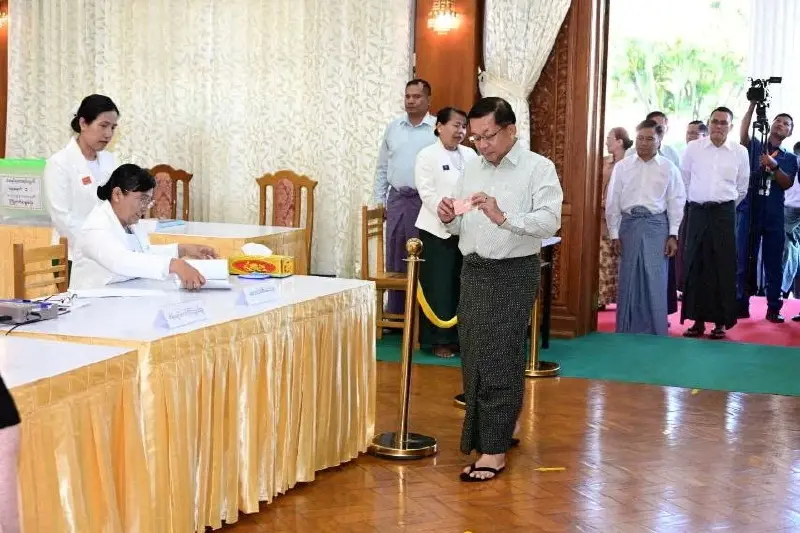


In the 2025 general election as a whole, more than 24.22 million people were eligible to vote, with over 13.14 million casting ballots, resulting in a voter turnout of approximately 55%, according to Maj Gen Zaw Min Tun, Head of the Information Team of the National Defence and Security Council.
He made the remarks on January 26 while responding to media questions regarding the successful conduct of the multi-party general election.
Zaw Min Tun said that across all three phases of the 2025 election, more than 24.22 million eligible voters were registered. In Phase (1), over 11.69 million people were eligible to vote, and more than 6.09 million participated, representing a turnout of 52.13 %. In Phase (2), more than 7.59 million were eligible, with over 4.24 million voting, resulting in a turnout of 55.95 %. In Phase (3), more than 4.94 million voters were eligible, and over 2.79 million cast ballots, bringing turnout to 56.48 %.
“Voter participation increased gradually from Phase (1) to Phase (3). As a result, across all three phases, more than 13.14 million voters cast ballots, and the overall turnout exceeded 54 %, at around 55 %,” Zaw Min Tun said.
He added that domestic and international election observers were invited to observe the elections to ensure they were free and fair.
During Phase (1), a total of 32 representatives from eight countries, Russia, Belarus, China, Kazakhstan, Cambodia, India, Vietnam, Nicaragua, and one organisation, the Japan–Myanmar Association, observed the elections.
However, due to time constraints, no international observer missions attended Phase (2).
Instead, observer teams from foreign embassies based in Myanmar conducted monitoring.
In Phase (3), observer delegations from seven countries, Belarus, Cambodia, Nepal, Indonesia, Vietnam, Nicaragua, and India, along with one organisation, the International Conference of Asian Political Parties (ICAPP), took part.
“We received positive feedback from them,” Maj Gen Zaw Min Tun said, adding that representatives from 14 foreign embassies based in Yangon, 133 individuals in total, also observed all phases of the elections.
In addition, international media organisations sent 215 journalists from 61 outlets during Phase (1), 101 journalists from 35 outlets during Phase (2), and 135 journalists from 41 outlets during Phase (3). Domestically, 1,177 journalists from 52 local media organisations were able to observe and document the entire election process, he said.
However, Zaw Min Tun stated that terrorist insurgent groups opposed to democracy carried out various acts aimed at disrupting the elections, preventing voters from going to polling stations, damaging polling stations, and intimidating voters.
These acts included attacks using improvised heavy weapons, small arms, rocket launchers, sound bombs, blocking vehicles carrying voters, issuing threats, dropping bombs, conducting fixed-wing attacks, and spreading misinformation.
He said that during Phase (1), disruptions and sabotage occurred in 13 townships; during Phase (2), in 10 townships; and during Phase (3), in 11 townships.
As a result of these terrorist acts, two loyal civil servants were killed, while two civil servants and seven innocent civilians were injured.
“Despite such attacks and disruptions, thanks to the cooperation of the government and voters who support the multi-party democratic system, the multi-party democratic general election has now been successfully held in a free, fair, transparent, and credible manner, in the presence of international election observers, diplomats, media representatives, and voters themselves,” Zaw Min Tun said.
He further noted that Acting President and Chairman of the State Security and Peace Commission, Senior General Min Aung Hlaing, personally met voters at polling stations, asking about their voting experience and their ability to vote freely.
The government, he said, deeply respects, recognises, and records the efforts of every individual who contributed to the successful conduct of the election and expresses its special gratitude to all involved.
According to the announcement, the 2025 multi-party democratic general election elected representatives for 263 Pyithu Hluttaw constituencies, 73 Amyotha Hluttaw first-past-the-post (FPTP) constituencies and 26 proportional representation (PR) constituencies, 255 Region or State Hluttaw FPTP constituencies, 42 Region or State Hluttaw PR constituencies; and 29 ethnic nationality constituencies in the Region or State Hluttaws.
Eleven Media
Asia News Network
