
Thai Army urges Cambodia to de-escalate and clear mines before JBC talks
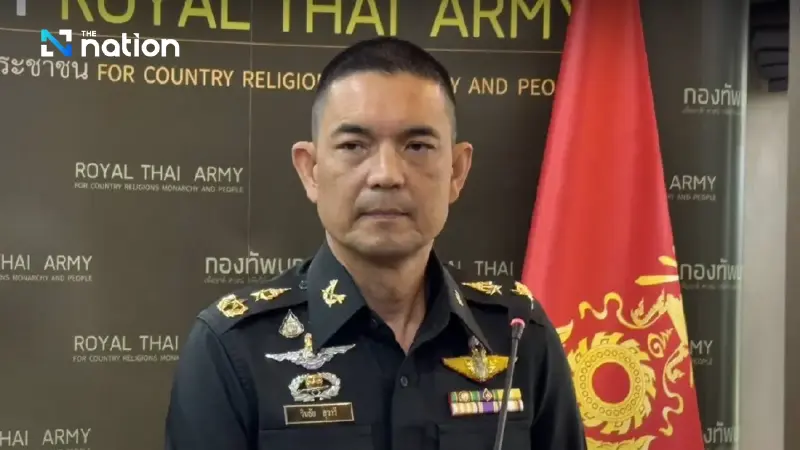


Thai Army asserts that future border demarcation talks through the Joint Boundary Commission (JBC) can only proceed after tensions have sufficiently reduced and the area is confirmed to be completely safe from landmines.
- One month into a ceasefire agreement, the Thai Army states it is complying with de-escalation measures by maintaining its current troop positions without reinforcement.
- As part of the agreement, Thailand is creating a safer environment by accelerating the clearance of unexploded landmines and repairing damaged infrastructure along the border.
- The Army asserts that further negotiations through the Joint Boundary Commission (JBC) can only proceed once tensions have sufficiently de-escalated and the border is completely safe from mines.
- Despite the ceasefire, Thailand accuses Cambodia of misleading the public with claims of territorial seizure, stating these ongoing tensions are a barrier to advancing talks.
At the Royal Thai Army Headquarters, Maj Gen Winthai Suvaree, the Royal Thai Army spokesperson, commented on the situation along the Thai–Cambodian border on Sunday (February 9), following the ceasefire agreement reached at the extraordinary session of the Thai–Cambodian General Border Committee (GBC) on December 27, 2025.
Both sides have been implementing the agreement for more than a month, adding:
Since the ceasefire began, the Thai side has strictly complied with the Joint Statement, particularly the de-escalation measures, an immediate ceasefire and maintaining troop deployments at their current positions, with no additional movement or reinforcement of forces already in place, under Clause 2 of the Joint Statement.
This has included creating a safer environment along the border by accelerating the clearance of unexploded landmines, repairing and improving routes, and restoring sites damaged by attacks.
“In addition, in areas found to have been used for military operations and activities linked to cyber scams, coordination has been made with police and relevant agencies to collect evidence and expand investigations to crack down on illegal networks. This is in line with Clause 10 of the Joint Statement, which emphasises cooperation to prevent and suppress transnational crime, an effort that will benefit both Thai people and foreign nationals who have fallen victim to such groups.”
The Army spokesperson added, however, that concerns remain because Cambodia still appears to misunderstand the situation and often presents information in a way that misleads the public, particularly claims that Thailand has seized Cambodian territory, including allegations that Thailand has placed shipping containers to block routes and hinder Cambodian residents from returning home.
The remarks described these as one-sided accusations that focused only on immediate developments and provided incomplete explanations, while failing to mention Cambodia’s past conduct, specifically, what was described as repeated support for Cambodian soldiers and civilians to encroach on Thai sovereign territory at multiple points along the border.
This was described as a long-accumulating problem that Thailand has consistently opposed, pursuing dialogue and lodging protests through peaceful means.
Cambodia, it was claimed, ignored these efforts and never took corrective action.
More recently, Cambodia was said to have used weapons and conducted military operations against Thailand in several areas, prompting Thailand to respond with weapons as appropriate under international law, based on the principle of self-defence.
Thailand was said to have used this opportunity to restore order in the area in line with Thai law and international law.
All areas currently under Thai control and surveillance were said to fall within the framework of Clause 2 of the Joint Statement.
As such, Thailand’s safety-related improvements in these areas were said to be permissible and not in breach of the agreement.
The locations Thailand currently controls and monitors were said to have previously been Cambodian military positions used to attack and threaten Thai troops and civilians, causing impacts on Thailand.
On allegations of the use of weapons against historical sites, including Preah Vihear Temple, Ta Kwai Temple (Ta Krabey), and Khana Temple, the remarks said this was because Cambodia had used those sites as military operating positions, and that there was clear evidence to prove it.
This was said to mean those areas were not entitled to protection from the use of weapons, and that Cambodia must take responsibility because, it was claimed, Cambodia had clearly violated international rules.
Cambodia was also said to frequently plan to bring media delegations and international observers to border areas, with a call that if Cambodia provides information about the situation, it should do so fully and straightforwardly.
Regarding Cambodia’s concerns over the border, the remarks said the Joint Statement clearly stipulates that the ceasefire agreement does not affect the future survey and demarcation of the boundary between the two countries, which must continue through the Thai–Cambodian Joint Boundary Commission (JBC) mechanism.
Before discussions proceed through the JBC, security agencies were said to need to assess whether tensions have reduced to a level that can be trusted, and to be confident that border areas are completely safe from landmines.
