
Knocking on hope's door: A lifeline for Thailand's lost youth
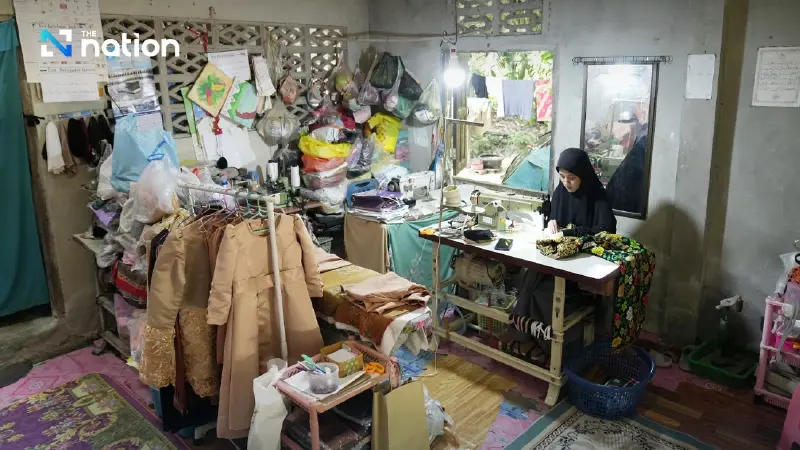


In Thailand’s Deep South, young lives once stuck in limbo find new hope through community-led support, skills training, and second chances to thrive.
In the quiet, sun-washed villages of Thailand’s southern border province, hope arrives not as a miracle but as a knock on the door.
For many children and young people across Narathiwat, Pattani, Yala, and parts of Songkhla, the path from school to employment is riddled with obstacles.
Poverty, language barriers, and societal expectations often leave them stranded between childhood and adulthood.
Many found school irrelevant and unhelpful in securing work. Girls, in particular, are often held back by caregiving responsibilities and cultural norms that discourage travel or staying away from home.
The region, predominantly Muslim, records some of the highest rates of youth in NEET situations (Not in Education, Employment, or Training) in Thailand, driven by limited opportunities, lack of support, and socioeconomic pressures such as poverty and caregiving duties, which especially impact young women.
Into this landscape stepped a new initiative: a collaboration between UNICEF Thailand and the Ministry of Labour, inspired by the European Union’s Reinforced Youth Guarantee.
According to the International Labour Organisation, nearly 1.2 million young people nationwide were classified as NEET in 2024.
Its goal is simple in theory: reintegrate young people through four steps—mapping, outreach, preparation, and offer.
The project began in 2023 in Na Phu, Udon Thani, under the collaboration between UNICEF Thailand and the Office of the National Economic and Social Development Council, where 96% of pilot participants found pathways back to learning or work within a year. Encouraged by this success, the program expanded into Thailand’s southern border provinces.
But scaling up such an intensive initiative required an anchor within each community. This is where the Ministry’s existing labour graduate network became pivotal.
One door where hope knocked was that of 22-year-old Fadira Tohseutae and her 19-year-old sister, Misbah, who live with their single mother, a self-taught dressmaker.

Although the sisters often helped with small sewing tasks, their mother was unable to teach them the craft properly, having never received formal training herself. Fadira has a diploma in accounting and had hoped to find work in Muang Narathiwat or Hat Yai, but job opportunities never materialised.
Her sister, who finished high school, faced similar challenges. With their older brother earning little and their youngest brother still in school, the sisters stayed close to support their mother—yet remained stuck in a NEET situation.
Then came that knock of opportunity. Labour graduate Nisuneeda Tuanmaeroh reached out to the sisters. “Sincerity is key,” she said. “We treat them like siblings. We want them to earn income and improve their lives.”

Under her guidance, the sisters took a five-day dressmaking course near their village, followed by intensive online business training. Within two months, Fadira began sewing shirts at home, earning 160 baht a day.
"I've changed a lot," she said. "Before, I stayed in my room. Now I dare to come out and talk to people, express myself more. I talk to my mum about what kind of clothes to make. I have more ideas now.”

After two short courses, the sisters eventually launched their own brand, Famiiis—a blend of their names—and set up a small online shop from a corner of their home. They will now learn how to photograph products and communicate with customers.
Between July 2024 and January 2025, labour graduates identified 2,370 NEET youth across the four southern provinces. Of these, 1,855 agreed to participate, and approximately 76% were successfully reintegrated into education, employment or training. In Narathiwat alone, 335 young people joined the programme, achieving a reintegration rate of 77%.
The initiative depends heavily on the commitment of the network of labour graduates who have been deployed across every tambon (subdistrict)—at least one per subdistrict, two if there are more than ten villages. They go door-to-door, identifying youth in NEET situations, gaining families’ trust, and matching them with education, training or job opportunities.
“The labour graduate network provides us with an invaluable foundation of trust and cultural understanding,” said Vilasa Phongsathorn, Adolescent Development Officer at UNICEF Thailand. “These youth mentors speak the local dialect and understand the nuances of each community. They're not outsiders imposing solutions; they're neighbours offering pathways.”
Sunthorn Mudlae, director of the Narathiwat Labour Office, echoed that sentiment. “Speaking the local language, understanding the culture, and being part of the community make all the difference. They can knock on doors and be heard.”
Labour graduate Sawanee Nibu has seen those efforts transform lives. “At first, it was hard. But once the youth and their families began to trust us, everything changed,” she said. “Now the mothers proudly tell me what their kids can do.”

In Sungai Padi, 19-year-old cousins Muhammadridwan Potheuma and Muhammadaiman Doloh were once aimless—racing motorcycles and hanging out with friends. With little education and few skills, they felt stuck, but didn’t want to leave their mothers behind.

"Just staying at home, having fun with friends day by day, racing motorcycles" - that's how Muhammadaiman recalled his past life.
Under Sawanee’s guidance through the programme, they completed two months of training at the Royal Vocational Training Center in Narathiwat and began internships in electrical work.

“At first, it was difficult,” Muhammadridwan shared. “I started from zero, with no foundation. It felt too hard, and I didn’t think I could handle it. But I pushed through, fighting for my future.” His life, he says, is now completely different. “From being a troublemaker, I’ve matured.”
Their hard work paid off. By the end of the training, they were assisting a small contractor with wiring systems and gaining hands-on experience. Both were offered jobs with the same contractor after the internship.
Ruswadee Sa-i, 19, dropped out at 15 and drifted for three years, too young to find work. After labour graduate Butsarin Awea reached out, he joined the same programme and completed a mechanics course. After finishing the training, he began an internship at a local garage near his village, where he now helps repair motorbikes every day. He’s currently waiting for a job offer that aligns with his interests and fits his life circumstances.

“Before, they just stayed at home, with a poor quality of life,” said Nisuneeda. “But we were able to persuade them to study and develop themselves. Now they’re confident, brave enough to go outside, to speak up. Their self-development has been remarkable.”
The work isn’t always easy. Many labour graduates initially found the job emotionally draining. But over time, trust and pride replaced frustration.
“I’m proud,” said Sawanee. “We’ve helped young people find their confidence again.”

UNICEF sees this initiative not just as a local success but as a potential national model. “We hope this becomes a blueprint for addressing NEET challenges across Thailand,” said Vilasa. “By working with local networks and respecting cultural contexts, we’re showing that every young person—no matter where they live—deserves a chance to thrive.”
As Thailand faces the pressures of an aged society, investing in young people isn’t just compassionate—it’s essential. Each success story is more than one life changed. It’s a family uplifted, a community strengthened, a future stitched together with possibility.

In Marubotok, that future now buzzes quietly on a sewing machine, as two sisters share the spinning wheel with their mother—crafting not just garments, but dreams.
“My dream is to open a shop,” Fadira said. “I want people to wear clothes that we make. I want to see the beautiful clothes we create being worn by others.”
By Sirinya Wattanasukchai and Nattaphon Chitsuksai
Photos by Abdulromae Taleh
