
80 Years on, 94-yr-old Japanese woman recalls naval bombardment


The city of Kamaishi, Iwate Prefecture, is said to have been the first place on Japan's main island to suffer a naval bombardment by the Allied powers during World War II.
More than 5,000 shells were fired into the northeastern city, which had a large iron mill, on July 17 and Aug. 9, 1945, killing a total of 782 people, mostly civilians.
As the bombardments lasted about two hours on both days, Mutsuko Sano, 94, clearly heard the earth rumbling at a school for girls about 30 kilometres away.
Sano was 14 years old when she evacuated with others from her hometown in Kamaishi to the school in the neighbouring city of Tono in April 1945.
After the second attack, more of Sano's classmates evacuated from Kamaishi. She could do nothing but hold devastated friends who had lost relatives.
"I want to tell young people now that natural disasters cannot be avoided, but war can," Sano said.
Since Kamaishi had a prisoner-of-war camp, Sano often saw lines of prisoners heading to a mine for work. After the war ended, however, she saw them whistling as they walked through town, a scene that made her fully realise her country's defeat.
When Sano returned to Kamaishi with her father, she saw burned ruins everywhere, with the five chimneys of the ironworks, which used to be a symbol of the city, bending miserably. Around Kamaishi Station, there were many holes created by the bombardments.
"It was complete hell," Sano said. "I wish the war had ended earlier."
Sano has lived in Kamaishi for 80 years since the end of the war, witnessing the rise and fall of her hometown. The city began to recover in the 1950s, led by its steel and fishery industries, but was devastated by the massive earthquake and tsunami on March 11, 2011.
"The city remains deserted now," she said. "Why should we experience such misery again?"
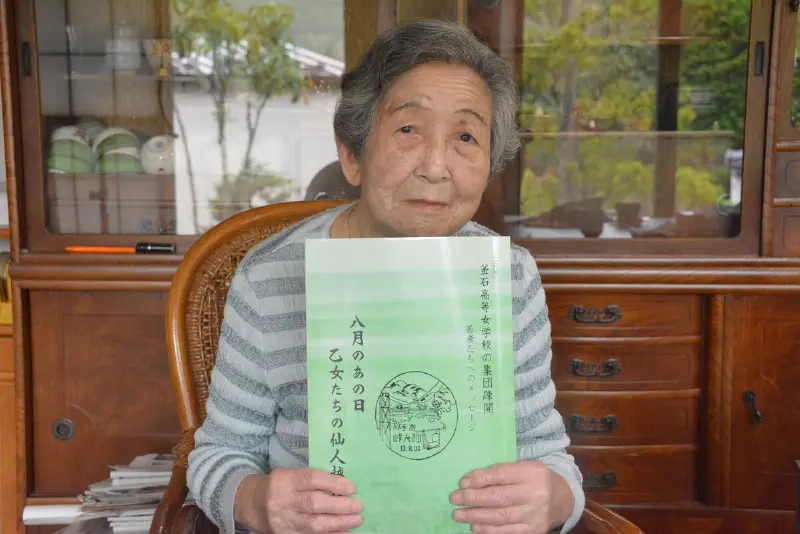
Still, she keeps busy working for the town, making her wartime experiences into a booklet and sharing her story through lectures.
"People can't resist a tsunami, but war can be avoided," she emphasised. "We must never start a war."

[Copyright The Jiji Press, Ltd.]
