
Ministry of Public Health provides update on crane accident in Nakhon Ratchasima
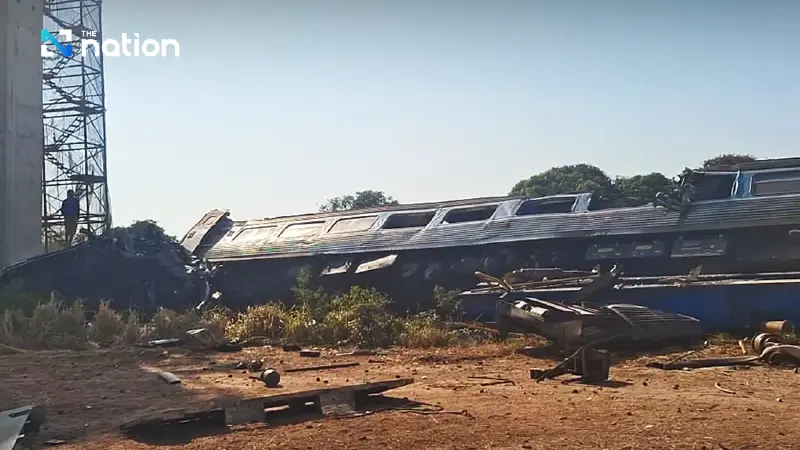


Emergency response teams are actively treating the injured following a crane collapse onto a train in Sikhio, Nakhon Ratchasima, with casualties still being identified.
- The crane accident in Nakhon Ratchasima resulted in 86 total casualties, with 22 confirmed deaths and 64 people injured.
- Among the injured, 10 are in critical condition (Red Level) and are receiving treatment at specialized facilities, including Maharaj Nakhon Ratchasima Hospital.
- The 22 deceased individuals are being held at Sikhio Hospital for identity verification before being returned to their families.
- The Ministry of Public Health has mobilized medical teams, prepared ICU facilities, and is organizing mental health support for the victims and their families.
At the Emergency Medical Operations Centre, Ministry of Public Health (MOPH), Dr Somruek Chungsaman, Permanent Secretary of the Ministry of Public Health, provided an update on the crane accident that occurred in Sikhio District, Nakhon Ratchasima, at 1.30pm on Wednesday (January 14).
Somruek stated that the Ministry of Public Health has been providing medical care to all injured individuals at hospitals with the necessary capabilities.
Medical teams are on hand to provide treatment.
There are currently 8 patients in critical condition (Red Level) being treated at Maharaj Nakhon Ratchasima Hospital and Debaratana Nakhon Ratchasima Hospital.
In addition, there are several patients with moderate injuries (Yellow Level) who will be monitored for potential changes in their condition over the next 3-6 hours.
Updates will follow as the situation develops.
"The 22 deceased individuals’ identities have not yet been confirmed, and the cause of death is still under investigation.
The bodies are at Sikhio Hospital, awaiting identity verification before being returned to their families," Somruek said.
He continued, stating that there are currently 37 injured individuals, all of whom have been listed.
However, the priority is to focus on the treatment of the injured before handling the details of their identification.
No foreign nationals have been reported among the injured, but further information about the deceased is expected soon.
Mental Health Support Measures
When asked about the mental health support for those affected, Somruek mentioned that the focus will be on treating the injured for the first 3-4 hours.
Once the condition of those with moderate or minor injuries is stabilised, a mental health assessment will take place.
For those in critical condition, mental health evaluations will be conducted 1-2 days after treatment.
Dr Ekachai Piansriwatchara, Deputy Permanent Secretary and Spokesperson for the Ministry of Public Health, added that the train had approximately 190 passengers.
As of the latest report at 12:30 PM on January 14, there were 86 casualties in total, with 22 confirmed dead and 64 injured.
The injured included 8 in critical condition, 19 with moderate injuries, and 37 with minor injuries.
The injured ranged in age from 1 to 85 years old, with most suffering head, chest, and leg injuries, including broken bones and complications such as pneumothorax (air in the pleural cavity).
Medical Preparedness
Medical teams, including surgeons and neurosurgeons, are fully prepared.
ICU facilities with 8 beds are ready, and there are more than 20 hospital beds available across Maharaj Nakhon Ratchasima Hospital, Thep Ratana Hospital, Pak Chong Nana Hospital, and Sikhio Hospital.
Emergency surgeries are underway, and blood banks are fully stocked.
Critical Patients Transfer
Several critical patients have been transferred to Maharaj Nakhon Ratchasima Hospital, including:
- 59-year-old male with injuries to the chest and head.
- 68-year-old male with a broken leg and head injury.
- 6-year-old male with leg injuries.
- 35-year-old male with multiple injuries.
- 1-year-old female with severe injuries to the head, arms, and broken bones in her legs. This child requires close monitoring.
- A 60-year-old male with head and chest injuries, with a pneumothorax.
Additionally, one 85-year-old female patient with a spinal injury was transferred to Thep Ratana Hospital, and one 73-year-old male patient with spinal and abdominal injuries was sent to Pak Chong Nana Hospital before being transferred to Maharat Nakhon Ratchasima Hospitall.
Mental Health and Support for Families
Dr Ekachai emphasised that mental health support teams would be deployed to assist the families of the deceased and the affected individuals.
Coordination with relevant agencies for further support and assistance will continue.
The Ministry of Public Health assured the public that the medical teams are working at full capacity to provide comprehensive care.
For families seeking more information, they can contact the central information centre at Nakhon Ratchasima Public Health Office at 065-506-6499, or for the deceased, contact SikhioHospital's information centre at 090-976-8154.
Updates on Patient Condition
Initially, 8 patients were categorised as Red Level (critical), and 19 as Yellow Level (moderate).
Two Yellow Level patients’ conditions have deteriorated, and they are being transferred to Maharaj Nakhon Ratchasima Hospital, bringing the number of critical patients to 10.
Among the critical patients, the 1-year-old child remains a significant concern.
However, there is still a possibility of recovery.
