
Thailand may face dual water risks as El Niño risk rises from May to July
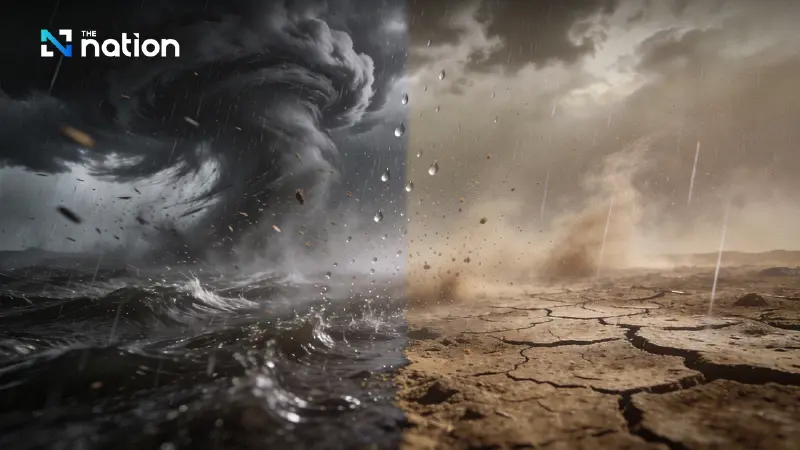


The Provincial Waterworks Authority is raising drought plans nationwide as experts warn of shortages, floods and flash floods in the same year.
- Thailand is forecast to face an El Niño event starting around May-July 2026, creating a "dual water crisis" with risks of both water shortages and flooding in the same year.
- The crisis is expected to begin with drought and extreme heat from May to August, followed by a period of heavy rain and potential flooding from September to November.
- In response, the Provincial Waterworks Authority (PWA) has identified 20 branches in 17 provinces at risk of shortages and is accelerating plans to secure backup water sources.
- Climate experts warn that global warming is amplifying the impacts of El Niño, which can lead to more intense heatwaves and extreme rainfall events.
Thailand could face a “dual water crisis” in 2026 after the Thai Meteorological Department forecast that El Niño could occur during May to July 2026, putting many areas at risk of water shortages and prompting the Provincial Waterworks Authority (PWA) to accelerate nationwide response plans and monitor 20 branches at risk of shortages.
Climate experts have warned that Thailand is facing its most severe and difficult-to-predict climate variability in several years, creating the possibility of heavy rain, flooding and runoff at the same time.
Tara Buakamsri, director of the Climate Connectors programme, said the World Meteorological Organisation (WMO) had assessed that El Niño was highly likely to begin forming from mid-2026 and affect temperatures and rainfall patterns in many regions worldwide.
The latest signals from the equatorial Pacific Ocean show sea-surface temperatures warming rapidly, creating a chance that El Niño could return as early as May to July 2026.
“There is currently no clear evidence that climate change is directly making El Niño occur more often or become more severe. However, global warming helps amplify the impacts of El Niño, making them more severe than before, because warmer oceans and atmosphere store more energy and moisture. This can lead to more frequent and more intense heatwaves, heavy rain and extreme weather.”
State of “water bankruptcy”
The United Nations (UN) said the world is moving into a state of “water bankruptcy” due to water use beyond ecosystems’ capacity.
Key data include:
- Water levels in 70% of major groundwater sources globally have fallen permanently, affecting nearly 2 billion people.
- Global wetlands have shrunk by 4.1 million square kilometres.
- Glaciers worldwide have declined by more than 30% since 1970.
- About 50% of global food production is in areas with unstable water sources.
The situation reflects the long-term links between water resources, ecosystems and food security.
Thailand prepares for raw-water shortage risk
Chakapong Kamchan, governor of the Provincial Waterworks Authority (PWA), said that, based on the 2026 drought forecast, PWA had assessed areas that could lack raw water.
It found 20 branches in 17 provinces at risk over water volume and another 7 branches in 5 provinces at risk over water quality.
To prepare, PWA has set measures in three main areas:
- Raw-water sources: accelerate the procurement and management of backup water sources to ensure sufficient supply for tap-water production throughout the year.
- Production and distribution: control production and distribution processes to maintain efficiency even in a crisis.
- Public communication and assistance: provide free tap water to disaster-hit residents. In the past year, more than 52 million litres of water have been distributed free of charge.
Adaptation under the NAP
The Thailand Environment Institute (TEI) advised that responding to the water crisis must follow Thailand’s National Adaptation Plan (NAP), covering four main areas:
- Water resource management: reduce water losses from waterworks and irrigation systems, develop backup water sources and promote the reuse of treated water.
- Settlements and human security: strengthen community-level water management mechanisms to set fair rules for water use.
- Agriculture and food: adjust cropping patterns, reduce water use in the dry season and promote low-water crops alongside water-management technology.
- Public health: monitor water quality and guard against saltwater intrusion and wastewater problems to reduce health risks.
Drought and flooding in the same year
Associate Professor Dr Seree Supratid, director of the Climate Change and Disaster Centre at Rangsit University and an expert for the Intergovernmental Panel on Climate Change (IPCC), said the world is clearly transitioning into El Niño from the middle of this year, with a likelihood of more than 80%, and the phenomenon is expected to peak late in the year.
“Although the world is transitioning into El Niño in 2026, which is generally associated with lower rainfall and hot weather, this does not mean flooding will not occur because climate variability remains high. Thailand will have temperatures above normal throughout the year, while average annual rainfall is likely to be below normal, which could affect available water reserves in 2027.”
Seree warned that analysis of sea-temperature distribution patterns over the past 10 years using AI found that the weather in 2026 resembles 2023 but is more variable, meaning drought and flooding could still occur in the same year.
“For the period from early to mid-2026 (May-August), many areas across the country may face water shortages, especially areas outside irrigation zones, alongside very hot weather. In the late-year period, between September and November, Thailand will be increasingly influenced by tropical cyclones and monsoon troughs, causing heavy rain in some areas.”
In the North, low-lying areas are at risk of flooding, while the Central region may be affected by overflowing riverbanks.
The South faces risks of runoff and flash floods late in the year, requiring close monitoring and preparedness systems.
The area requiring special monitoring is the Mae Sai district in Chiang Rai province, because upstream areas in Shan State, Myanmar, are likely to experience heavy rain.
The severity index is at 0.7-0.8, reflecting the risk of runoff and floodwater awaiting drainage.
