
El Niño impact puts 41 Thai provinces at risk of water shortages
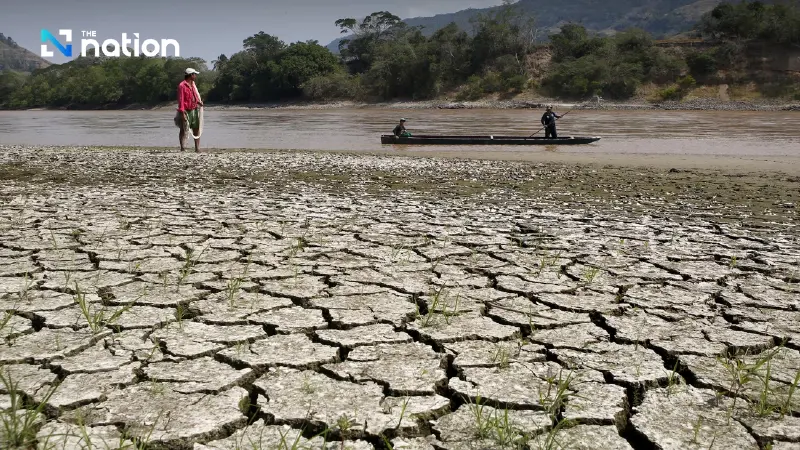


Water agencies identify risks nationwide, while TEI says systemic adaptation under Thailand’s National Adaptation Plan must be accelerated.
- Declining "source water" reserves, exacerbated by El Niño and climate change, have put 41 provinces in Thailand at risk of water shortages for domestic use.
- The risks extend beyond domestic consumption, with 12 provinces facing agricultural water shortages and 22 major river basins experiencing water quality issues like seawater intrusion.
- The Thailand Environment Institute is urging the acceleration of the country's National Adaptation Plan (NAP) to address the crisis through improved water management and agricultural adjustments.
- The shortages are expected to impact citizens' access to clean water, lower agricultural yields, and constrain water-intensive industries.
Thailand is facing the risk of water shortages after its “source water” reserves, stored supplies used during the dry season, declined due to climate change and El Niño.
Data from water agencies indicate risk areas across the country, while the Thailand Environment Institute (TEI) says systemic adaptation under Thailand’s National Adaptation Plan (NAP) must be accelerated to cope with a situation likely to become more severe.
UN warns world is moving towards “water bankruptcy”
The United Nations (UN) said the world was moving towards “global water bankruptcy” because water resources were being used beyond the capacity of ecosystems.
Key data include:
- 70% of the world’s major groundwater sources have seen permanent declines in water levels, affecting nearly 2 billion people.
- Wetlands worldwide have decreased by 4.1 million square kilometres.
- Glaciers worldwide have shrunk by more than 30% since 1970.
- About 50% of global food production is in areas where water sources are unstable.
The situation reflects the long-term connection between water resources, ecosystems and food security.
Thailand faces multidimensional water shortage risks nationwide
The Office of the National Water Resources estimates that, in the 2025/2026 dry season, Thailand faces risks in several areas, including:
- Risk of shortages for domestic use and consumption in 41 provinces.
- Risk of agricultural water shortages in 12 provinces.
- Water quality risks in 22 major river basins.
Areas under watch include eastern Bangkok, Nonthaburi and Samut Prakan, where seawater intrusion could affect tap-water production.
TEI proposes adaptation under NAP
Based on information from the Thailand Environment Institute (TEI), responding to the water crisis must proceed in line with Thailand’s National Adaptation Plan (NAP), covering four main areas:
- Water resource management: reduce water losses from tap-water and irrigation systems, develop reserve water sources and promote the reuse of treated water.
- Human settlement and security: strengthen community-level water management mechanisms to set fair rules for water use.
- Agriculture and food sector: adjust cropping patterns, reduce water use during the dry season and promote low-water crops alongside water management technology.
- Public health: monitor water quality and prevent seawater intrusion and wastewater problems to reduce health risks.
Impacts on people, the economy and state management
The tight water situation is likely to have wide-ranging impacts.
People may face uncertainty in accessing clean water, the agricultural sector risks lower yields, while businesses, especially water-intensive industries, may face resource constraints.
For the state sector, water management efficiency must be improved in both the short and long term to cope with fluctuations that are becoming more frequent and severe.
TEI data indicate that the current water crisis reflects the limits of resources that can no longer be used without constraint.
Changing water-use behaviour and managing resources efficiently are therefore important factors in reducing future risks.
