
Kobsak urges govt: 20 results in 4 months
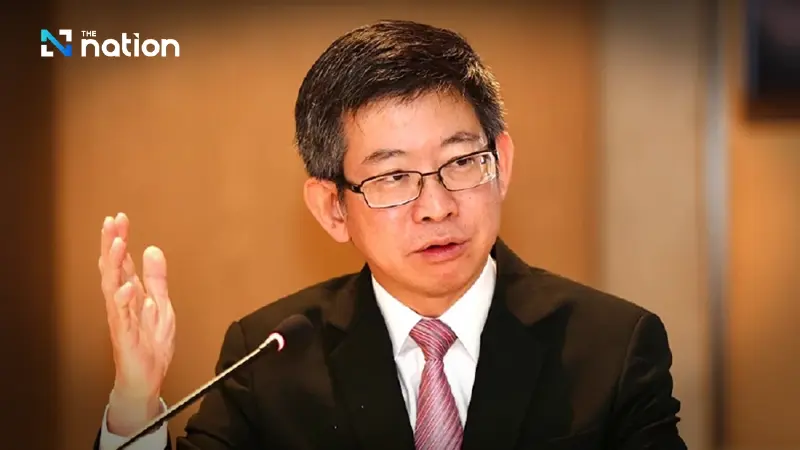


Thai Economic Association president Kobsak Pootrakool urges ministers to adopt a “1 person, 1 team, 1 task” approach, aiming for one achievement per month.
- Kobsak Pootrakool urges the government to achieve over 20 results in its four-month term by having each of the 5-6 key ministers complete one specific task per month.
- He proposes "Leverage 10X" policies, which are low-cost but high-impact initiatives, such as reviving a government procurement policy favoring Thai SMEs and tripling the budget for revenue-generating agencies.
- He also advocates for an "Open the Floodgates, Unlock" strategy to remove regulatory blockages, suggesting reforms to allow certain companies to IPO more easily and accelerating the "Regulatory Guillotine" policy.
- The primary goal of these policies is to urgently stimulate the public's disposable income, which he argues is the most critical measure of economic success for the average citizen.
Kobsak Pootrakool, Chairman of the Federation of Thai Capital Market Organisations (FETCO) and President of the Thai Economic Association, shared his views at the "4-Month Seminar: What We Want to See from the New Government" event, held at the Stock Exchange of Thailand on October 21, 2025.
He stated that the four-month working period for the government is quite short.
With almost a month already elapsed, Kobsak believes the most urgent policy is stimulating disposable income for the public.
He explained that when people are told the GDP grows by 4%, they don’t really feel it. Instead, people ask, "Do I have money in my pocket?" He stressed that this is the core focus of all the government's policies.
He considered the government's current initiatives, such as the "Let's Go Halves" (co-payment) scheme and the "We Travel Together" (travel subsidy) project, to be acceptable.
Although they may require some spending, they are programs that at least feel achievable to the public and are beginning to gain more interest.
He also believes that supporting everyone, building confidence, and creating a future are at the heart of the matter.
Kobsak doesn't see a need for additional short-term stimulus policies, as he feels the current ones are well executed. He also praised the government for being unashamed to adopt good policies from others, seeing this as a strength of the current administration.
He reasoned that relying solely on the government's own policies would take another year to implement.
Kobsak proposed new policies he calls "Leverage 10X," which are defined as initiatives that use little money but yield significant results.
SME GP Policy
He wants the government to revive the "SME GP" policy, which previously existed but was discontinued. This policy is crucial for supporting Thai Small and Medium Enterprises (SMEs), especially with the imminent influx of products from China targeting the Thai SME sector.
He recommended that the government urgently implement a policy requiring public sector agencies to procure goods from Thai SMEs and grant them a slight advantage (a preference), allowing them to be about 10% more expensive than products from large companies.
This should be specifically limited to Thai SMEs and Thai products to prevent Chinese goods from dominating the market.
Triple Budget and Personnel for Revenue-Generating Agencies
Another readily implementable policy is to propose increasing the budget and personnel by at least 2-3 times for key revenue-generating agencies. These include the Tourism Authority of Thailand (TAT), the Ministry of Commerce, and the Board of Investment (BOI), which he considers very important. These agencies will be critical for the country's success over the next 3 to 5 years.
"Open the Floodgates, Unlock" Policy
Kobsak urged the government to pursue an "Open the Floodgates, Unlock" policy. Even with a short term in office, the government can enact policies with a Long-lasting Impact. He believes many issues are genuinely stalled simply due to a lack of interest and people not paving the way forward.
One specific example is allowing companies that receive BOI privileges to proceed with an IPO (Initial Public Offering) to expand the S-Curve business groups. He believes the internal regulations for this can be modified within the four-month timeframe.
He also wants to discuss reforming retirement savings with the Ministry of Finance, as this can be done immediately and has clear goals. Additionally, he suggested adjusting BOI regulations to support companies that assist local communities and liberalising the service sector.
These policies, if implemented now, will yield future results and demonstrate to everyone that the country is moving forward.
Furthermore, he urged the acceleration of the Regulatory Guillotine policy proposed by Bowornsak Uwanno, stating that these policies are essential for unlocking progress.
For the four-month working period, Kobsak called on the government to adopt the principle of "1 Person, 1 Team, 1 Task." This involves assigning highly motivated, younger officials to complete just one specific task within the four-month period. He also proposed setting a monthly KPI for each minister: completing one task per month.
He argued that if each of the 5-6 ministers completes one task per month, that results in over 20 accomplishments in four months, which would surely benefit Thailand.
The country's primary issue, he said, is being completely locked down; simply getting started and completing tasks would be an achievement.
He warned that if action isn't taken now, the Thai economy will lag behind others, noting that the IMF projects Thailand to drop to the 5th position in ASEAN by 2030.
