
Lawfare hunts Shinawatras over Hun Sen clip ruling
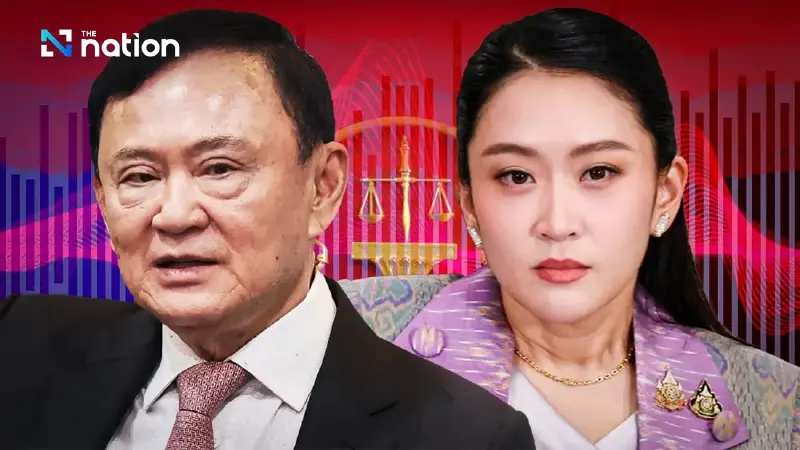


Thaksin and Paetongtarn Shinawatras await a court ruling on the Hun Sen clip, with two possible outcomes that could determine their political future.
Thailand’s legal warfare against the Shinawatra family has escalated dramatically, with the Constitutional Court accepting a petition to rule on whether Paetongtarn Shinawatra must be disqualified as a Cabinet minister.
The petition was filed under Article 170 paragraph 3 in conjunction with Article 82 of the Constitution, questioning whether Paetongtarn’s ministerial status should be terminated, marking a new chapter in the legal-political offensive against the influential political dynasty.
The petition was submitted by 36 senators after an explosive leaked audio clip surfaced, purportedly capturing a private conversation between Paetongtarn and Cambodian Senate President Hun Sen.. The court has ordered her to respond to the allegations within 15 days.
In a decisive 7-2 vote, the court ordered Paetongtarn to suspend her duties as prime minister effective immediately, prompting her to vacate the Thai Khu Fah Building at Government House.
However, because her name also appears on the Cabinet reshuffle list as Minister of Culture, she retains a seat at the Cabinet table. This mirrors a past precedent: when former PM General Prayut Chan-o-cha was suspended by the same court over his term limit, he continued to serve as defence minister and attended Cabinet meetings in that capacity.
Paetongtarn’s suspension opens a brief but critical window for behind-the-scenes political manoeuvring. Analysts believe the Constitutional Court’s final ruling could come within 30 to 45 days, and only two scenarios are possible:
- The court rules her ministerial status remains intact, allowing her to resume the premiership.
- The court disqualifies her, ending her tenure as prime minister.
Pheu Thai's powerbrokers, including former premier Thaksin Shinawatra, are no doubt hoping for the first outcome. A favourable verdict would rejuvenate Paetongtarn’s political image and reinforce her leadership standing.
Moreover, such a decision could deflate the momentum of protest groups, many of which have united under a nationalist banner, accusing the Shinawatras of colluding with Hun Sen and betraying Thailand.
Without a clear legal resolution to the leaked clip saga, these groups could continue fuelling public unrest. But if the court delivers clarity and exoneration, their grievances may lose traction, weakening attempts to rally the public against Paetongtarn.
If the Constitutional Court rules that Paetongtarn’s ministerial status has ended, the process of selecting a new prime minister must begin, just as it did when Srettha Thavisin was removed from office.
Assuming no unexpected legal complications arise, the new PM must be chosen from among the official nominees submitted by political parties to the Election Commission (EC). Each nominating party must have at least 25 MPs in Parliament.
As of now, the remaining candidates on the list include:
- Chaikasem Nitisiri (Pheu Thai)
- Anutin Charnvirakul (Bhumjaithai)
- Gen Prayut Chan-o-cha (United Thai Nation)
- Pirapan Salirathavibhaga (United Thai Nation)
- Jurin Laksanawisit (Democrat Party)
However, if the political game drags on to the point where Parliament is forced to vote for a new PM from this list, it will almost certainly require a new coalition deal. The conservative bloc will still need to rely on Pheu Thai’s numbers, meaning a new alignment between conservative parties and Pheu Thai may be necessary to form a government.
Some combinations, however, can be ruled out. A Pheu Thai–People’s Party alliance, for instance, is highly unlikely. Equally unviable is a conservative bloc joining hands with the People’s Party, given that the future of the Shinawatra family lies in the hands of conservative powerbrokers who are steering the course of this legal ‘lawfare.’
If the standoff becomes intractable and no PM can be selected from the official list, a more drastic option may emerge: selecting an “outsider” PM.
The process involves three steps:
- If MPs fail to elect a prime minister within 90 days, they may seek parliamentary approval—by simple majority—to convene a special joint session with the Senate.
- The joint session of MPs and senators must then approve a motion, with a two-thirds majority, allowing the appointment of a PM from outside the official list.
- Finally, the House of Representatives will reconvene to vote for the outsider PM.
If all these steps fail to produce a new leader, Parliament would traditionally be dissolved, leading to a fresh general election.
Thai politics has now entered a high-pressure phase of legal warfare, as the Shinawatra father-daughter duo faces mounting pressure. The question is whether this pressure will force them to retreat—and whether such a retreat would favour certain political players, or if the game may unexpectedly swing back in favour of Thaksin and Pheu Thai.
