
Social media war heats up ahead of PM’s audio clip verdict


Pheu Thai VS the army: Secret offensives in the political battlefield
- Rival political factions are engaged in an intense "social media war" ahead of the Constitutional Court's August 29 verdict on a leaked audio clip involving Prime Minister Paetongtarn Shinawatra.
- Anti-government groups are using social media to discredit the military by circulating a critical poll and an old video clip, as military figures are named as potential successors to the PM.
- In response, pro-government supporters are pushing counter-narratives online, blaming past administrations for current issues like border disputes and call-centre scams to defend the PM.
- The online conflict is fueled by the high stakes of the verdict, which will either allow the PM to continue or force Parliament to select a new leader, intensifying political maneuvering.
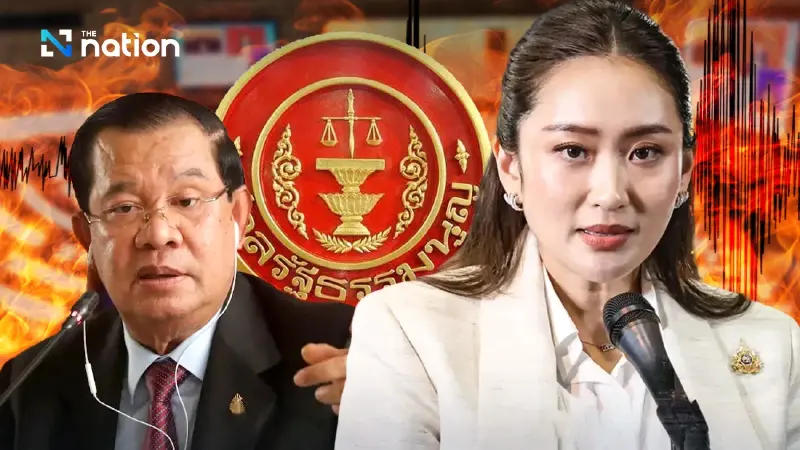
The clock is ticking towards August 29, when the Constitutional Court will rule on the case of Prime Minister and Culture Minister Paetongtarn Shinawatra, stemming from a leaked audio clip of her conversation with Cambodian Senate President Hun Sen.
As the political stage braces for this pivotal ruling, the news cycle remains dominated by a “social media war,” with rival camps waging daily battles online.
Analysts outline two possible scenarios. In the first, “PM Paetongtarn” survives. The Pheu Thai-led government would resume its course with Paetongtarn at the helm, though she would face pressing challenges, most notably reviving her party’s plummeting popularity ratings.
In the second scenario, Paetongtarn falls. Parliament would then be tasked with selecting Thailand’s 32nd prime minister, the third in just two years since the general election. This outcome would open a new round of political manoeuvring, with factions deploying “offensive strategies” on both parliamentary and mass-movement fronts, fuelled further by the intensifying social media battleground.
Names of possible successors have already emerged. Former prime minister Gen Prayut Chan-o-cha has been floated as a candidate of the United Thai Nation Party, amid speculation of a “deep state” comeback.
Meanwhile, the viral campaign slogan “What are soldiers for?” has been revived in the context of border tensions, with some voices promoting Lt Gen Boonsin Padklang, the Second Army Area commander, who retires in September, as a potential political player.
These manoeuvres mirror the latest Nida poll findings, which reveal growing disillusionment with politics: 32.29% of respondents said they were dissatisfied, 28.24% “not satisfied,” 27.18% “not satisfied at all,” while only 11.60% said they were “quite satisfied.”
Such numbers raise the question of whether voters are losing faith in career politicians altogether.
In stark contrast, Pheu Thai has insisted that should Paetongtarn be disqualified, the next prime minister must be its second candidate, Chaikasem Nitisiri, and no one else.
The party’s chief government whip, Wisut Chainarun, underscored this stance, warning those seeking to leapfrog into the premiership that they must wait their turn behind Chaikasem.
The mobilisation game on the “red” side is no different. Whether it be hardcore red-shirt supporters or the so-called “reds turned orange,” efforts are underway to dominate the social media space and rally opposition against “extra-constitutional power” that they claim may intervene at a time when the government’s standing is at a low ebb.
Their narrative digs deep into the roots of the border dispute, especially the dismantling of fences along the Thai-Cambodian frontier. They counter claims from the other camp by insisting that these incidents did not occur under the Yingluck Shinawatra administration, but rather during the premiership of Abhisit Vejjajiva, when Gen Prayut Chan-o-cha was army commander.
The offensive extends to the call-centre scams, with Pheu Thai supporters amplifying the argument that the problem stemmed from past governments that turned a blind eye, while hinting that certain “big names” from some parties may have had vested interests.
They contend that Pheu Thai came to power determined to clean up these messes, angering Hun Sen and leading to the release of the controversial audio clip.
Adding fuel to the fire was the release of a “Pacific Poll,” which posed a loaded question: “Do you agree with soldiers becoming prime minister?” A striking 68.1% responded “strongly disagree.” Another question asked whether the military and democracy could coexist. Here, 36% said “yes,” but only if the military curtailed its power.
Meanwhile, a video clip surfaced online alleging that a senior officer physically assaulted a junior soldier at a border outpost near Ta Kwai Temple in Phanom Dong Rak district, Surin.
The army quickly rebutted the claim, clarifying that the footage dated back to 2015 and that disciplinary action had long since been taken.
The Second Army Region commander, Lt Gen Boonsin Padklang, was equally swift to respond, dismissing both the poll and the clip as deliberate attempts to discredit the military. He also addressed speculation about his own future, insisting that after retirement, he would not enter politics, declaring: “I can be anywhere that carries no vested interests.”
All of this underscores the intensifying “social media war,” with rival factions trading fire in the countdown to the Constitutional Court’s August 29 ruling on the explosive audio clip case.
Darakorn
