
Election 2026 showdown: fading popularity weakens orange and red blocs
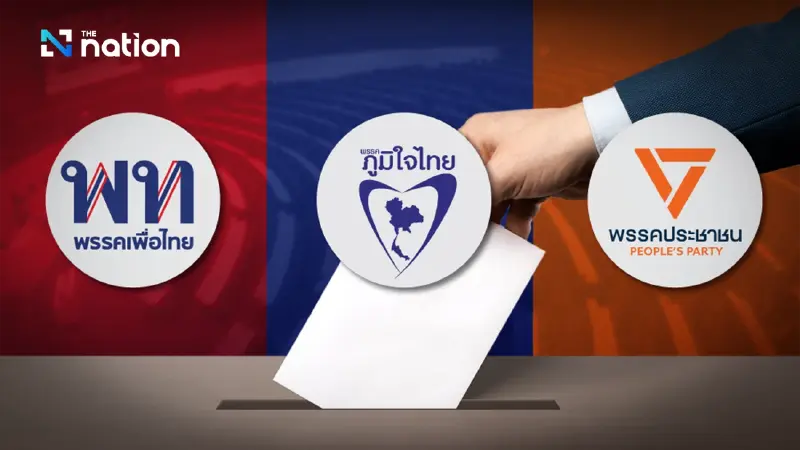


Anutin Charnvirakul and the Bhumjaithai Party have seen a clear rise in popularity since he became prime minister, but the share of undecided voters for parties and leadership has also grown, forming a key battleground for all parties.
- Recent polls show a sharp rise in undecided voters, indicating growing dissatisfaction with the current political options ahead of the 2026 election.
- The leading People's Party ("orange bloc") has experienced a significant drop in popularity, with both the party and its leader, Natthaphong Rueangpanyawut, losing substantial support.
- The Pheu Thai Party ("red camp") has also suffered a major decline in party and leadership ratings, particularly after former prime minister Paetongtarn Shinawatra stepped down.
- In contrast, Prime Minister Anutin Charnvirakul and his Bhumjaithai Party have seen their approval ratings soar, gaining ground as their rivals weaken.
With four months left before Parliament is dissolved and six months before election day, every move by political players is being made with extreme caution. No party wants to risk a misstep that could trigger a negative backlash.
Public opinion surveys, whether conducted by political parties, universities, or private firms, have become a crucial tool in shaping strategy. Polls influence decisions on candidates for prime minister, party leadership, and policy platforms, all aimed at capturing voter sentiment and securing party-list seats.
One of the most trusted surveys, conducted by the Nida Poll of the National Institute of Development Administration, recently released the results of its third quarterly political popularity survey (September 18–24), following the September 3 parliamentary vote that installed Anutin Charnvirakul as prime minister.
The findings reveal a sharp rise in the number of undecided voters. When asked who they would support as prime minister today, 27.28% said they had not yet found a suitable candidate. This was up from 23.70% in March and 19.88% in June, an increase of 7.4 percentage points between the last two surveys.
A similar trend was seen in party preference. In March, 13.75% of voters said they had no preferred party; by June, the figure had dropped to 7.72%, but in September it surged to 21.64% — a 13.92-point jump.
The swelling ranks of undecided voters suggest that Anutin’s selection as prime minister has had a boomerang effect, sending momentum back to the opposition People’s Party. These voters are now seen as a “big pool” of support that all political parties will be fiercely competing to capture.
People’s Party still leads but support slips
The People’s Party remains at the top of the polls, but both its leader and party support have suffered steep declines. Party leader Natthaphong Rueangpanyawut saw his popularity fall from 31.48% in June to 22.80% in September, a sharp drop of 8.68 percentage points.
Support for the party followed the same downward trend, sliding from 46.08% in June to 33.08% in September, a 13-point plunge. The erosion of support for both Natthaphong and the People’s Party contrasts with the steady rise in undecided voters, suggesting that many former supporters may now be stepping back to “wait and see.”
Analysts note that the People’s Party's vote to elevate Anutin Charnvirakul to prime minister dealt a blow to the People’s Party’s “orange wave,” despite assurances that Parliament would be dissolved within four months to allow constitutional reform.
Anutin’s ratings climb, Bhumjaithai gains ground
By contrast, Prime Minister Anutin’s personal approval has soared since taking office. His popularity rose from 9.64% in June to 20.44% in September, a jump of 10.8 points.
The Bhumjaithai Party also gained support, though less dramatically, rising from 9.76% in June to 13.24% in September, up 3.48 points.
Observers say Anutin’s surge reflects not only momentum from assuming the premiership but also the weakening of conservative rivals, whose support appears to have shifted in his direction. In addition, simmering Thai–Cambodian border tensions may have fuelled nationalist sentiment, with voters expecting decisive leadership from Anutin.
Although the party’s gains have not matched its leader’s meteoric rise, Bhumjaithai is clearly on an upward trajectory, with no sign of losing ground.
Pheu Thai’s leadership ratings plunge, party support dwindles
The Pheu Thai Party has seen a sharp drop in popularity after former prime minister Paetongtarn Shinawatra stepped down. In her absence, the only remaining prime ministerial candidate is Chaikasem Nitisiri.
In the first survey, Paetongtarn polled 30.90%, but by the second survey her rating had collapsed to 9.20%. Chaikasem, meanwhile, registered just 0.20%. By the third survey, his rating stood at 6.76%, a staggering 24.14-point decline from the first round.
Party support mirrored this trend. Pheu Thai’s popularity dropped from 28.05% in the first survey to 11.52% in the second, before edging up slightly to 13.96% in the third, still a 14.09-point fall compared with March.
Analysts link the decline to the Thai–Cambodian border dispute. The September survey was conducted after the release of a controversial leaked conversation between Paetongtarn and former Cambodian premier Hun Sen, which appears to have damaged the party’s standing. The fall has shaken the “red camp” brand at its core.
UTN struggles as Prayut fades from the scene
The United Thai Nation Party (UTN) has also seen declining support, reflecting its reliance on the personal popularity of former prime minister Prayut Chan-o-cha.
In the second survey, Prayut polled 12.72%, but his support dropped to 6.00% in September. Party leader Pirapan Salirathavibhaga fared even worse, falling from 8.45% in the first survey to just 2.72% in the third, a 5.73-point decline.
UTN’s party support slipped as well: from 8.75% in March to 13.24% in June, before plunging to 6.12% in September, down 2.63 points overall.
With Prayut no longer expected to be on the ballot in the 2026 election, UTN has lost its figurehead. As Prayut’s influence wanes, Pirapan’s declining support and the party’s fading brand have left members fragmented, with the UTN's vote base collapsing.
Democrat Party regains momentum as Abhisit tipped for leadership
In the latest survey, Democrat Party stalwart Chalermchai Sri-on registered a modest 1.76% popularity rating. Meanwhile, former prime minister Abhisit Vejjajiva scored 1.04% after his name resurfaced as a potential candidate to return as party leader.
Support for the Democratic Party itself has improved significantly, rising from 1.76% in June to 5.52% in September, a 3.74-point increase. Analysts note that the boost came after Chalermchai stepped down as party leader, paving the way for a new executive committee and fuelling speculation of Abhisit’s comeback. This development has helped revive political momentum for the country’s oldest party.
Sudarat holds steady as Thai Sang Thai retains support
Sudarat Keyuraphan of the Thai Sang Thai Party continues to feature in every survey. Her personal popularity has steadily increased, from 3.90% in March to 6.12% in June and 7.16% in September, a 3.26-point rise overall.
The party’s own ratings have inched up from 2.00% to 2.92% over the same period. Despite senior members leaving the party, the survey results suggest that both Sudarat and Thai Sang Thai still retain a base of public confidence and support.
Kla Tham has MPs but lacks momentum
Polls also show that some parties have seats in Parliament but little to no momentum in terms of public support for either their leaders or the party itself. These parties rely heavily on local political networks and “big house” models, such as Kla Tham, Chartthaipattana, and Palang Pracharath.
The survey highlights both the strengths and weaknesses of each political party, while also underscoring Thailand’s leadership crisis. Current party leaders and declared prime ministerial hopefuls have yet to inspire real confidence among the public. This is reflected in the rising number of respondents who say they cannot find anyone suitable for the role of prime minister.
With less than a year to go before the 2026 election, parties are struggling to generate excitement. As individual leaders fail to capture attention, populist policies are increasingly being deployed as the key strategy to build momentum. The big question now is which “trend parties” will succeed in capturing voter sentiment, and by what political manoeuvres.
