
Who will be Thailand’s next defence minister?
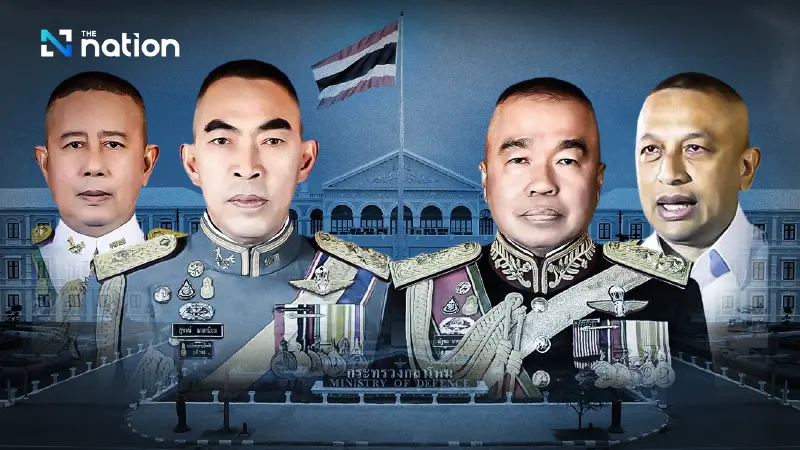


Amid escalating security challenges at home and abroad, the defence minister post in the next government is emerging as one of the most closely watched appointments.
- The Bhumjaithai Party may retain the current defence minister, Gen Natthaphon Narkphanit, or appoint someone from leader Anutin Charnvirakul's network, such as Adm Suwin Chaengyodsuk.
- Other potential candidates mentioned include Gen Supot Malaniyom, a former National Security Council secretary-general, and Lt Gen Adul Boonthamcharoen, the current deputy defence minister.
- Capt Thammanat Phromphao of the Klatham Party has also been named as a possible defence minister, leveraging his network of military classmates.
- Two other major parties, the Pheu Thai Party and the People’s Party, have not yet publicly named their candidates for the position.
At a National Security Council (NSC) meeting last week, chaired by NSC Secretary-General Chatchai Bangchuad, officials assessed shifting geopolitical tensions following a US military operation to arrest Nicolás Maduro, Venezuela’s president.
While the immediate fallout has not yet reached Thailand, the NSC views the longer-term risks as harder to ignore. If the conflict widens and triggers broader disruption, particularly in energy markets, Thailand may need to revive and update its crisis playbook first used during the Russia–Ukraine war, adjusting it to fit a new, more volatile scenario.
Thailand’s energy security approach: three principles
Officials described Thailand’s energy policy as resting on three core principles:
Supply stability: the government must ensure domestic energy supplies remain stable and sufficient, to avoid shortages that would hit households and businesses.
Price stability: the government must prevent energy prices from rising to levels that severely impact living costs, especially diesel and cooking gas (LPG), which affect a broad swathe of the population.
Targeted relief: future price-support measures should focus on households and vulnerable groups, delivered through appropriate support schemes.
In a wartime scenario, Thailand would also need to maintain minimum oil reserves for domestic circulation, covering the public and private sector, for at least 21 days, while the armed forces would require 45 days, subject to assessments of how prolonged a conflict might become. The reserve level could be increased beyond the minimum if conditions warranted.
Regional flashpoints still on the radar
Beyond global developments, the NSC also reviewed neighbouring issues with direct implications for Thailand.
Thailand–Cambodia border: the situation remains fragile and could flare up at any time, officials believe, driven by boundary disputes and competing territorial claims, as well as provocation, misinformation, and political narratives. The assessment suggested that restoring the relationship to “normal” levels may not be easy.
Myanmar: the NSC is also watching Myanmar’s domestic conflict and fighting near Thailand’s border. Despite Myanmar being in an election period, officials believe the process could face allegations of illegitimacy and may not be widely accepted.
On the crackdown on scam operations, the destruction of buildings linked to KK Park and Shwe Kokko was noted, but the assessment held that operations deeper inside the area persist, and that China remains dissatisfied with progress.
The Deep South: the NSC also flagged the southern security situation as another risk that could intensify if not managed effectively.
These developments underline why this election matters. Thai voters have already seen each party’s prime ministerial candidates, the faces volunteering to tackle the country’s problems.
Yet one pivotal post remains largely unnamed: the defence minister. The job requires a figure who can connect the political leadership with the armed forces and keep both moving in the same direction. Even though several parties have used nationalist sentiment, particularly over the fragile Thailand–Cambodia border, as a campaign theme, none has clearly revealed who it would appoint as the next defence minister.
Bhumjaithai: keep Gen Natthaphon or not?
Attention has turned to the Bhumjaithai Party. If it leads the next coalition, the key question is whether it would retain the current defence minister, Gen Natthaphon Narkphanit, sticking to a “don’t change horses mid-stream” approach amid regional border pressures and simmering global geopolitical tensions.
On the campaign trail, Anutin Charnvirakul, PM and Bhumjaithai leader, has told voters that if his party forms the next government, three names would definitely be part of it:
- Ekniti Nitithanprapas as deputy prime minister and finance minister
- Sihasak Phuangketkeow as foreign minister
- Suphajee Suthumpun as commerce minister
Security spotlight: Adm Suwin and Anutin’s networks
In security circles, attention has focused on Anutin’s networks, Assumption College 98 and NDC (National Defence Course) Class 61, particularly Adm Suwin Chaengyodsuk, who has been appointed an adviser to the prime minister, tasked with providing advice and recommendations on assigned matters.
Adm Suwin is a Class 25 Armed Forces Academies Preparatory School graduate and a former deputy commander of the armed forces. He previously served as an assistant commander-in-chief of the Royal Thai Navy, commander of the fleet, and a naval attaché in Washington, DC. He also once commanded the aircraft carrier HTMS Chakri Naruebet and played a role in preparing force readiness during the period surrounding the burning of Thailand’s embassy in Phnom Penh.
Other names in the frame
Another figure not to overlook is Gen Supot Malaniyom, a former NSC secretary-general and former chief of staff of the armed forces, described as a veteran cavalry officer with deep experience in both operational and staff roles.
Gen Supot is from Class 22 of the Armed Forces Preparatory School and Class 33 of the Chulachomklao Royal Military Academy, in the same cohort as former army chief Gen Narongphan Jitkaewthae. He studied demanding courses in Thailand and abroad, including the US Army Command and General Staff programme.
He served on the northern border and fought in the Ban Romklao conflict in Phitsanulok in 1987–1988, where he was wounded. He was later nominated for a bravery decoration. His career then shifted from the army to the Royal Thai Armed Forces Headquarters, and into development work under the Military Development Command, before he was brought into the Counter-Terrorism Operations Centre as chief of staff and deputy commander.
He also took part in Thailand’s COVID-19 response while serving as deputy chief of staff and later chief of staff of the armed forces, under the security emergency operations structure.
It is also difficult to overlook Lt Gen Adul Boonthamcharoen, a deputy defence minister and former commander of the Second Army Region. Anutin has brought him in to help share the burden of the Thailand–Cambodia border work. He is also a classmate from NDC 61, and from the same armed forces preparatory school cohort as Gen Phana Klaewplodthuk, the army chief, and Lt Gen Weerayuth Raksilp, the Second Army Region commander.
Klatham’s Thammanat and a military-classmate machine
On the Klatham Party side, Capt Thammanat Phromphao, deputy prime minister and agriculture minister, has also been mentioned as a possible defence minister in an Anutin-led cabinet.
He has pulled in a circle of Class 25 classmates and associates to help with party work, including Himalai Phiwphan, Gen Thaweepool Rimsakorn, Gen Dechanithit Lueangngamkham, Gen Damrong Khongdech, Gen Yutthakiat Luanphairin, ACM Worachart Fongchon, Lt Gen Jirankrit Lueangjinda, VAdm Nirat Thakudruea, Maj Gen Krit Sukmak, and Air Vice Marshal Chaisom Romphothong.
Thammanat has said he has a strategy, stressing his combat training and the military education of his colleagues.
Two major parties still keep their cards close
The Pheu Thai Party and the People’s Party have yet to make clear who they would appoint to oversee the armed forces and handle national security if they lead the next government, whether a former soldier or a civilian.
A defining test for the next defence minister
With security challenges now as urgent as economic concerns, the next defence minister will need the credibility and skill to bridge politics and the armed forces, and keep both aligned as Thailand faces an increasingly uncertain period ahead.
