
People’s Party sets out foreign policy vision for People’s Government


Party says Foreign Ministry would work more closely with overseas agencies, pair diplomacy with security cooperation, and deepen regional ties through trade, technology, education and public health.
- The policy will prioritize protecting Thai interests by using diplomacy to enhance national security and collaborating with international partners to combat transnational crime.
- It aims to strengthen ASEAN's unity and credibility by pushing for a free trade area and greater security cooperation, while also boosting economic ties with neighboring countries.
- The vision includes transforming Thailand into a high-technology nation by seeking strategic partnerships and investment from East Asian countries like Japan and South Korea in sectors such as autonomous vehicles and electronics.
- Economic mechanisms will be used to open new markets for Thai products, from agricultural goods under free trade agreements to cultural exports like drama series in the US market.

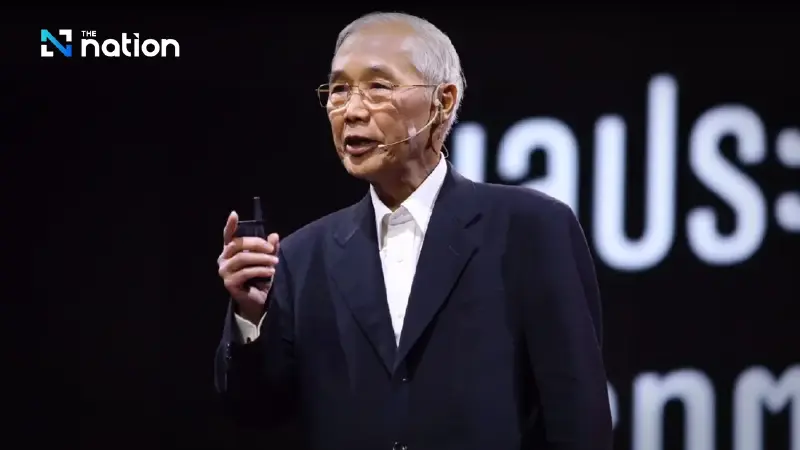
At Samyan Mitrtown, Pisan Manawapat, a member of the People’s Government management team for foreign affairs, delivered a vision statement at the People’s Government Vision Forum organised by the People’s Party.
He said the Ministry of Foreign Affairs’ policy would focus on working with all government agencies overseas to support the People’s Party’s agenda and drive it to become the core policy of a People’s Government, promoting Thailand and protecting Thai interests.
Pisan said diplomacy would guide relations and support security agencies in improving public well-being and protecting people from military threats.
The country would also work with international partners to combat cybercrime, “grey capital”, and other forms of transnational crime.
Economic mechanisms would be used to strengthen trade and investment along the country’s border corridors in all directions, while education and public health would help foster lasting friendship and build long-term affinity for Thailand among all neighbouring countries.
On ASEAN, he said that, as a founding member, Thailand would push for the creation of an ASEAN free trade area and an ASEAN meeting on political and security cooperation in the Asia-Pacific region, so that ASEAN could become a united bloc with strength and credibility, capable of handling renewed great-power rivalry and geopolitical volatility.
He added that Thailand would become a high-technology country by pursuing joint technology development and seeking cooperation with East Asian countries, stepping in where gaps exist.
As an example, he said Japan lacks testing space, so Thailand would invite investment in new technologies such as autonomous vehicles and hydrogen energy.
He said South Korean investment is concentrated in Vietnam alone and has stopped looking for new locations; a People’s Government would position Thailand within South Korea’s electronics supply chain, while also opening the US market for Thai BL drama series.
“In the last 15 years of my service in the Ministry of Foreign Affairs, as a senior executive and as ambassador to four countries, I have worked on economic issues throughout. I served as chief negotiator for the Thailand–Japan free trade agreement, which enabled many Thai agricultural products to be sold in the Japanese market duty-free, and I also helped Thai exporters in the European Union overcome regulations,” Pisan said.
“I ask you to choose the People’s Party. If the People’s Party forms a government, you will have someone like me, with this level of experience, helping with foreign affairs,” he added.
