
PM Anutin ends policy debate vowing strong, secure Thailand
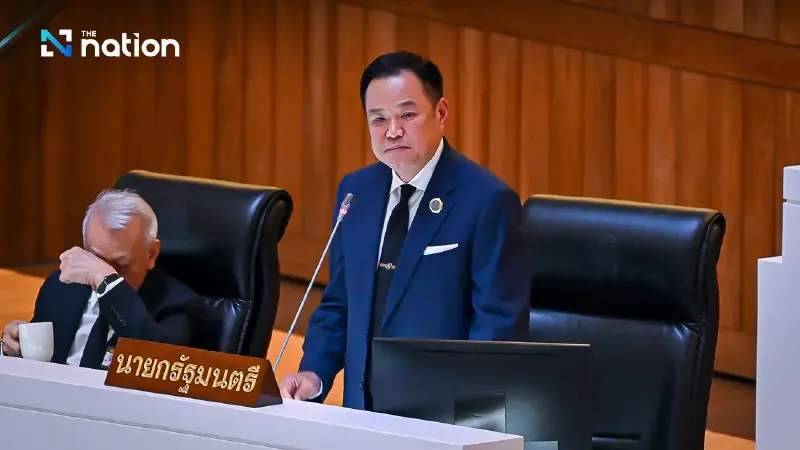


Closing the debate, Anutin pledged to devote all his strength to Thailand and said his government would work in a professional and accountable way.
- Prime Minister Anutin concluded the policy debate by vowing his government will use its full authority to make Thailand a strong, secure, and prosperous country.
- He affirmed that his cabinet will work to achieve all 23 core policies and will incorporate useful suggestions from the debate for the benefit of the people.
- Anutin defended his management style of delegating tasks to carefully selected ministers, stating he holds them accountable for results to ensure effective governance.
At Parliament, Prime Minister Anutin Charnvirakul, in his concluding remarks to a joint sitting of Parliament on the government’s policy statement under Section 162 of the Constitution, said that, on behalf of the Cabinet, he would like to express his thanks to the President of Parliament and all members of Parliament for taking part in the debate, offering opinions, suggestions and concerns regarding the government’s policy statement.
He added that he fully understood that each side was doing its own duty as best it could.
He confirmed that every opinion, comment, suggestion and speech had been heard and acknowledged by all members of the Cabinet, and that anything useful, substantive and true would be welcomed, applied and put into practice for the benefit of the people.
He was fully aware that the challenges facing the country, whether in the short term or the long term, would require cooperation from all sectors.
All members of the Cabinet, he said, gave their assurance that they would push for everything stated in the policy statement to be achieved effectively, while also affirming that all 23 policies were core policies that everyone would have to carry out within the government’s term, which he hoped would last the full four years.
Anutin also added that everyone was determined to work.
As for the Cabinet, he had selected every minister with care and caution, taking into account each person’s experience and record before deciding which ministry each should be entrusted with.
He maintained that he had considered every appointment thoroughly and carefully.

As for the accusations made against him, that he was not serious about working, that he threw work to others, avoided responsibility and did not know how to administer government, that was part of each side’s role, but he would ask for one thing: that critics speak the truth and do more homework.
He added that this applied in particular to the member who had just spoken, saying that the member had clearly not done his homework in stating that he had personally taken charge of coalition “clusters” on the Pheu Thai side, such as the Agriculture and Cooperatives Ministry.
He insisted that the Agriculture and Cooperatives Ministry was supervised by Yodchanan Wongsawat, Deputy Prime Minister and Minister of Higher Education, Science, Research and Innovation, along with all other ministries under Pheu Thai’s supervision.
As for Bhumjaithai, he said each deputy prime minister and minister had been assigned to oversee the agencies placed under their responsibility.
“I have managed work this way ever since I was an executive in the private sector. It may even be my talent, because I know how to assign work. I know who is good at what. I know who can go out, do something and bring the results back to me.”
The prime minister also stressed that every minister to whom he assigned work must be someone he was confident could do it, in line with the thinking and the goals he wanted, and that there was no one who would come back to him with something that could not be done.

“For me, whichever minister or deputy prime minister comes back in failure, once the report is finished, that person should know it is time to pack up and let someone with better ability come in and do the job. That is how I manage and work. I have worked this way and achieved success in every field. Have there been failures? There have been some, but there has been more success than failure. That is why I have built up the experience to see that this person is suited to one thing, that person is suited to another, and then assign work accordingly. I can assure you that I think first.”
Anutin also added that, when it came to answering interpellations in Parliament, he would assign the minister concerned to respond, or, if he was free, he would come and explain matters to Parliament himself.
“Today I am the prime minister, and I must thank you. You have made it possible for me to become prime minister for the first time. I truly thank you. But today I am the prime minister while also overseeing the Interior Ministry, and I have appointed three deputy interior ministers to help me work. Each minister has a duty to answer interpellations in Parliament, and every other minister must likewise have the same duty to answer questions in Parliament.”
The prime minister also noted that earlier in the evening, he saw two or three ministers still on stage, so he sent a message to the group on Line telling them that they had to show respect to Parliament and asking them to come up and listen to the parliamentary debate.
He asked whether that could really be called throwing work to others.
He insisted that, when he worked, position meant nothing to him, and that when he went into the field, he plunged into work alongside all officials.
So, in his view, accusations that he threw work to others and did not take responsibility were unfounded.
He had gone everywhere under the sun; when there was fighting, he went; when there was a need to inspect the border, with landmines lying only two or three metres away, he went.
That, he argued, was why he knew what conditions were really like on the ground and along the border.
“It is like some of you receive reports and then come and speak to me. The moment you do that and try to pin me down, you end up flat on your back, because I am at the scene.”
The prime minister said he understood that the concerns and views of all members were all for the people, and that this was one thing on which they agreed.
He added that he had never doubted that members were not doing everything for themselves.
He reaffirmed that he gave each minister full authority to work and that everyone had to take proper responsibility for their own duties.
He also insisted that every member of the Cabinet was fully equipped in terms of qualifications, maturity, experience and dedication.
The only thing he asked was that everyone present facts to the public.
They must not fabricate things, he said, and if anything was genuinely true and reflected a flaw, he would be willing to accept it and make improvements.
He noted that people had probably seen him come out and apologise to the public many times whenever something had not fully satisfied the people, even though on many occasions he did not personally feel that he had done anything wrong.
But because he understood the people and considered them, and because they were the ones who had elected the government, any public dissatisfaction still meant that the government had not done well enough, so he had to apologise and continue working to put things right and make them better.
However, he added that he practised constructive politics and was ready to listen and take note of everything members had advised his government to do.
He insisted that what was set out in the policy statement was something his government had already said and was already doing, and that he would also be pleased to carry out the recommendations that members had made to his team.
He said there was no need to limit action to only the 23 declared policies; however, there were many additional ideas, if they were beneficial to the country and the people, he was ready to do them.
As for supporting the mission of Parliament, whether the House of Representatives or the Senate, in areas related to the government, he said he was willing to provide full support.
The procedures were already there, provided matters were carried out in line with the proper process and steps.
Anutin also referred to the case in which a member said he should be willing to let the Election Commission investigate.
He said that was for the Election Commission to consider, as all elections already had established procedures.
If the law had been broken, legal proceedings would have had to follow.
No one, he said, should be able to escape, no matter how influential they were; no one could get away with it.
Likewise, on the appointment of standing parliamentary committees, he said that if the matter was proper, Bhumjaithai would support it.
He added that he did not forget the kindness others had shown him, and that they still had to work together in a constructive way in the service of the nation.
Members should do their duty, and he would do his, he said, with the people as the goal, the centre and the most important priority for all of them.
“I would like to express my deepest thanks to the President of Parliament for allowing us to present our policy statement. From today onwards, we will have full authority to administer the country to the fullest extent, and all of us will devote every ounce of our strength and everything we have to serving the nation and the people, and to making Thailand move forward, prosper, gain the driving force it needs, and become a strong and secure country of which every Thai can be proud.”

