
Decoding Thaksin’s eight-month hibernation: freedom behind the political curtain
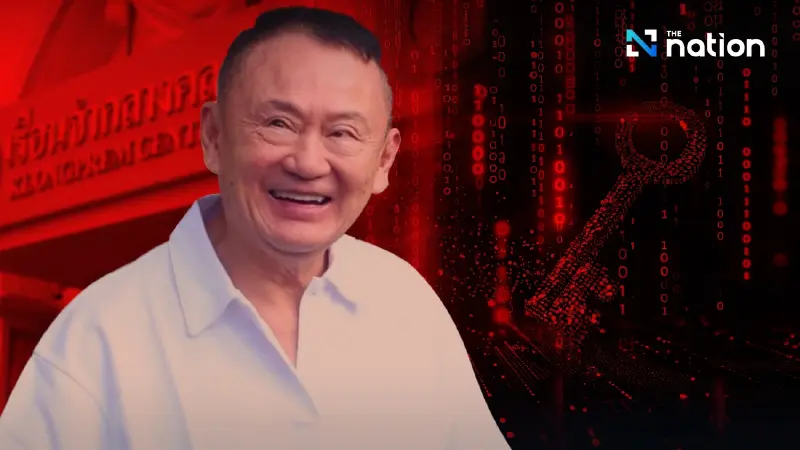


Thaksin Shinawatra’s release on parole may look like freedom, but his legal risks and political influence remain central to Pheu Thai’s next moves.
- Despite being in custody for eight months, Thaksin Shinawatra's "hibernation" was not a political halt; he continued to direct his Pheu Thai party and communicate with associates.
- His newfound freedom is conditional, described as "freedom in chains," as he remains on parole with an electronic monitor, faces ongoing legal cases, and must calculate his moves carefully.
- Thaksin is expected to avoid a direct front-stage political role and instead operate as a "behind-the-scenes director," shaping strategy and wielding influence without a formal position.
- He remains the "centre of gravity" and "spiritual leader" for the Pheu Thai party, which continues to rely on his direction and brand for momentum.
“I went into hibernation for eight months. Now I can’t remember anything.”
That was the answer former prime minister Thaksin Shinawatra gave to red-shirt supporters who had gathered in front of his Chan Song La residence after he was granted parole on May 11.

It may have sounded like the relaxed remark of a man who had just regained his freedom. But in Thai politics, no one believes that Thaksin’s eight months in prison meant a complete halt to everything political.
On the contrary, it may have been the period in which he “thought the most”. His so-called “political hibernation” may have appeared quiet and inactive, but people inside Pheu Thai know well that their “big boss” had not stopped and had not let go.
For a politician like Thaksin, even if his body was inside prison and his freedom was restricted, his networks, power, relationships and political game were not imprisoned with him.
Although Thaksin also said he felt “relieved”, the truth is that Thai politics may now be entering a period in which it is others who are beginning to feel less relaxed, as the man named Thaksin regains his freedom — even if that freedom still comes with chains attached.

Over the past eight months, information still reached him, close associates were still able to visit, and, importantly, “not-so-secret characters” at former ministerial level continued to shuttle between sides, coordinating instructions and communicating political direction from the prison on an ongoing basis.
The same applies to people inside Pheu Thai, who continued to move in response to signals from Chan Song La throughout that period.
It is clear that Thaksin may have had his freedom restricted, but he never left the game. It was merely a pause to reset the board.
From now on, this may mark the beginning of a new chapter in Thaksin’s political life.

Freedom with conditions
Although Thaksin has been granted parole, the reality is that the next four months remain a form of “freedom in chains”.
His liberty is still not complete. The electronic monitoring bracelet remains in place. Probation conditions still apply. The Section 112 case, for which an appeal has been filed, has not ended. And the 14th-floor issue at the Police General Hospital — a case in which someone has been found to have done wrong — remains a political time bomb sitting beside Thaksin at all times, waiting only for someone to file a complaint alleging that he was the beneficiary.
Although Thaksin has left prison, he has not escaped the “lawfare encirclement”.
Every move he makes from now on must therefore be calculated on several levels. If he returns to front-stage politics openly and in full view, he may create an opening for opponents to revive old cases and apply pressure again. The risks would only increase.

This is especially true at a time when his daughter, Paetongtarn, remains a core figure in Pheu Thai and faces political risks of her own in several cases from her time as prime minister, which still hang over her.
It should not be forgotten that Pheu Thai is no longer the No. 1 party. With 78 seats in the House, it has become the second-largest coalition party under Anutin’s government, with Bhumjaithai taking the lead. That has changed Pheu Thai’s status from “game-setter” to a party that must play by someone else’s game — a complete departure from the past.
The most likely scenario in Thaksin’s political return, therefore, may be one of keeping a certain distance: not advancing too aggressively, not moving too forcefully, but not disappearing either.

Pheu Thai still orbits Thaksin’s gravity
Even so, for Pheu Thai, Thaksin’s name remains the party’s centre of gravity.
Even the decision on whether to field Bangkok councillor candidates under the Pheu Thai banner has reportedly had to wait for the “big boss” to come out first, so that he could read the game and assess the situation.
Symbolically, Thaksin remains the “spiritual leader” of both the party and the red-shirt masses. At a time when the Pheu Thai brand is beginning to lose strength, the party needs a “momentum-builder” more than ever.
As the brand weakens, another major challenge is that Pheu Thai is now in a period of transition. Its current is not as strong as during the landslide era. Parts of its support base are beginning to waver, while the younger generation in the party has yet to build the same level of “political prestige” as Thaksin.
Although Pheu Thai has tried to restructure and place younger figures in roles to drive the party forward — especially Dr Yodchanan Wongsawat, the prime ministerial candidate whose name has been discussed more frequently as the next-generation heir who works hard on the ground — the problem is that Thai politics is not measured only by diligence. It is also measured by faith, charisma and the aura of power. On these fronts, Thaksin still surpasses almost everyone else in the party.
Therefore, if the party wants to push a political heir forward as a real replacement, that person must fit into an equation accepted by the old centre of power, Thaksin. Put simply: they may rise, but only as a “game manager”, not the “owner of the game”.

From leading actor to behind-the-scenes director?
Many people close to Thaksin want to see him rest, spend time with his family, look after his grandchildren as he once said he would, and pass the baton to the younger generation. But the reality that has emerged is that Thaksin has never let go — and cannot bring himself to do so.
The lively scenes outside the prison and later at Chan Song La, where red-shirt supporters gathered to welcome him, may be a phenomenon that reassures Thaksin that his own brand can still sell, even if it is not as powerful as it was in the landslide era. What is also interesting is that Pheu Thai politicians still orbit around him.
Judging by Thaksin’s style — the style of someone who must set the game and does not let it drift while others play it — the political question from now on is not whether the former prime minister will return to political involvement. The real question is: “What role will Thaksin return in?”
The continued media attention, the calls from supporters, and the steady flow of politicians to Chan Song La all reflect the fact that his influence is not ending easily.
If past lessons are decoded, then after eight months of “hibernation”, and during a period in which he has still not formally completed his sentence, the key signal to watch is whether Thaksin chooses the role of “behind-the-scenes director” — reducing his front-stage role while increasing his influence behind the curtain.
There is also talk from within Pheu Thai that Thaksin may speak only on subjects he is familiar with, such as economic problems and policy proposals, adopting the image of a senior figure offering advice rather than a full-time politician.
His real role, however, may lie in shaping election strategy, balancing power groups within the party and quietly controlling political deals — the formula of “power without position” that Thaksin knows best.
Because in Thai politics, the person who is not on the front stage may sometimes be the one who determines how the entire story ends.
For Thaksin, this freedom may not be a return to an ordinary life. It may instead be the start of “chapter one” of a new political act.
He may no longer stand in the centre of the spotlight, but he may still be the person deciding who the spotlight shines on.
