
Royal Ploughing Ceremony returns with centuries-old traditions
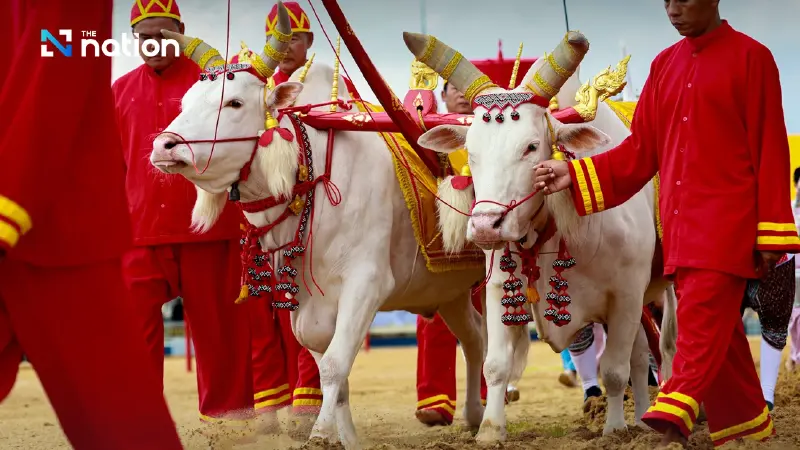


Thailand prepares for the Royal Ploughing Ceremony, an ancient royal rite tracing back to the Sukhothai era and linked to farming prosperity
Thailand will hold the Royal Ploughing Ceremony on May 12-13, continuing one of the country’s oldest royal traditions and reaffirming the historic bond between the monarchy, agriculture and the Thai people.
The ceremony is formally made up of two rites. The first is the Royal Cultivation Ceremony, a Buddhist rite held at the Temple of the Emerald Buddha in the Grand Palace. The second is the Royal Ploughing Ceremony, a Brahmin rite held the following morning at Sanam Luang.
This year, Their Majesties the King and Queen are scheduled to preside over the Buddhist rite on Tuesday, May 12, at 5pm. The Royal Ploughing Ceremony will take place at Sanam Luang on Wednesday, May 13, with the auspicious time set between 8.09am and 8.39am.
The Royal Ploughing Ceremony dates back to the Sukhothai period, when the king presided over the ritual but did not personally plough the field. The ceremony was intended to encourage cultivation, strengthen farmers’ morale and mark the beginning of the rice-growing season.

During the Ayutthaya period, the practice changed. The monarch no longer presided over the ceremony in person and instead observed three days of quiet religious discipline. Royal authority was granted to Chao Phraya Chanthakuman, who acted as the king’s representative in performing the rite. This practice continued until the late Ayutthaya period.
In the early Rattanakosin era, the ceremony was performed from the reign of King Rama I. The duty of carrying out the first ploughing was later assigned to Chao Phraya Phonlathep and was linked with the Swing Ceremony. During the reign of King Rama III, the person who performed the Swing Ceremony was also regarded as the one responsible for the first ploughing.
The ceremony took its present combined form during the reign of King Rama IV, who ordered Buddhist rites to be added to various royal ceremonies. From that period, the Buddhist Royal Cultivation Ceremony was joined with the Brahmin Royal Ploughing Ceremony, creating the combined royal rite known today as the Royal Ploughing Ceremony and Royal Cultivation Ceremony.
The purpose of the ceremony was explained by King Rama V in The Royal Ceremonies of the Twelve Months. His Majesty wrote that first ploughing had long been a duty of rulers because it set an example for the people and encouraged them to take up rice farming with confidence. Rice cultivation was essential to the livelihood of the people and the prosperity of the kingdom.

The ceremony also reflects ancient concerns over natural risks facing farmers, including too much or too little rain, pests and other threats to crops. Its rituals combine prayer, Buddhist merit-making and Brahmin offerings to seek blessing, reassurance and signs for the farming year ahead.
The ceremony is held in the sixth lunar month, usually in May, which is considered an appropriate time to begin rice cultivation. Unlike some other royal ceremonies, the date is not fixed each year but is selected according to an auspicious time.
The full traditional ceremony was last performed in 1936 before being suspended. It was revived in 1960 after the Cabinet resolved to restore the royal tradition, recognising its value in preserving national heritage and strengthening public morale.
After the revival, His Majesty King Bhumibol Adulyadej The Great ordered some parts of the ceremony to be adjusted to suit the modern era and presided over the ceremony every year thereafter.
In the early years after the revival, the Lord of the Ploughing Ceremony was the director-general of the Rice Department, while the four celestial maidens were selected from wives of senior officials in the Ministry of Agriculture and Cooperatives.
Today, the Lord of the Ploughing Ceremony is the permanent secretary of the Ministry of Agriculture and Cooperatives. The four celestial maidens, who carry gold and silver baskets, are selected from unmarried female civil servants under the ministry who meet official rank and royal decoration requirements.
The Royal Cultivation Ceremony is a blessing rite for grains and food crops. The king offers prayers for abundance across the kingdom, with rice regarded as the main food of the people. Other edible crops, including beans and sesame, are also included in the rite.
The grains used in the ceremony include both ordinary rice and glutinous rice, as well as 40 types of crop seeds packed in white cloth bags, together with tubers and other plant varieties capable of germination.
The rice seeds used in the ploughing ceremony are high-quality varieties grown under royal projects at Chitralada Villa. Some are scattered during the ceremony, while the remaining seeds are packed and distributed to farmers and people nationwide as an auspicious blessing for the planting season.
Since 1966, the Cabinet has also designated the day of the Royal Ploughing Ceremony as Farmers’ Day, encouraging people to recognise the importance of agriculture and its contribution to the country’s economy.


