
Ishiba, Lee vow to promote forward-looking Japan-S. Korea ties
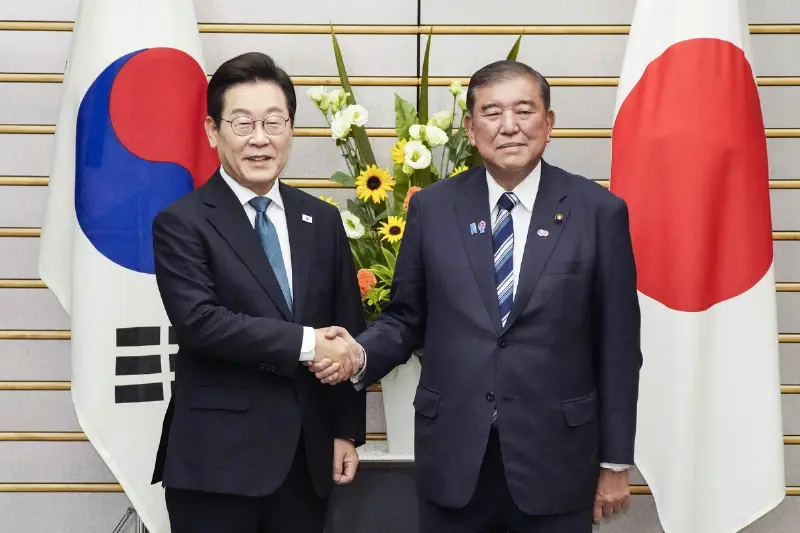


Japanese Prime Minister Shigeru Ishiba and South Korean President Lee Jae-myung on Saturday agreed to promote relations between the two countries in a stable and forward-looking manner by building on the foundations developed since the normalisation of their diplomatic ties 60 years ago.
In their meeting at the Japanese prime minister's office in Tokyo, Ishiba said he upholds the previous Japanese cabinets' recognition of history, including a 1998 Japan-South Korea joint declaration that included Tokyo's remorse and apology over Japan's wartime colonial rule of the Korean Peninsula.
"I hope we can move forward toward a better future hand in hand," Ishiba said at a joint press conference after the meeting. Lee said he hopes that his visit to Japan will be the beginning of a journey to build up true trust between the people of the two countries.
Ishiba and Lee welcomed the resumption of "shuttle diplomacy" between Japan and South Korea, or mutual trips by their leaders to each other's country.
The two leaders agreed that Japan, the United States and South Korea will promote their three-way collaboration to counter military threats from China and an alliance between North Korea and Russia.
The Japanese and South Korean leaders reaffirmed that the two countries will strengthen strategic security communication and promote cooperation in advanced industries such as hydrogen and artificial intelligence.
They also agreed to start discussions on social challenges, including an ageing population and regional revitalisation. Japan and South Korea will enhance working holiday programs between the two countries.
The two governments released a joint press release to outline the achievements of the roughly two-hour summit, the first joint document between Japanese and South Korean leaders in 17 years.
Lee travelled to Japan for the first time since he took office in June. He became the first South Korean president to visit Japan for bilateral diplomacy before a trip to the United States, a major ally, since the 1965 normalisation of Japan-South Korea relations.

[Copyright The Jiji Press, Ltd.]
