
Japan to pour US$68bn into AI, chips and start-ups in India
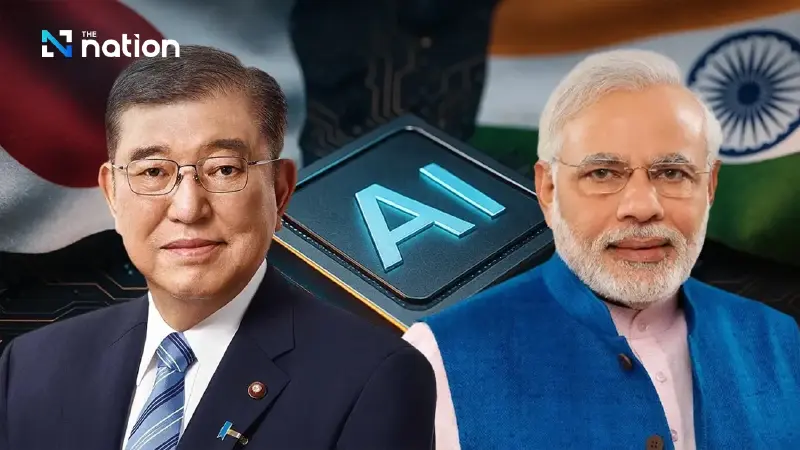


Tokyo will invest over US$68 billion in AI, semiconductors, healthcare, environment and start-ups over the next decade, while doubling the intake of Indian specialists to ease its labour shortage.
Nikkei Asia has reported that Japanese Prime Minister Shigeru Ishiba is preparing to announce a US$68 billion (about 2.2 trillion baht) investment initiative aimed at strengthening business relations with India over the next decade, during his summit with Indian Prime Minister Narendra Modi beginning this Friday.
The package will support Japanese companies in expanding into India in fields such as artificial intelligence (AI) and semiconductors, while also creating more opportunities for Indian specialists to work in Japan.
The initiative is designed to stimulate India’s economy through closer bilateral business ties.
Modi is scheduled to arrive in Japan on Friday, where the two leaders are expected to update their joint security statement for the first time in 17 years.
Ten-year cooperation blueprint
Tokyo and New Delhi are set to launch a 10-year cooperation framework, including the 2.2-trillion-baht investment, focusing on eight key sectors such as transportation, logistics, environment and healthcare.
Discussions will also cover the establishment of a young researcher exchange programme in AI under a new “AI cooperation project,” which will apply AI solutions to address social issues.
At the same time, India is keen to draw on Japan’s strengths in semiconductor materials and equipment.
On Saturday, Ishiba and Modi will tour Tokyo Electron’s semiconductor equipment plant in Miyagi prefecture, where they will also visit its customer training centre, a chance for Japan to showcase its technological edge.
Expanding investment and talent exchange
Japan will further expand investment support for Indian start-ups, building on Japan International Cooperation Agency (JICA)’s past yen-denominated loans to tech firms in Telangana state, India’s IT hub.
Facing an estimated shortfall of 790,000 highly skilled tech workers by 2030, Tokyo plans to take in more Indian specialists, while India produces around 1.5 million engineering graduates each year.
For this reason, Ishiba is set to announce Tokyo’s commitment to welcoming more specialists in semiconductors and advanced technologies. Over the past five years, about 25,000 skilled Indian professionals have come to Japan for work, study or training.
Ishiba said Japan would double this figure over the next five years, in line with the growing labour shortage faced by Japanese companies.”
Some Japanese companies are already moving ahead. Sompo Care, an elderly care provider, has begun employing and training Indian staff, with the first batch already working in Japan after training at a facility it set up in India in 2024.
Similarly, energy firm Sekisho has launched a student–business matching programme linking Indian graduates with Japanese firms. In August, Sekisho established a subsidiary in India to support students and Japanese companies with language training and job placement, focusing particularly on regional firms in Japan.
