
Japan Shipbuilding Industry in Focus over Cooperation with US
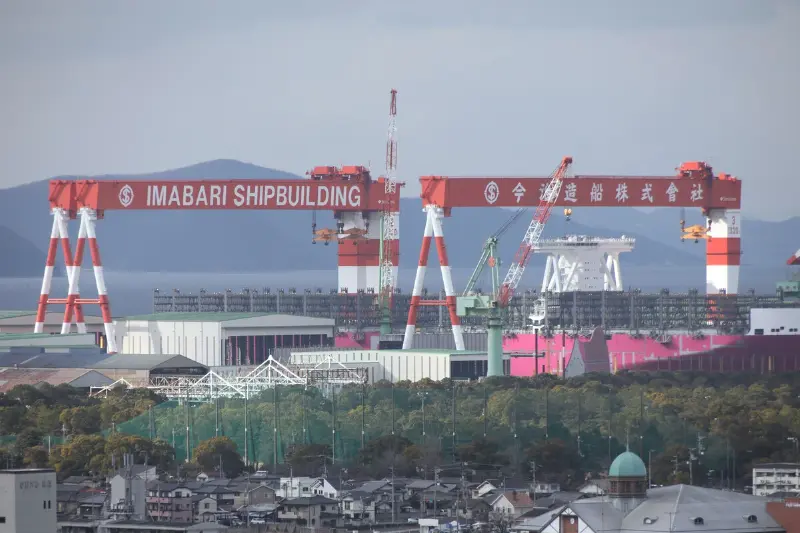


Japan's shipbuilding sector is in the spotlight after Tokyo agreed to help the United States revive its declining shipyard industry, but challenges such as the lack of workers and decarbonization lie ahead.
Japan was once a shipbuilding behemoth that produced over 50 % of the world's new vessels, but it has since fallen behind China and South Korea. The Japanese government plans to draw up a road map to boost the industry around this autumn.
Tokyo and Washington signed a memorandum Sept. 4 that calls for investing 550 billion dollars in the United States, including in its shipbuilding sector.
"It's a once-in-a-lifetime opportunity," Masatoshi Ishida, chairman of the ruling Liberal Democratic Party's Special Committee on Marine Transportation and Shipbuilding, said of the cooperation.
The LDP submitted to the government in June an emergency proposal for revitalizing the Japanese shipbuilding sector, arguing that "the death of the shipbuilding industry means the death of the country." It called on the government to draw up a road map by autumn that includes concrete measures as well as the sizes of investments from the public and private sectors.
In response, the transport ministry included in its budget request for fiscal 2026 new or increased funds for automating ship production and for decarbonizing ship fuel. It also made a request on cooperation with the United States without specifying the fund amount, as details have yet to be decided.
Japan had led the world in ship production volume since the late 1950s until the industry was battered by oil crises and the appreciation of the yen following the Plaza Accord. Chinese and South Korean shipbuilders, backed by hefty government aid, overtook Japanese rivals in the 1990s, and Japan's market share now stands at under 20 %.
Major heavy industry companies such as Mitsubishi Heavy Industries Ltd. have downsized their shipbuilding operations, and many shipyards have been shut down. The shipbuilding labour force has shrunk and aged, with one former industry official saying that it is too late to revive the sector.
On the other hand, many companies specialising in shipbuilding are optimistic about the Japan-US cooperation.
"The government is finally paying attention to us," said Yukito Higaki, president of the largest of such firms, Imabari Shipbuilding Co. "We will introduce robots and artificial intelligence to improve utilisation rates."
In a bid to expand its global market share, Imabari Shipbuilding announced in June a plan to make Japan Marine United Corp., the second-largest specialised shipbuilder in Japan, a subsidiary.
"The Japanese shipbuilding industry may survive with a certain market presence if a revival can be carried out according to plan with government support," said Toshitsugu Uesugi of the Deloitte Tohmatsu group. "The next two to three years will be a turning point."

[Copyright The Jiji Press, Ltd.]
