
APEC CEO Summit opens amid calls for cooperation, resilience
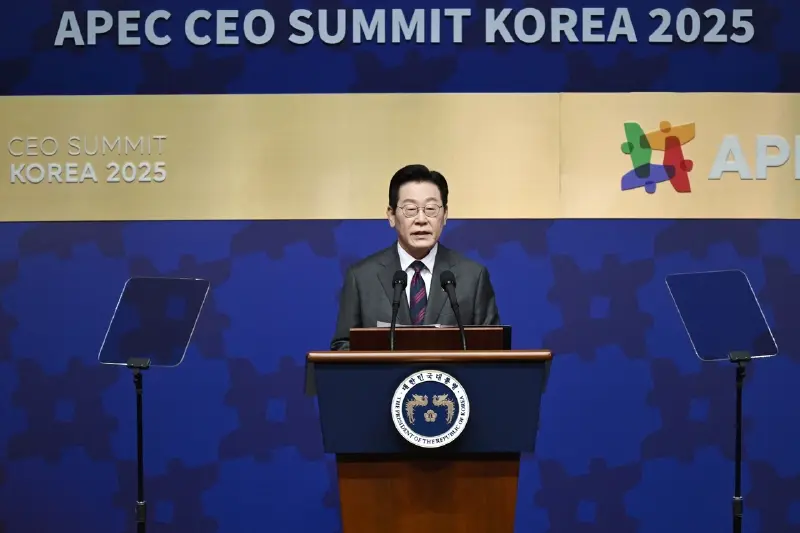


Business and political leaders from across the Asia-Pacific region convened on Wednesday for the opening of the APEC CEO Summit, calling for greater multilateral cooperation and supply chain resilience to address escalating global challenges ranging from technological disruption to climate change.
The three-day forum, organised by the Korea Chamber of Commerce and Industry, brought together more than 1,700 global tycoons, leaders of APEC economies and renowned experts for discussions on artificial intelligence, digital innovation and partnership opportunities. This year’s summit, marking its 30th anniversary, is the largest in the event’s history in terms of the number of sessions, participating speakers, and high-level attendees, according to the KCCI.
Opening the event, South Korean President Lee Jae Myung vowed that Korea, as chair of this year’s APEC summit, will spearhead efforts to strengthen multilateral cooperation and resilience amid growing trade protectionism and economic uncertainty.
“In an era where trade protectionism and policies focused on national interests are rearing their heads and when immediate survival is urgent, cooperation, coexistence and inclusive growth may sound hollow. But this is when APEC’s value as a platform for solidarity shines most," he said.
Lee said past crises have repeatedly shown that cooperation and solidarity rooted in mutual trust is the best way to achieve shared prosperity, also stressing supply chain cooperation as the "core" of the solidarity.
“Even in the face of the global (COVID-19) pandemic, APEC economies worked together to keep goods and resources moving. Now, 20 years after Korea brought together APEC's cooperation, we are once again ready to lead the way for renewed collaboration,” Lee said in reference to the 2005 APEC meetings in Busan.
In one of the day’s most anticipated appearances, US President Donald Trump underscored the importance of strong economic ties with APEC economies as crucial for prosperity, highlighting Washington's partnership with Seoul.
“We’re serious partners,” Trump said. “We’re really — we’re wedded, and we have a very special relationship, a special bond,” he said, pointing to cooperation in shipbuilding efforts between firms from South Korea and the US.

“We’re going to have a very thriving, very thriving shipbuilding industry, and we’re working it with South Korea very much,” Trump said, mentioning South Korea’s Hanwha Group’s acquisition of Philly Shipyards.
He added that on his trip to Asia, the US has signed “ground-breaking agreements” with Malaysia, Cambodia and Japan, and said the trade deal with South Korea will be “finalised very soon.”
“These agreements will be incredible victories for all of us because everyone is better off when we have stable partnerships, not plagued by chronic problems and imbalances.”
He also added that the US is “going to have a deal” with China, and it will be a “good deal for both,” as Trump is poised to hold a summit with Chinese President Xi Jinping on Thursday in Busan.
In his opening remarks, SK Group Chief Chey Tae-won, who chairs the APEC CEO Summit as the head of KCCI, also echoed concerns about multiple challenges amid a fast-changing environment.
“The global economy is now going through a massive wave of transformation,” he said. “We are facing many challenges at once — like supply chain shifts, competition for AI and new technologies, digital transformation and the climate crisis, too.”

Chey stressed that these uncertainties are a reason why partnerships between APEC economies are critical, in areas of trade and investment ties, technology partnerships, as well as achieving sustainability going forward.
“Companies must go beyond creating jobs and profits. They must design a future with the government and society to achieve sustainable development.”
In his keynote session, OECD Secretary-General Mathias Cormann said that despite the world economy being “remarkably resilient” throughout the first half of this year, with a 3.2 per cent annual growth rate, it is expected to slow further to 2.9 per cent in 2026.

“Additional increases in barriers to trade or prolonged policy uncertainty could lower growth further by raising production costs and weighing on investment and consumption,” said Cormann.
He added that economies across the Asia Pacific would be among the most affected by any further trade fragmentation, “given deeper integration in global supply chains and higher dependency on trade in intermediate goods.”
He called for constructive dialogue between countries to resolve trade tensions.
“Our strong advice to all governments is to work harder. Work harder bilaterally and multilaterally to find the best possible ways to make our international trading arrangements fairer and function better, in a way that preserves the economic benefits of open markets and rules-based global trading systems. “

The APEC CEO Summit gathered major executives from South Korea and around the world. The event runs parallel to the annual APEC Economic Leaders’ Meeting, held from Friday to Saturday.
Among the attendees on Wednesday were heads of major South Korean conglomerates, including Samsung Electronics Chair Lee Jae-yong, Hyundai Motor Chair Chung Euisun, LG Group Chair Koo Kwang-mo, Lotte Group Chair Shin Dong-bin, POSCO Holdings Chair Chang In-hwa and GS Group Chair Huh Tae-soo, as well as global executives, including Amawon Web Services CEO Matt Garman, David Hill, CEO of Deloitte Asia Pacific, Google’s Chief Marketing Officer for Asia Pacific Simon Kahn, Citigroup CEO Jane Fraser and Johnson & Johnson CEO Joaquin Duato, among others.
Throughout the day, business executives and leaders in technology, retail and AI, culture, and nongovernment organisations emphasised the importance of cooperating with APEC economies to drive innovation and growth.

“AI is becoming a tool that seamlessly connects the digital ecosystem, but its true value depends on trust and cooperation,” said Naver CEO Choi Soo-yeon. “The power and environmental issues surrounding AI data centres are challenges that call for our collective effort.”
In the retail sector, GS1, the global non-profit organisation for barcode standardisation, stressed that digital transformation offers enormous potential for retail and trade, but the benefits can only be realised through trusted data and cooperation among all stakeholders.
“Digital tools can also improve product safety and make trade more efficient. Yet, to realise these benefits, trading partners need to share data, quality data across the entire value chain,” said GS1 CEO Renaud de Barbuat. “Without trusted data, none of those opportunities can be fully realised.”

RM, the leader of global K-pop sensation BTS, also took the stage, describing K-pop as bibimbap, a traditional Korean mixed rice dish, highlighting the genre’s ability to embrace different elements of hip-hop, R&B and EDM from the West, while combining them with Korea’s own aesthetics, emotions and production system.
K-pop’s global success, he said, does not stem from the superiority of one culture, but from its ability to respect “diversity and embracing world cultures, but still holding onto Korea’s unique identity.”
“When cultural barriers come down and different voices harmonise together, there is an explosion of creative energy,” said RM. “I'd like to see this creative flow of culture happen everywhere around the world, and the Asia Pacific region has incredible dynamic cultural diversity.”
Ahn Sung-mi
The Korea Herald
Asia News Network
