
‘We’ll run the country’: Trump’s Venezuela move tests ‘America First’ pledge
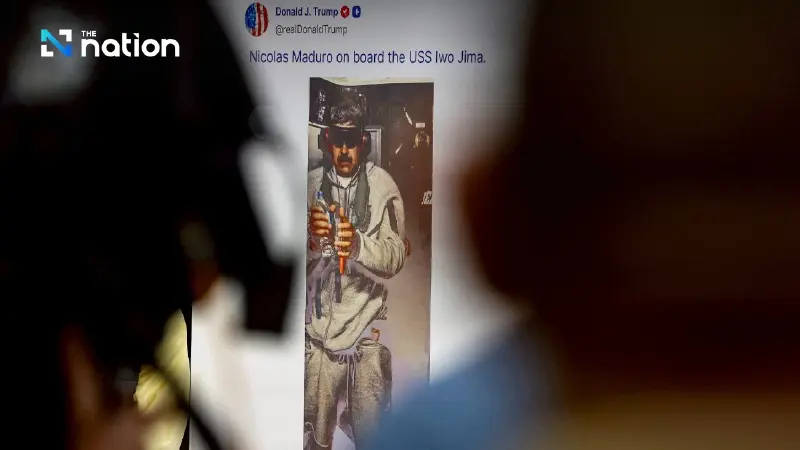


President Donald Trump has signalled an open-ended US role in Venezuela after ordering strikes, detaining President Nicolás Maduro and saying Washington would effectively take charge during a transition, a posture that clashes with his long-running warnings against foreign “adventures”.
Speaking at a daytime news conference on Saturday( January 3), Trump framed the intervention as a security and energy priority, arguing that the United States needed “stable” neighbours and pointing to Venezuela’s vast oil reserves.
But his remarks also suggested the possibility of deeper military involvement, continued influence over Caracas’s politics and the prospect of US forces being deployed.
Trump said the United States would “run” Venezuela until a “safe” and “proper” handover could be arranged, without offering detailed parameters for what that would mean in practice or how long it might last.
He also gave little indication of how far he would go to consolidate control in a country where Maduro’s senior allies appeared to remain in positions of authority.
A sharper turn than Trump’s past rhetoric
Trump has often contrasted himself with leaders he accused of overextending US power abroad, promising to avoid entanglements and measure success not only by wars won, but by wars ended, and those avoided altogether.
Yet since taking office for a second time, he has authorised a series of overseas strikes in multiple theatres and issued threats that critics say sit uneasily with his “America First” message.
The operation in Venezuela, which hit Caracas and other locations overnight and ended with Maduro and his wife taken into custody to face drug-trafficking charges in New York, was described by observers as his most forceful military action to date.

The escalation also risks complicating Republican hopes that Trump will keep attention on domestic priorities, such as prices, healthcare, and economic growth.
Pushback from both parties — and inside MAGA
Democrats quickly cast the operation as reckless, focusing on the absence of congressional authorisation and the lack of a publicly defined plan for what comes next. Senate Minority Leader Chuck Schumer said intervening militarily without approval from Congress or a clear post-conflict strategy was dangerous.
The developing row could also become an election issue. With mid-term congressional elections in November expected to be decided by slim margins, Democrats may try to portray the president’s foreign policy as erratic or risky. Republicans currently hold narrow control of both chambers, which has largely eased Trump’s path for his wider agenda.

There were signs of unease among some of Trump’s own supporters as well. Republican Representative Marjorie Taylor Greene, who has criticised what she sees as a departure from limiting foreign involvement, posted that the intervention was the kind of move many in the MAGA movement thought they were voting to stop. She has said she will resign from Congress next week.
Public scepticism and a familiar historical pattern
Polling before the attack suggested limited public appetite for military action to remove Maduro, with only around one in five Americans backing the use of force in Venezuela, according to a Reuters/Ipsos survey conducted in November.
Analysts also noted echoes of earlier Republican-led interventions in Latin America.
The US invasion of Grenada in 1983 and the Panama operation in 1989 were cited as precedents in which Washington challenged the legitimacy of governments and, in Panama’s case, helped install a successor after removing a leader wanted on US drug charges.
Trump, who has repeatedly criticised the foreign-policy “neoconservatives” of past decades, now finds his approach being compared to those episodes, a contrast likely to intensify as the consequences of the Venezuela operation unfold.
Rubio’s calls and a GOP debate over presidential powers
Marco Rubio, Trump’s top diplomat and national security adviser, contacted members of Congress early on Saturday in an effort to soften opposition and reassure lawmakers.
Senator Mike Lee, who initially questioned whether the president could launch military action without a declaration of war or authorisation to use force, later said he believed the operation probably fell within the president’s authority after speaking with Rubio.
Others were unconvinced. Representative Thomas Massie, a frequent Trump critic, argued the administration’s messaging did not add up, and questioned the legal and constitutional logic of arresting the leader of a sovereign state and his wife on US charges.
The biggest question: what does “running” Venezuela mean?
Even some voices sympathetic to Maduro’s removal warned that the hardest part may now be ahead. Elliott Abrams, who served as Trump’s Venezuela envoy during his first term, said the political risk at home could be manageable so long as US troops were not dying, but questioned what “running” the country would actually involve.
Brett Bruen, a former adviser in Barack Obama’s administration, warned the US could be drawn into overseeing an intricate and prolonged transition, a scenario that could create spillover problems in the region and new challenges for Washington.
For now, Trump is betting that the intervention can be sold as consistent with his “America First” worldview, safeguarding US interests by reshaping an unstable neighbour. But with unanswered questions about governance, security and the scope of US involvement, critics argue the move could become exactly the kind of quagmire he once vowed to avoid.
US seizes Venezuela’s Maduro, flies him to New York to face drug and ‘narco-terror’ charges
The United States launched overnight strikes in Venezuela and captured President Nicolás Maduro, flying him and his wife, Cilia Flores, to New York as US prosecutors prepared to bring the long-serving leader before a federal court on charges including narco-terrorism conspiracy and drug trafficking, according to Reuters and other media reports.


US President Donald Trump, speaking at Mar-a-Lago in Florida, said the operation involved US Special Forces and ended with Maduro being detained in or near one of his safe houses.

Trump said Washington would oversee Venezuela “until” what he described as a safe and orderly transition, but did not spell out how the US would exercise authority inside a country where Maduro’s administration still appeared to be functioning.
Multiple outlets reported that a plane carrying Maduro and Flores landed at Stewart International Airport in upstate New York on Saturday evening, and video showed US personnel boarding the aircraft after it arrived.
A US Justice Department official told Reuters that Maduro is expected to make an initial appearance in Manhattan federal court on Monday, and that he is expected to be held at the Metropolitan Detention Center in Brooklyn beforehand. The official said Flores also faces US charges, including a cocaine importation conspiracy allegation.
In Caracas, Vice President Delcy Rodríguez denounced the seizure as a “kidnapping” and demanded the immediate release of Maduro and Flores, calling Maduro “the only president of Venezuela.”
The operation has triggered immediate legal and diplomatic scrutiny. Reuters reported that international law experts questioned the US administration’s attempt to frame the action as a law-enforcement operation tied to US indictments while also signalling an intent to control Venezuela’s political future.
Reuters
