
Japanese restaurant numbers fall in Thailand for first time in 20 years
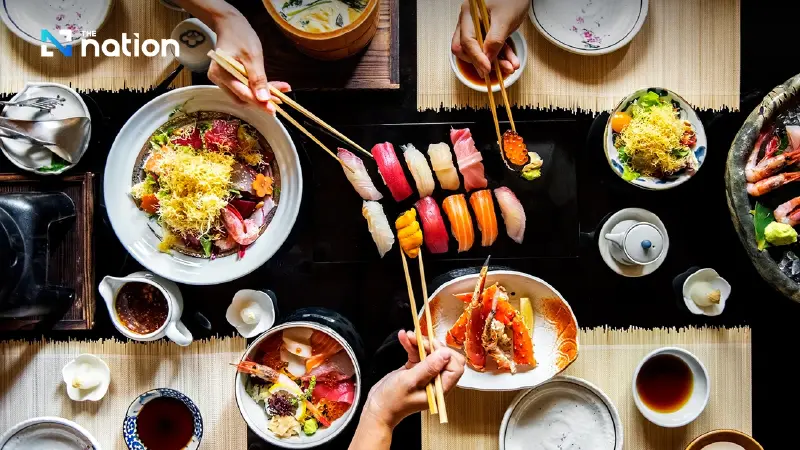


JETRO’s latest survey shows the sector is being squeezed by weaker spending power, higher costs and intense competition, forcing operators to rethink expansion plans.
- For the first time in nearly 20 years, the number of Japanese restaurants in Thailand has decreased, falling by 2.2% (135 outlets) in 2025, according to a JETRO survey.
- Key reasons for the decline include Thailand's slow economic recovery, reduced consumer purchasing power, intense market saturation, and rising operational costs for owners.
- The weak yen has also contributed, encouraging Thai consumers to travel to Japan for high-end dining experiences rather than spending on them locally.
- Mid-sized restaurant brands are the most affected and are closing at a higher rate, struggling to compete with the economies of scale of large chains and the agility of small, niche eateries.
Japanese restaurants have long remained one of Thailand’s most popular dining segments, ranging from small eateries to premium venues.
However, in 2026, the Japanese restaurant market is facing a major turning point, after the number of outlets fell for the first time in nearly 20 years.
Abe Ichiro, president of the Japan External Trade Organisation (JETRO) Bangkok, cited the 2025 survey of Japanese restaurants in Thailand, which found a total of 5,781 outlets nationwide, down 135 outlets, or 2.2%, from 5,916 the previous year.
This marked the first decline since the survey began, with contraction seen across all areas.
Bangkok fell by 2.3%, the five surrounding provinces by 3.1%, and upcountry provinces by 1.9%.
This reflects Thailand’s slow overall economic recovery, with consumer purchasing power yet to fully return, weighing on growth across the restaurant business as a whole.
At the same time, Thailand’s Japanese restaurant market is entering a more saturated phase.
Consumers are already highly familiar with Japanese cuisine, making it harder for new openings or branch expansion to drive growth as easily as before, especially in Bangkok, where outlet density is high, competition is intense, and expansion opportunities are increasingly limited.
Another key factor is the decline in the number of Japanese residents in Thailand and a drop in foreign tourists, which has affected the core customer base for certain Japanese restaurant segments.
Meanwhile, the yen’s continued weakness has encouraged more Thais to travel to Japan.

Some consumers have therefore held back on high-priced Japanese dining in Thailand, such as omakase, wagyu, and sake, choosing instead to spend on these experiences in Japan.
Operators are also under pressure from inflation, including rising rents, wages, and raw material costs.
Many have slowed investment plans, delayed branch expansion, or adjusted their business structures, leading to a faster cycle of openings and closures across the Japanese restaurant market.
Consumer behaviour, especially among younger diners, has also shifted towards choosing restaurants based on reviews and social media buzz.
This has boosted demand for more specialised Japanese concepts, such as ramen, tonkatsu, and Japanese-style hamburg steak, as well as Japanese cafés focused on niche ingredients, with matcha continuing to be a major tailwind.
Poramin “Min” Pruangmethangkul, chief executive officer and founder of Sompasuk Co., Ltd., or YUZU GROUP, told Thansettakij that competition in the Japanese restaurant business has clearly intensified this year.
What used to be competition based on product differentiation has now shifted towards price competition, driven by weaker purchasing power and greater price sensitivity.
Operators are facing pressure from imported ingredient costs, exchange rates, and logistics expenses that remain high, yet they cannot raise menu prices in line with costs, resulting in higher costs amid fierce competition.
He said the current market structure resembles a sandwich: large brands with strong capital and high liquidity can still keep their businesses afloat thanks to scale advantages, while small or new outlets, typically with lower costs and faster adaptation, still have a chance of survival.
However, the hardest-hit group is mid-sized brands, which must shoulder high management overheads, shared expenses, and back-end costs, but are not large enough to gain cost advantages, leading to more brands gradually disappearing from the market.
Amid economic uncertainty, Yuzu Group has shifted from branch expansion to renovating existing outlets.
It is pausing new openings in the short term and focusing on improving profitability per unit of space.
The strategy has begun with two core brands: Yuzu Suki (Japanese-style sukiyaki), which has nine branches and has already started rebranding some locations.
Meanwhile, Kogoro Katsu (tonkatsu) is undergoing a menu restructuring.
The group is also looking to introduce new, more affordable brands, while expanding delivery revenue through its cloud-kitchen brand “Nuea Na Boon”. Delivery currently accounts for 3–5% of total revenue.
This year, the company is targeting 10–15% growth.
Waruntorn Dangyai, an executive director and co-founder of Nigiwai Group Co., Ltd., which operates Japanese restaurant franchises, commented that Thailand’s overall economy over the past year has been clearly sluggish.
Consumer purchasing power continued to shrink throughout 2025 into early 2026, reflected in sales across the group’s restaurant chain, especially upcountry branches that sit in the mid-to-upper segment and are relatively high-priced, where sales have fallen noticeably.
This broader picture reflects the current Japanese restaurant market, which is now in a “red ocean” of intense competition.
Mid-tier restaurants that lack strong cost management systems, do not have central kitchens, or lack economies of scale, are gradually exiting the market, leaving mainly large brands with robust systems and a portion of small outlets with clear niche strengths.
Small Japanese restaurants requiring around THB2–3 million in investment, typically operating in shophouses, now have a relatively low chance of success under current conditions, as they cannot compete on costs with large brands.
Mid-sized brands that expand from one branch to two or three, while back-end systems remain unready, are the most heavily affected group and are steadily leaving the market.
By contrast, large brands with dozens of branches, central kitchens, and strong logistics systems can control costs and market widely, giving them the capacity to survive and continue expanding.
Small outlets that can still operate typically need an advantage, such as low rent, owning their land or building, hands-on owner management, and the ability to adapt quickly.
“We admit the economy has not fully recovered, so we choose to expand cautiously. These days, Japanese restaurants are as easy to open as a 7-Eleven, but not everyone will survive, especially mid-tier brands without supporting systems.”
For this year’s business plan, the company is set to open the first Nigiben branch at Don Mueang Airport on February 23, 2026, after Airports of Thailand (AOT)’s area approval process took a long time and was delayed by around three months.
The firm believes airports remain high-potential locations, as airports in major tourist destinations, such as Phuket, Chiang Mai, and Don Mueang, have foreign customers accounting for around 70%.
The company is targeting 12–15 additional branches this year, focusing mainly on Nigiben, with a revenue target of about THB200 million.
