
Japan local govts recover phosphorus from sewage sludge
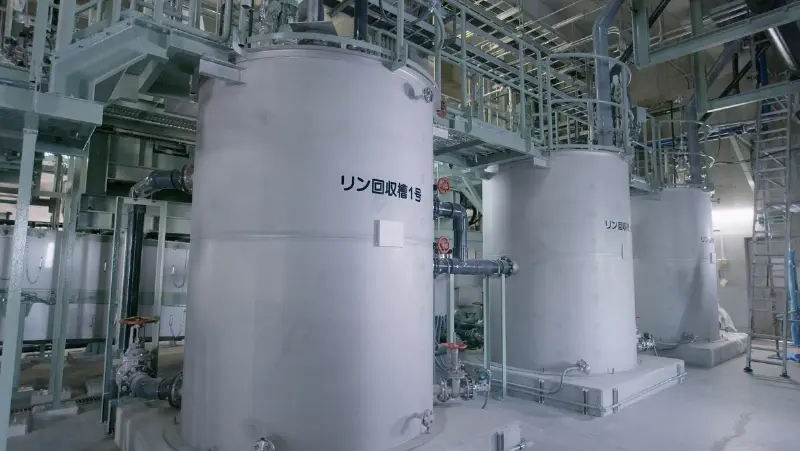


More Japanese local governments are extracting phosphorus from sewage sludge for fertiliser, aiming to reduce the country's reliance on imports amid increasing global prices reflecting the Middle East tensions.
Phosphorus, essential for crop cultivation, is imported almost entirely from abroad. Supply disruptions triggered by Russia's full-scale invasion of Ukraine in 2022 prompted the central government to promote fertiliser production from sewage sludge as part of efforts to strengthen food security.
Eight prefectural and municipal governments nationwide had 11 facilities to recover phosphorus from sewage sludge at the end of fiscal 2025, according to the infrastructure ministry.
Of the eight, Tokyo began operating a recovery system in January 2024 at its Sunamachi Water Reclamation Centre in Koto Ward.
The Japanese capital tested vegetable cultivation using fertiliser derived from recycled phosphorus. Its effects were "comparable" to those of conventional fertiliser, a metropolitan government official said.
The metropolitan government plans nationwide distribution of the fertiliser from fiscal 2026, cooperating with the National Federation of Agricultural Cooperative Associations, or Zen-Noh.

The southwestern city of Fukuoka, also among the eight, began operating a facility in April at its Seibu water treatment centre that can produce 300 tons annually. It is one of the country's largest phosphorus recovery facilities.
The Fukuoka centre uses technology that efficiently recovers phosphorus from sludge containing the chemical element at high concentration, achieving roughly the same recovery volume as conventional facilities, although it is only half their size.
Japan's annual phosphorus demand stands at about 300,000 tons, while sewage sludge generated nationwide each year contains an estimated 50,000 tons.
Production capacity, however, remains limited. The Sunamachi facility produces only about 70 tons annually.
"Production costs for recycled phosphorus are far higher than those of imports," a metropolitan government official said, adding that technological advances and public aid are key to cost reduction.

[Copyright The Jiji Press, Ltd.]
