
Thailand's green evolution: unlocking a clean future with advanced sustainable energy solutions


To position itself as a regional leader in sustainability, Thailand must turn to more advanced green solutions that can turbocharge its efforts to create a cleaner future.
Thailand stands at a pivotal moment in its journey towards decarbonization. Clear skies and fresh air are no longer just targets on paper but plans in motion. Since 2022, the country has set concrete climate targets: carbon neutrality by 2050 and net-zero greenhouse gas emissions by 2065.
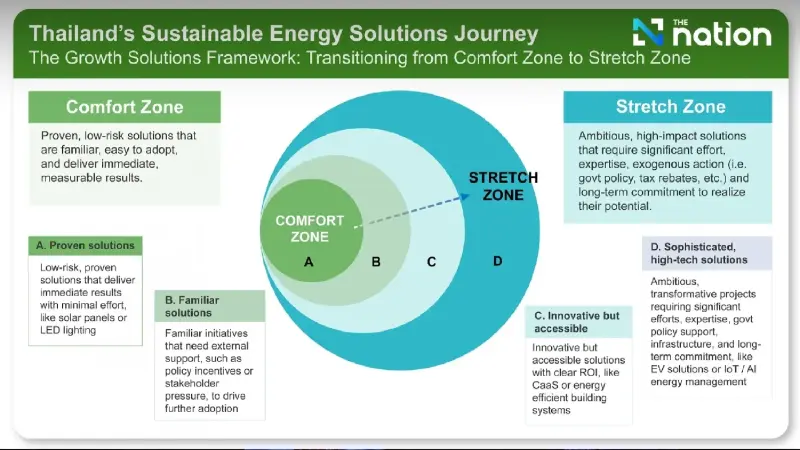
The good news is that businesses in Thailand have embraced low-barrier sustainable energy solutions such as solar photovoltaic (PV) systems, energy-efficient lighting, and waste reduction programs. But achieving ambitious national goals requires more than just incremental steps.
To position itself as a regional leader in sustainability, Thailand must turn to more advanced green solutions that can turbocharge its efforts to create a cleaner future.
The gap between ambition and reality
Thailand has laid a promising foundation using the Bio-Circular-Green (BCG) economy model. It aims to promote sustainability, strengthen communities, enhance industry competitiveness, and build resilience to global uncertainty.
For businesses that align with the model, the adoption of baseline sustainable energy solutions represents a major first step in going green. These technologies have gained traction for their clear benefits, offering some level of cost and energy savings with minimal disruption during implementation.
In fact, Thailand’s solar PV market is expected to grow, after the government announced a one-stop service centre in March to simplify solar panel installations for factories. While such moves by the authorities and firms are encouraging, these familiar, proven solutions are not the game changers Thailand needs in its sustainable energy journey.
A cross-industry survey in Thailand revealed that the basic sustainable energy solutions that businesses have widely adopted may fall short of delivering the transformative impact required for long-term climate goals and energy security. The insight was captured in a white paper by SP Group, a leading utilities group and sustainable energy solutions provider in Singapore and the Asia Pacific, titled “Unlocking Thailand's Sustainable Energy Future”.
The report also highlights a 'replication trap' – the tendency to repeat what has worked before rather than pursue new, integrated technologies that can drive a more significant sustainable impact. From a risk management standpoint, it makes sense for companies to deploy the dependable, but over time this limits progress towards low-carbon transformation.
What the next level could look like is, for instance, a large-scale district cooling system such as the one deployed at Government Complex Zone C that can reduce 3,000 tons of carbon emissions annually.
The gap between Thailand's climate targets and its current level of implementation is evident – the country aims to achieve an energy mix of 51 percent renewable energy by 2037, but only 19 percent of its power comes from renewable sources.
Thailand must ramp up its decarbonization plans and mitigate growing economic risks that extend far beyond environmental concerns. Global markets are rapidly shifting toward low-carbon products and services. In 2026, the European Union will implement the Carbon Border Adjustment Mechanism (CBAM), which penalizes imports from countries with weaker climate policies.
For Thailand’s export-driven economy, the policy is a countdown to push companies to act faster. But as businesses face greater pressure for change, they must also receive support to overcome longstanding structural challenges that may curtail their efforts.
From barrier to breakthrough solutions
Thailand's burgeoning sustainable energy rollout suggests a strong intent to decarbonize. With greater collaboration, the net-zero dream can be realized sooner.
Public-private partnerships play a significant role, especially if designed to streamline regulations that unlock green financing. Simplifying approval processes and offering blended finance models to small and medium-sized enterprises (SMEs) struggling with high upfront costs is one way Thailand can incentivize businesses to go beyond their comfort zone.
Another form of cooperation is knowledge sharing and workforce development programs. Many organizations hesitate to implement complex solutions as they may lack the technical expertise to manage such systems – energy management platforms powered by artificial intelligence (AI) require new skillsets.
Thailand’s Industry Ministry announced a five-point strategy in 2024 to support the country’s SMEs in upskilling to enhance productivity and competitiveness in several industries, including the green sector. By providing an avenue to build in-house capabilities, Thailand can empower its people to drive the country’s green transformation.
Stakeholder expectations are also evolving, especially as investors begin to gravitate towards companies that put sustainability at the heart of their operations. Organizations need to look past short-term returns, and pioneer pilot projects and lighthouse initiatives that lead the way for long-term success.
Ultimately, what's needed is a shift in perspective – from viewing sustainability as a cost, to seeing it as an investment in long-term competitiveness. Shaping new industry perceptions through success stories matters. Momentum builds when industry peers see that smart energy adoption leads to greater resilience, lower operational risks, and stronger stakeholder trust.
Leading the sustainable journey
Overcoming these hurdles will not happen by chance as it requires shared intent and a coordinated effort. One group that can play a crucial role is energy solution providers, who bring technical expertise and practical experience from more advanced markets to offer AI-driven energy management systems, district cooling, and partnerships with policymakers that address mutual challenges and opportunities.
Across the country, pioneering projects already demonstrate the possibilities, from university campuses combining solar panel installations with innovative building intelligence systems, to government developments saving energy through district-scale cooling.
As Thailand pursues net-zero emissions, the technologies to achieve these goals are already within reach. With decisive action, Thailand can set a benchmark for sustainable energy solution adoption and transformation, cementing its role as a regional leader in sustainability.
