
Never 100% while Hun Sen still calls the shots
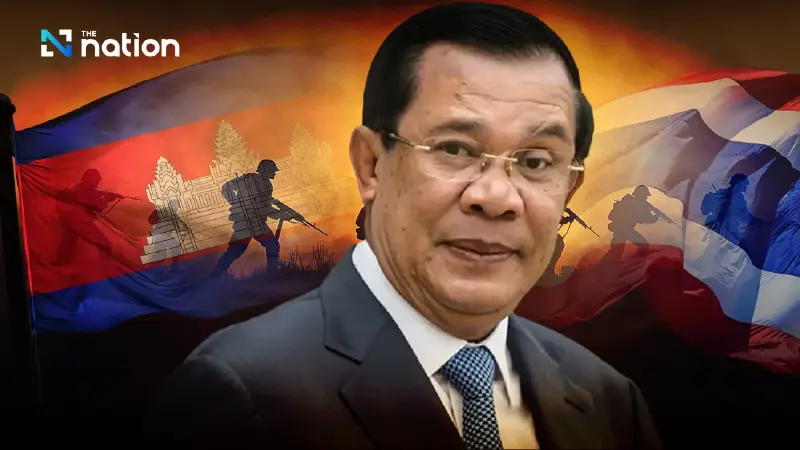


Thailand–Cambodia dispute shifts to ceasefire talks, but analysts warn peace won’t be 100% while Hun Sen remains influential
- At this point, positions from all sides are strikingly clear and aligned: the Thailand–Cambodia dispute is moving into a “negotiation mode” and preparations for a ceasefire agreement are under way.
- At the same time, there are clear signals from Thailand’s military operations and security work that it is preparing for talks and a ceasefire deal.
- As long as major powers still view Cambodia as important—possibly more important than Thailand in the current context—a key indicator is whether someone like Hun Sen remains in power.
- The real test for Thailand is how it can leverage major-power influence to dismantle the “Hun Sen system” and establish a new peace with its old neighbour, Cambodia.
Fifteen days into the fighting between Thailand and Cambodia, the overall picture is that Thailand holds the advantage.
That is hardly new. Long before the first shots were fired, most people already assumed that if it came to war, Thailand would come out on top because it is stronger on nearly every front.
So the goal is not simply to win. It is to reduce Cambodia’s capacity to pose a threat for as long as possible, as Thai military leaders have repeatedly stated.
How the two countries might rebuild relations as neighbours—neighbours who cannot “move away” from one another—is a separate question that will have to be thought through later. The Thai military, the government, and much of Thai public sentiment have already chosen the current path.
The latest situation can be summed up as follows:
- Thai forces have secured Hill 350, taking control of the area.
- The bodies of two soldiers—hailed as “heroes of Hill 350”—have been recovered and sent to the rear for religious rites.
- Military operations continue, focusing on BM-21 positions, ammunition stores, troop concentrations, as well as casinos and other civilian-front buildings allegedly used to conceal firing points and troop bases.
- Thailand has struck Cambodia’s logistics routes—targeting movements of troops, weapons and supplies—effectively disrupting resupply.
- The navy has retaken territory at Ban Tha Sen, Chamrak subdistrict, Mueang district, Trat, and the Thomoda casino, which Thailand says had encroached on Thai soil.
- The military and government continue to speak with one voice on three conditions Cambodia must meet before Thailand halts military operations.
- The Second Army Region has been reorganising the Chong An Ma area and other strategic points to establish “100%” security.
- The First Army Region has detained 66 Cambodian workers—16 men, 29 women and 21 children—for in-depth screening before repatriation. Authorities say around 10 are suspected of being “spies” who infiltrated Thailand, suggesting Cambodia is still attempting covert operations.
At this point, signals from all sides are unusually clear and aligned: the Thailand–Cambodia dispute is moving into a negotiation phase and preparations for a ceasefire agreement.
External developments point in that direction, including:
- A special ASEAN foreign ministers’ meeting in Kuala Lumpur on Monday, December 22, 2025.
- Malaysian Prime Minister Anwar Ibrahim making a final push before handing the ASEAN chair to the Philippines. Anwar, the argument goes, wants to resolve this conflict as his personal “trophy”, to claim success in securing peace in the region—his own vision being elections in Myanmar and an end to the Thailand–Cambodia fighting.
- The two major powers—China and the United States—stepping up their diplomacy, with China in particular visibly intensifying its push to seize the initiative.
- The issue spreading to the European Union and the United Nations, as the Thailand–Cambodia conflict is now being viewed as one of the world’s eight “hot spots” at present.
On the other hand, Thailand’s military and security moves also show clear preparation for talks and a ceasefire:
1. Thailand’s operational plan is to degrade Cambodia’s fighting capability as much as possible before shifting fully into negotiations and a ceasefire.
“Fighting capability” here is not limited to the frontline or border area, but includes any range from which Cambodia can still strike Thailand—everything within that threat radius must be neutralised.
On the ground, Thailand has prioritised seizing the final key strategic area—Hill 350. Once that is secured, the only remaining area cited is Huai Ta Maria, a low-lying zone where Cambodia has deployed troops, but which is assessed as difficult to hold through the flood season, when forces may have to withdraw.
2. As negotiations and a ceasefire have become more likely, Thai forces have accelerated operations at full throttle. Reports suggest that Friday–Saturday was among the periods when Cambodia suffered some of its heaviest losses since clashes began.
3. Thailand has begun releasing evidence to accuse Cambodia of breaching conventions, laws and international agreements. This includes photographs, video clips, operational reports, as well as weapons and communications equipment seized from the battlefield. The stated purpose is to build leverage during negotiations so that ceasefire terms align as closely as possible with Thailand’s demands.
4. Thailand is seeking to close loopholes seen in the previous ceasefire arrangement of July 28, 2025, when a ceasefire was set to take effect immediately at midnight the same day. That caused problems for operational units, disrupted planned actions, and fuelled internal blame and accusations.
This time, the military is reportedly requesting at least 48–72 hours to clear areas and notify frontline units, to prevent mistakes and complete operational details before any ceasefire takes effect.
The latest expectation is that at the ASEAN meeting on December 22, Thailand will avoid committing to anything, arguing that a ceasefire agreement is not something that can be decided at “ministerial level”.
Meanwhile, along border areas that Thailand says are disputed but within Thai sovereignty, Thai soldiers have continued to step on landmines—one incident cited is the eighth soldier to lose a leg—making any path from “ceasefire agreement” to a broader “peace agreement” highly sensitive.
The biggest obstacle, however, is the person seen as the real policy-maker: Hun Sen.
A ceasefire now may not amount to a clear Thai victory. It could be the start of a new game played on Hun Sen’s terms. Heavy Cambodian losses and punishing Thai strikes do not necessarily translate into Hun Sen losing face at home or facing greater backlash—because the broad outcome of the war was predictable, and Cambodia has already used information operations to pin blame on Thailand.
Many senior diplomatic figures therefore believe the decisive turning point will be whether the major powers step in once again to impose de-escalation. If Thailand cannot “flip the diplomatic game”, it could end up worse off—“losing more than it gains”—especially if political actors remain focused primarily on the coming election.
The voices of evacuees who fled for their lives, border traders whose incomes have collapsed, and many others have been drowned out by gunfire and explosions amid a wave of nationalism. These are long-term problems Thailand will still have to confront.
As long as major powers continue to view Cambodia as important—possibly more important than Thailand in the current context—one key indicator will be whether someone like Hun Sen remains in power.
So long as he does, claims that Thailand has achieved a “100%” victory, or has removed Cambodia as a threat “100%”, will not convince many people—and even those making such claims may not truly believe them, except where such rhetoric serves domestic political interests.
That, ultimately, is presented as Thailand’s real test: how it will enlist the leverage of major powers to dismantle the Hun Sen-era power structure and build a new, lasting peace with an old neighbour—Cambodia.
