
DPO plans big domestic and Asean push


Play
The Dairy Farming Promotion Organisation of Thailand (DPO), the Kingdom's first dairy-product manufacturer, is pressing ahead with an aggressive plan to capture more of the market for lucrative milk products at home and boost overseas sales under the comi
With the state-run enterprise forced by regional liberalisation to ply its trade in a tougher environment, the business plan has been designed to strengthen its competitiveness not only in manufacturing but also in flexible management to generate more profit.
The DPO plans to increase its sales from an estimated Bt6.5 billion this year to Bt10 billion within the next five years, after the AEC has been implemented.
It aims to double or triple its export value in the same period from the current level of between Bt200 million and Bt250 million.
The organisation’s sales revenue is targeted to grow by 7-8 per cent this year. It reported a net profit of Bt470 million last year.
Deputy director Noppadol Tunvichian said yesterday that the plan would focus on four key strategies: expanding new business channels; launching new products; managing more direct selling; and selling more cattle-farm products and know-how.
In addition, it will encourage the DPO to concentrate on creating new products, including pasteurised and fermented milk. Its main product currently is ultra-high-temperature-processed (UHT) products.
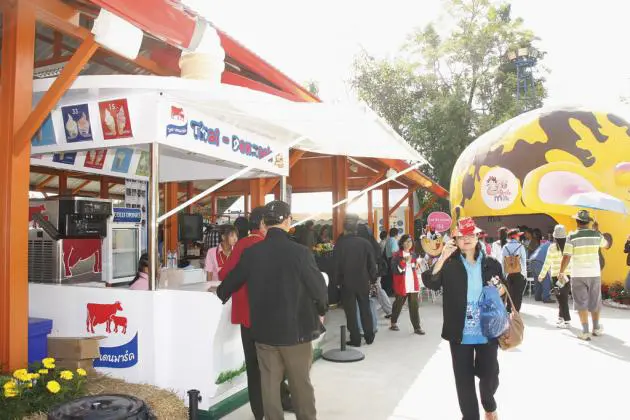
The organisation will this year launch its first prototype kiosks and shops for the sale of milk and related products such as ice cream, Noppadol said.
The two business channels aim to capture different markets, with the kiosks focused more on schools, universities and other educational institutions, while the milk shops will focus on other buildings and modern-trade channels.
The kiosks are expected to generate income of Bt300 million in the first year of operation, rising to Bt1 billion annually within five years.
To facilitate the new business channels, the DPO will invest more than Bt10 million on machinery to ensure the quality production of pasteurised milk and related products.
Pasteurised and fermented milk will be launched this year, while direct selling will also be introduced to maintain close service to customers, he added.
Finally, with its decades-long experience in cattle-farming development, it also plans to sell more management and other services and equipment to farms in the areas of machinery and know-how.
For instance, the DPO is in talks with a private farm as well as Wang Nam Yen Dairy Cooperatives to provide such services.
“We have long experience in farm development over 50 years, which is our strength in exporting parent animals and machines,” said the executive.
The organisation has established business in Laos and Cambodia by selling milk products through its trading partners in those countries.
Exports to Burma are currently focused on border trade and it is looking for a local partner there, he said.
Moreover, Vietnam also has high export potential as its government is promoting the dairy business to meet rising demand to serve the 80-million population. Vietnam currently farms some 100,000 cows, compared with the 500,000 raised in Thailand to feed 65 million people.
Thailand’s total raw-milk production is 980,000 tonnes per year, but this serves only 60 per cent of demand and 57,000 tonnes of powdered milk needs to be imported each year.
Noppadol said the local market for milk products still had room to grow from the current value of nearly Bt100 billion per year. UHT milk, fermented milk and soybean milk account for Bt20 billion each, and pasteurised milk for Bt10 billion of the total.
In addition, the DPO will soon propose that the Cabinet extend its school-milk contract for another three years when the current one expires next year, he said.
