
Boost for Chiang Khong Customs House
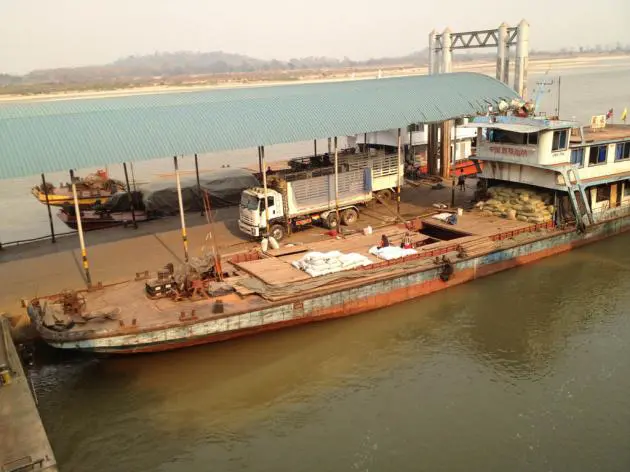


The Customs Department will request a budget from the Finance Ministry to build a bigger customs house in Chiang Khong to serve the surge in Asean shipments from the Greater Mekong Subregion.
“The new customs house is necessary to cope with trade flowing via Highway R3A, connecting Thailand with southern China’s Kunming through Laos,” Somchai Poolsvasdi, director-general of department, said last week.
“We expect to propose the project for the fiscal 2013 budget,” he added.
Meanwhile, the private sector in Chiang Rai is urging the government to lay out a strategy for the province, as border trade in Mae Sai district has been booming, doubling in three to four years to about Bt10 billion a month.
According to projections by the National Economic and Social Development Board, border trade in Chiang Khong would hit Bt10.53 billion this year and Bt17.55 billion in 2017, assuming that the proposed Fourth Thai-Laos International Bridge is constructed.
Border trade through the port of Chiang Khong reached Bt8 billion last year from Bt2.8 billion in 2009, and through the port of Chiengsan reached Bt7.89 billion from Bt3.85 billion. Border trade in Mae Sai is expected to rise to Bt100 billion this year.
The department is now preparing to improve all of its electronic systems for the coming of full liberalisation in 2015 with the Asean Economic Community, which will facilitate shipments across borders.
The opening of Burma to foreign investment has also helped increase trade with Thailand, he added.
Suwat Daungpan, chief of Chiang Khong Customs House, said the new customs house would cost about Bt300 million. It would be equipped with an IT system and e-customs to serve the Asean single-window scheme that allows cargo to pass only one inspection within the region.
The US$47-million (Bt1.44-billion) bridge crossing the Mekong River between Chiang Khong and Laos’ Houayxay is expected to open in July next year, a delay of six months from the previous schedule.
In fact the new customs house should be ready at the same time as the fourth Mekong River bridge, but the budget has not been set aside yet. Even if the budget is approved, it would take about 18 months to complete construction of the customs house.
The 60-kilometre route along the Mekong River from China via Laos to Thailand is restricted when the water recedes during the hot season. Shipments by the Mekong are also costly, the deputy director of Chiengsan Customs House said.
Boontham Tipparson, chairman of the Mae Sai Chamber of Commerce, said operators want the government to draw up a strategy for Chiang Rai in such aspects as international trade, tourism, agricultural products, logistics and industry. Then the province can design a city plan, which is its weak point.
“Now, trade between Thailand and Burma, Laos and southern China is beyond border trade,” he said.
Almost 80 per cent of consumer goods in Burma are imported from Thailand.
Trade in Mae Sai is now running at Bt500 million-Bt600 million a day, or more than Bt150 billion a year, compared to Bt4 billion-Bt5 billion annually over the past three years, he added.
