
Expansion Plans: Firms draw on experience
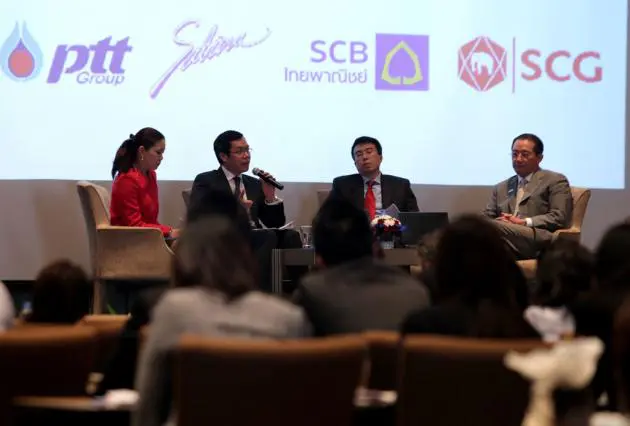


Top executives of leading Thai companies Green Spot, Sabina, PTT and SCG share their experiences and views on expanding to other Asean countries to capture the opportunities expected to arise from the integration of the 10 Southeast Asian nations under th
Thammasak Jittimaporn, managing director of Green Spot, said that for companies looking to expand into Asean, the most important thing is that their executives go out to see the markets for themselves. In the case of Green Spot, Thammasak said, he started by going to see the trading activities of the so-called “ant army” at Thailand’s borders several years ago. He learned that it would be difficult for Green Spot to expand to these neighbouring markets with the same products it sold in the Thai market.
“And don’t forget that, while we say there are 600 million people in Asean, 250 million of them are in Indonesia, where the people don’t drink soy milk,” said the Green Spot chief executive at a seminar organised by the Thailand Management Association (TMA) recently.
The next most important thing was to study consumer tastes. His firm had learned that consumers’ preferences in soymilk drinks differed across Asean, and even within countries. For example, in Thailand, people in the Northeast are different to people in the South with regard to their taste in soymilk drinks, he said.
--‘Mass premium’ approach
The soymilk market in Malaysia is totally different to the Philippines’, for example. While Malaysian consumers have been familiar with soymilk for a long time and the country is ranked fifth in the world in terms of per capita consumption, consumption of milk of all types is quite low in the Philippines, where beer sells for Bt10 a bottle, versus Bt20-30 for milk. Thailand, meanwhile, has surpassed Malaysia to become the world’s third most important market for soymilk, as measured by per capita consumption.
Green Spot studied the Malaysian market and found there was room between the home-made soymilk selling on the street corners – which has good but inconsistent taste – and the mass-manufactured and imported products that are sealed in hygienic packaging but have “bland”, “diluted”, “too sweet” or “industrial” tastes, Thammasak said.
To protect “parallel imports” of its own Vitamilk-brand soymilk from across Thailand’s border, Green Spot has created the new V-Soy brand specifically for the Malaysian market. Banking on the “mass premium” segment with “delicious and hygienic” product features, V-Soy took only three years to become the No 1 imported soymilk brand in Malaysia.
“Now, seven years on, we can say it’s the only imported soymilk drink that you can find anywhere in Malaysia,” said Green Spot’s chief executive.
The company sells V-Soy for two ringgit, or about Bt21-22, a bottle in Malaysia compared to Bt12 for a bottle of Vitamilk in Thailand, even though the soymilk inside the bottles is identical.
“But consumers don’t feel they are alike. The pricing is driven by the image,” he said.
Similar to its approach in the Thai market, Green Spot has marketed V-Soy as a meal replacement, which consumers perceive as a “liquid snack” that is cheaper than other foods while offering good nutritional value.
“Students like it very much when they don’t want to feel ‘too full’...as we say in our advertising slogan here in Thailand. And it provides more nutritional value than other foods,” said the Green Spot chief executive.
--Philippines vs VietNam
Thammasak said many companies weigh up the relative advantages of the Philippines and Vietnam, which have similar populations. Green Spot chose the Philippines.
“Filipinos never drink soymilk, while Vietnamese drink a lot. [But] while Vietnamese are similar to Thais, they drink cheaper soymilk and they often take Thais as their competitors. Whichever Thai products go there, they’re always beaten,” he said.
Actually, Green Spot did make an attempt to enter the Vietnamese market, but it was not a success and the firm had to pull out, said Thammasak.
Finding a good partner is a crucial factor in ensuring a successful entry into Asean markets. Green Spot is lucky to have found a good Philippine partner that has been in the alcoholic-beverage business for a long time, but is expanding into other businesses including drinking water and milk, he said.
“This could be fate. It’s not easy to find [a good partner],” said the Green Spot chief executive.
As it has in the Malaysian market, Green Spot has found some room in the middle to penetrate the Philippine soymilk market.
“While the ‘super premium’ soymilk drinks from the US are being sold at Bt70 a carton, on the other corner, there are the low-cost soymilks, which city dwellers don’t want to carry with them because they don’t want to look ‘cheap’,” he said.
Therefore, Green Spot has opted for a “premium quality at affordable price” strategy, retailing its soymilk there at 25 pesos, or about Bt19, a bottle.
Besides the advantages of packaging bottles, which Philippine consumers are more familiar with, compared to imported soymilk packed in cartons, Green Spot has benefited from its experience in the Dubai market, where Filipino workers were found to be the largest single customer group.
Concerning product-placement strategy, Thammasak said retailers, including 7-Eleven, which has 600 branches in the Philippines, could help when it comes to choosing where to sell products in major cities.
“Many 7-Eleven stores are in the lobbies of buildings. Our target is specifically the call-centre workers in these buildings. The Philippines is a call-centre hub with 500,000 seats [of call-centre workers]. I’m trying to encourage these workers to drink more of our products, which are seen as matching their lifestyle, as they come down regularly to take a break downstairs and have snacks,” he said.
As for its promotional strategy, Thammasak said Green Spot has used a lot of Facebook marketing, which has proved to be an effective and inexpensive medium for attracting Filipino customers, who very much like social media. The company runs its Facebook marketing base from Thailand, where a dedicated team monitors and replies to questions and inquiries from Filipino consumers.
Despite the absence of import tariffs under the AEC, Thammasak said Green Spot would consider setting up factories in other Asean markets in the next phase because transportation contributes a significant chunk of its total costs.
The Green Spot chief executive said non-tariff barriers continue to prevail in Asean, including through the practices of authorities at the borders.
Citing Green Spot’s recent introduction of the GS1 traceability standard, which allows consumers to find the sources of ingredients in its soymilk from an RFID (radio frequency identification) tag, Thammasak said Thai firms could gain a competitive advantage through applying information technology.
He also suggested companies look to explore business opportunities in Asean to join in business-matching activities “to get a glimpse of the flavour of what other businesses are doing”, even though they might not find anything suitable, as well as going to trade fairs, getting to know bankers and other Thai companies that have been operating in the particular countries for some time.
--Potential in Myanmar
Bunchai Punturaumporn, chief executive officer of Sabina Plc, told the TMA seminar his company has been in the Singaporean market for 10 years, whereas it has just entered Myanmar and Vietnam in the past few years. While Thailand has an ageing demography, Myanmar and Vietnam have quite young populations, he said.
“Within only one or two years, we have opened 20 sales outlets in Myanmar. The market has vast potential,” he said.
Bunchai said Sabina had looked overseas 18 years ago as the firm had striven to reduce its reliance on original equipment manufacturing markets (OEMs) and increase its own-brand markets, but the cost structure was prohibitive, largely due to import tariffs. The [scheduled] import duty waiver under the AEC, thus, has made our life much easier,” he said.
“When the baht fell to Bt35 [to the US dollar], our future as a producer for other people’s [brands] looked uncertain,” said the Sabina chief executive.
Now, as the baht is being traded at about Bt30 per dollar, Sabina has reversed its sales structure to 20 per cent OEM and 80 per cent own-brand sales, compared to the 80:20 ratio it saw during 2006-2007.
Thank to the AEC, potential markets for Sabina have expanded ten-fold from 60 million Thais to cover the 600 million population of Asean, while it is also easier for the lingerie maker to move into the Asean market, where ladies’ sizes are not too much different from those in Thailand, he said.
Unlike Green Spot, Bunchai said, Sabina does not have plan to set up manufacturing plants in other Asean countries, despite the high manufacturing costs in Thailand and the Bt300 daily wage policy, which has prompted many other firms to “flee overseas”.
“We think about selling first. Because nowadays, things change so fast. Taking the case of Vietnam, which is now experiencing high inflation, I believe they won’t take long to follow us in wage costs. Manufacturing requires big investments, while sales don’t,” he said.
In his opening address, Tevin Vongvanich, chairman of the TMA and chief financial officer of energy giant PTT, said the combined economic size of the 10 Asean nations was US$2 trillion (Bt60 trillion), which is still small by global standards, accounting for only 3 per cent of the world’s economy.
“The weight won’t be much. We should look forward to the Asean plus 3 and plus 6, whose economies will be worth about $16-19 trillion, and will begin moving closer [to the size of other economic groups in the world], he said, referring to the further integration of Asean and six other economies: China, Japan, South Korea, Australia, New Zealand and India.
Chaovalit Ekabut, chief financial officer of Thai conglomerate SCG, told the seminar that people are a key success factor for companies looking to capitalise on the opportunities arising from the AEC. He predicted a “talent war”, since there are many multinational companies residing in the region. These firms intend to either move their resources to lower labour-cost countries or prepare their human resources for the change.
Companies eye expansion and growth in Asean and need to realise the importance of corporate governance and sustainability issues, he said.
“For people who think about relocating from Thailand [to other Asean countries] because they have an environmental agenda, this way of thinking will be an obstacle, because our neighbouring countries are not stupid,” said the SCG executive.
Chaovalit cited the case of Vietnam, which has adopted stricter environmental regulations for new kraft paper plant investments than Thailand’s.
