
Virabongsa calls for hike in VAT


Play
Says other taxes could be eased
Virabongsa Ramangkura, chairman of Prime Minister Yingluck Shinawatra’s advisory team, yesterday proposed raising by 1 percentage point the value added tax (VAT), which currently adds 7 per cent to the cost of consumer products.
“This would result in additional revenue of Bt60 billion for the country, which would enable us to ease other types of tax collection,” he said.
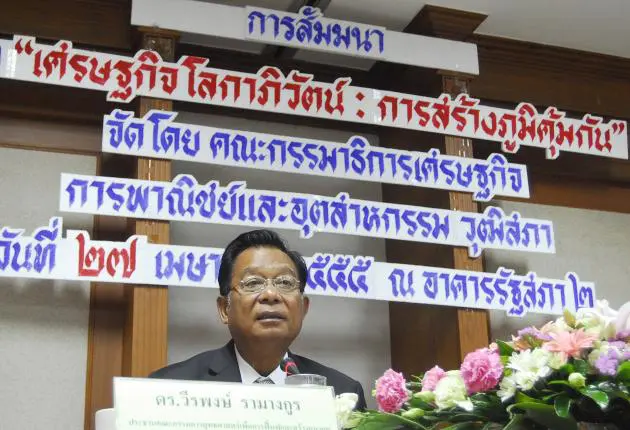
Speaking at a seminar on globalisation organised by the Senate committee on the economy, Virabongsa said the current tax structure created a negative investment environment. Taxation should be used not only for income generation, but also to reduce the gaps between different groups’ standard of living, he said.
Taxation tends to have the heaviest impact on middle-income earners, Virabongsa said, because existing tax measures contain many exemptions, making it hard for the government to collect more from the rich, whose income derives mostly from interest, dividends and capital gains. Without these exemptions, however, the country’s competitiveness would suffer – including a drop in stock-market sentiment – resulting in capital outflows to such places as Singapore, he said.
“Therefore, the tax system should be based on consumption.”
Virabongsa also outlined his vision for the country’s future, two keys to which would be increased efficiency of rail and air transport.
He said the global poles of economic growth had shifted from the West to Asia, in particular China and India. In addition, Myanmar is opening up to new foreign investment. Thailand has many advantages over other countries, with its 1,500-kilometre border with Myanmar, he said.
However, Thailand still lags behind some of its neighbours, so it is important to speed up development of infrastructure and the information-technology system, Virabongsa said.
Of particular importance in terms of infrastructure is Suvarnabhumi Airport, which is now stretched beyond capacity, he said. The airport handles 48 million people a year, compared with an official capacity of 36 million. He urged the government not only to come up with an expansion plan for Suvarnabhumi’s second phase, worth Bt60 billion, but also to develop Don Mueang Airport for greater use.
“Now, Thai AirAsia has confirmed its participation in the development plan [for Don Mueang]. The connectivity problem between Suvarnabhumi and Don Mueang will be resolved with a shuttle-bus service,” he said. But he added that in the long term, the government would need to build an extension of the Airport Rail Link connecting Bangkok’s Makkasan station to Don Mueang. However, this could take up to three years, he said.
He said the government would develop industrial estates for heavy industries in the eastern provinces, to ensure a sufficient water supply. Light industries would be encouraged to locate in other areas in the North and Northeast.
New mindset needed
For IT development, Virabongsa said the government should change its mindset, from focusing on how to generate maximum income for the state to how the state can help bring down prices. For example, if there is bidding, the government should not focus solely on finding a winner who offers the highest price, as this would be passed on to consumers.
“When tackling big tasks, have the confidence and assurance to do it. One thing I wish to reform is railway transport, which is obsolete,” Virabongsa said.
However, he said the government should not remove the existing railway system altogether, but leave it in place for use by lower-income earners. Meanwhile, it should build a new railway system that is able to carry shipments at speeds of 100-120km/h, in addition to mass-transit lines with speeds of 250-300km/h.
“This proposal could be completed in 10 years at a cost of Bt2.2 trillion,” he said.
He also suggested that labour-intensive industry should move to neighbouring countries or they would not be able to survive, as technology would replace manpower in the Kingdom.
