
Ambitious Thai Smile debuts Bangkok-Macau service
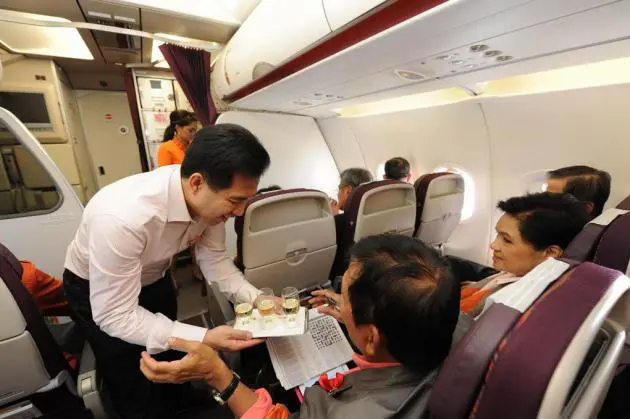


Saturday's first flight to Macau by Thai Smile, the new sub-brand of Thai Airways International, marked the national carrier's foothold in the regional market with its new A320-200 aircraft, as well as an intensification of competition on the route betwee
The number of daily flights each way between the destinations has risen from six to eight, said the Macau Government Tourist Office. Four are operated by AirAsia, two by Air Macau, and now another two by Thai Smile.
AirAsia also operates a daily service between Chiang Mai and Macau.
Woranate Laprabang, managing director of the Thai Smile business unit, yesterday acknowledged that the number of seats on offer from the three airlines between Bangkok and Macau could exceed demand.
However, he believes Thai Smile, with 174 seats per flight and its Smile Plus business-class service, will have a competitive edge over rivals.
Besides attractive pricing, the new carrier offers convenience and rewards, as passengers can share facilities with sister airline Thai Airways and also collect mileage points with Royal Orchid Plus, he said.
Some snacks and drinks are served, while those requiring something some substantial can choose from the airline’s in-flight menu. Hot dishes cost Bt130, for example.
Thais are among the top travellers to Macau, with almost 200,000 visitors last year and about 87,500 in the first five months of this year.
Thai Smile expects its average cabin-load factor on the Bangkok-Macau route will reach between 74 and 75 per cent.
“Macau offers big potential and we are confident we can achieve [success] in this market,” Woranate said, adding that Thailand is also a tourism destination for many of Macau’s residents.
Strategically, Thai Smile will also capture |passengers on the Macau to Bangkok route wishing to connect to other Asian cities, especially New Delhi in India, with the benefit of a short stop-over.
Macau is also close to Hong Kong, with only an hour’s travel by ferry. That means Thai Smile can facilitate connections to cities in mainland China, he said. In addition, Macau connects to border cities like the tourist destination of Zhuhai.
Thai Smile follows the business concept of SilkAir, which is the sister airline of Singapore Airlines. However, SilkAir is an independent firm, while Thai Smile is operated by Thai Airways. The former has 30 aircraft in its fleet, while the latter plans to have about 20 aircraft by 2015.
By the end of the year, the new carrier will service six domestic and regional destinations. In September, it will fly to Hyderabad, a major growth-economy city in India, Woranate said.
Seventy per cent of its flights will be regional, and the remainder domestic. The regional focus is Asean, Chinese and Indian cities within a three-hour flight time of Suvarnabhumi Airport.
Thai Smile is expected to show a return on investment within one year, Woranate said previously. This year, sales revenue is expected to reach Bt1.8 billion, rising to Bt4.8 billion next year.
While Thai Airways plans to launch a new lost-cost airline by the middle of next year, he said Thai Smile would not be unduly affected by its operations as there would be clear segmentation between the two.
However, he acknowledged that there could be some overlap in the routes they fly, but this would not pose a big trouble for his unit.
“If we [Thai Airways International] do not launch a new low-cost carrier, we will not get a single baht from this [budget part of the] market,’’ he said, adding that the regional aviation industry was continuing to heat up, driven by low-cost operators.
He cited low-cost carriers IndiGo, based in India, and Lion Air, based in Indonesia, as prime examples. They have each ordered 200 new aircraft and will inevitably have to fly regionally in order to increase load capacity, he said.
