
3G auction faces new challenge


Play
Green Politics group will ask court to halt bidding if reserve price not raised
Suriyasai Katasila, chief coordinator of the Green Politics group, has threatened to file another petition with the Administrative Court seeking an injunction blocking Tuesday’s auction of 3G, or third-generation, telecom licences.
The court last week had accepted two similar petitions. They seek an injunction on grounds that consumers’ rights would be infringed upon if the multi-billion-baht auction goes ahead without changes to its rules and regulations.
Suriyasai said yesterday that if the court did not issue the injunction today, the Green Politics group would submit another petition to the court seeking suspension of bidding for 3G licences on grounds that the Bt4.5-billion reserve price for a slot in the 2.1-gigahertz spectrum is too low.
The National Broadcasting and Telecommunications Commission (NBTC) is offering a total of nine 5-megahertz slots to bidders. Consultants from Chulalongkorn University recommended a reserve price of Bt6.44 billion per slot.
Suriyasai said that by failing to follow the recommendation, the NBTC had endangered the public interest.
“The NBTC should amend the starting price before it starts the auction process; it can be done in a few days. Within a week the auction could take place. We are taking this action to protect the public interest. We do want to have the new 3G network,” he said.
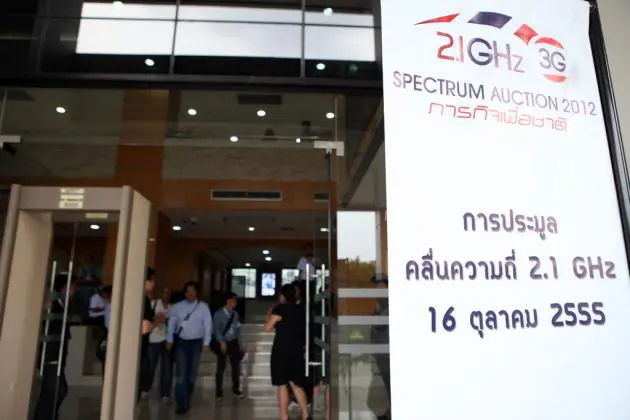
Earlier, Anuparb Tiralarp, an independent academic, and a consumer-protection group filed petitions with the court seeking an injunction against the October 16 auction.
Unless the court issues an urgent order to suspend the bidding, the NBTC will go ahead with the long-delayed auction at around 9am on Tuesday.
The auction of 3G telecom licences was suspended once before – about two years ago, when the court issued a last-minute injunction citing the unconstitutionality of the bidding process.
The court said the National Telecommunications Commission (NTC) – the NBTC’s predecessor – was not empowered under the Constitution to hold the auction. In its ruling, the court said the charter clearly states that the country needs to set up a combined regulatory body for both the telecom and broadcasting sectors before any auction of the scarce radio frequencies for telecom and related uses can be held.
According to Suriyasai, the NBTC had no sound reason to reduce the starting price for spectrum bids by nearly Bt2 billion per slot – or 30 per cent.
Suthipol Tawee-chai-karn, a member of the NBTC in charge of the auction, said a further delay of the bidding would lead to a loss of economic and business opportunities amounting to an estimated Bt210 million per day.
But Suriyasai said the country would lose more if the NBTC went ahead with the excessively low prices for licences, which will be valid for the next 15 years.
Critics say the bidding criteria also appears to have facilitated collusion, as all three major telecom providers in the country are qualified to bid in a scenario that is likely to see each of them get three of the nine spectrum slots.
“In other words, it’s a neat legal collusion scheme. All 11 members of the NBTC are well aware that the public have high expectations of their integrity and handling of this crucial auction, so they may also expect people to file complaints with the anti-graft body if there is corruption and collusion,” Suriyasai said.
Besides the multi-billion-baht fees from auctioning off the spectrum, the process will lead to estimated investment in additional equipment and infrastructure to the tune of more than Bt100 billion in the coming years. The investment will boost data transmission speeds to at least 2 megabits per second – 5 to 6 times faster than the current network, proponents say.
