
TBank, Tisco top lenders under first-car scheme


Play
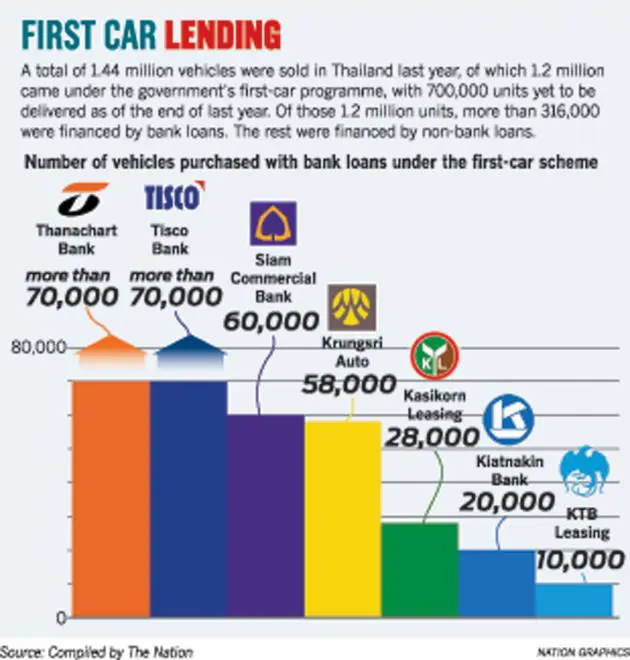
Thanachart Bank and Tisco Bank took the lead in granting loans to buyers under the first-car scheme, each bank financing purchases of more than 70,000 of the 1.2 million vehicles sold under the government's tax-rebate programme.
The extraordinarily strong car sales in 2012 helped grow TBank’s auto-loan portfolio by more than 30 per cent, while Tisco Bank enjoyed growth of instalment loans of more than 34 per cent.
Fears have been expressed that the first-car programme could lead to non-performing loans because many buyers under the scheme were new graduates and first-jobbers. However, major players in the auto-loan segment insist there is little chance they will be hit by significant NPLs because of their credit-rating systems.
Some banks that provided few loans to first-car buyers said they had to be more cautious with this segment because after these customers held their new cars for a year and received a tax rebate of up to Bt100,000, they might use the money for other purposes and become unable to make their car-loan payments.
TBank, the leader in the auto-loan market, believes there will be few NPLs resulting from the first-car scheme, said senior vice president Anuchart Deeprasert. His theory is that since many buyers are new graduates and first-jobbers, if they are unable to pay an instalment, their parents will help them.
TBank allows down-payments of less than 20 per cent but no less than 15 per cent of the vehicle price and a repayment period of 72 months. Anuchart said that even that condition could be eased, as the credit-rating system at the bank could screen buyers.
Isara Wongrung, chairman of the Thai Hire Purchase Association, recently warned that car buyers with down-payments of less than 20 per cent and a repayment period of more than 72 months were on a watch-list for NPLs.
Chalit Silpsrikul, executive vice president of Tisco Bank, said NPLs from the first-car scheme would be lower than for buyers outside the programme because the bank had set tight conditions on granting loans to the former. He said the incidence of NPLs depended on the conditions set by each financial house.
After buyers have had their cars for a year, they are expected to be on a watch-list for NPLs, but Chalit noted that by that time the principal of the loans would have been paid down by a lot, so buyers were not likely to want to see their vehicles repossessed.
NPLs would occur if financial houses allowed buyers to make low down-payments or the buyers already had high debt burdens and became unable to make their payments, he said.
Most Tisco customers taking advantage of the first-car scheme were younger people. Siam Commercial Bank, on the other hand, lent mostly to older car buyers, said executive vice president Narong Srichukrin, incurring less risk.
Under the scheme, SCB granted loans for about 60,000 vehicles.
He said the only risk of the first-car scheme was artificial demand, with buyers who were not really ready to handle monthly instalments but wanted to receive the tax incentive while it was available. The scheme ended on December 31.
About 70 per cent of first-car loans at SCB were for white-collar workers with monthly salaries of more than Bt20,000.
The first-car scheme was the key driver of Bt100 billion in new auto loans booked last year, leading to outstanding loans in 2012 of Bt170 billion.
Banks that provided few loans to the first-car buyers said the scheme was regarded as high-risk, especially in the eco-car segment, where the buyers are a new group.
Isara, who is also an executive at Kasikorn Leasing, said the company financed about 28,000 units under the programme. It foresees that eco-car buyers under the project will find themselves on a watch-list for NPLs. This segment might be unprepared for the costs of running a car such as for maintenance and fuel, he said.
To mitigate this risk, eco-car buyers who applied for loans from KLeasing had to make down-payments of no less than 20 per cent and undertake a repayment period of no more than 72 months.
KTB Leasing granted the fewest loans under the scheme, financing only 10,000 units in a bid to control risk, said president Phinyavat Chantrakantanond.
The company previously estimated that the risk from this project was subrogation, whereby people who would not normally qualify for a loan would acquire them by way of other people with better credit ratings. Therefore, KTB screened out such borrowers who were going through non-family members because they represented higher risk than those who went through relatives, he said. Even then, the actual owners of the new cars were requested to attend the signing of the auto-loan contracts.
KTB Leasing provided loans to borrowers with a down-payment starting at 10 per cent of the vehicle price and provided the longest repayment period of 84 months. Phinyavat said the low down-payment was not a problem because the loans were granted based on the careers of borrowers.
“We consider the debt-payment ability of a customer. If a new civil servant makes a down-payment of only 10 per cent of the vehicle price but has job security, he should be a qualified for an auto loan,” he said.
