
Chiva-Som Academy helps fill global demand for qualified spa pros


Play
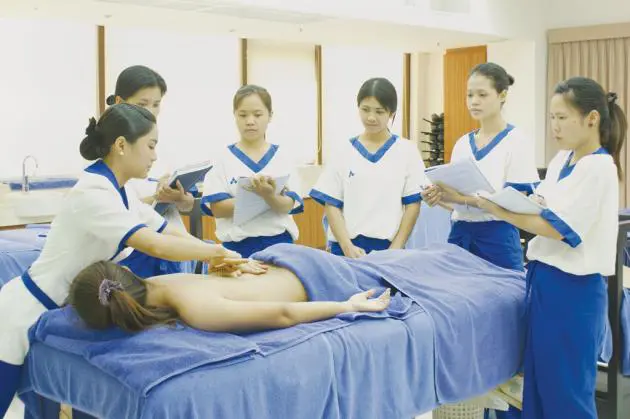
At Chiva-Som International Academy in Bangkok, a group of students, international and local, were paying attention to a lecturer teaching in English. The atmosphere seemed quite relaxed, but when the subject turned to spa anatomy, they became serious.
Outside the class, its surroundings are filled with the scent of herbal aroma, creating a perfect place for learning. The 1,000-square-metre floor is divided into four classrooms and seven private rooms. A guest was waiting to be a study case as way to ensure that students get real-life experience before they graduate. However, guests have to pay a small amount for the service.
This is the scene at Chiva-Som International Academy, the country’s first accredited spa-training school. Established 10 years ago, it was renovated five years ago at a cost of Bt50 million.
The programme is practical, designed as a blend of science and art. Its purpose is to produce workers skilled in serving the fast-growing spa business, not only in Thailand but internationally.
Krod Rojanastien, sales and marketing manager of Chiva-Som, told The Nation that during the academy’s decade of operation it had groomed a large number of professionals in this field. It is committed to producing skilled workers over the next decade while at the same time conducting research projects to deepen its knowledge of its subject.
Internationally, it intends to promote itself as a body qualified to certify professional standards for those working in this field. Currently there is no such body in Asia. On the global stage, the UK-based Confederation of International Beauty Therapy and Cosmetology has played a dominant role in certifying spa professionals. Holding a CIBTAC certificate can pave the way for a work visa in a number of countries.
Last year, 334 students were enrolled at Chiva-Som. Sixty-one of them were return students, up 18.26 per cent from 2011. The rising number in this group reflects that graduates have progressed in their careers and need more knowledge to step up to a higher level.
This year, the academy projects that the number of students will increase by at least 5 per cent. In general, Thais are 80 per cent of the total, while overseas students come from Asian countries such as the Philippines and India, from Europe, and from South Africa, attracted by a course that is 30 per cent cheaper than in neighbouring nations. After completing the programme, they will return to their homelands to work as therapists or spa managers, especially in high-end hotels.
Most of the Thai students are women. Graduates often choose to go abroad to work, especially with luxury hotels in the Middle East where they earn at least Bt30,000 a month.
Krod, who is also president of the Thai Spa Association, said spa jobs were still growing significantly both locally and in international markets. However, there are only a few international-standard spa schools in Thailand to help satisfy this demand.
Given the growth of this industry, valued at more than Bt10 billion for both licensed and unlicensed services, it seems to be time for Thailand to revise its strategy. Though recognised as having a stronger infrastructure than regional peers, the Land of Smiles has no clear policy for making itself the spa-service destination of choice. A lack of cooperation among relevant agencies in 10 ministries is still a problem.
“It’s time to promote standardisation and let education play a key role in shaping the industry,” Krod said. “Legislation must be imposed as well to regulate and create new standards. This is essential for the industry’s development.”
If Thailand fails in this regard, he said, the industry will become uncompetitive when the Asean Economic Community is implemented in 2015.
“How can the country be the spa destination if illegal massage parlours, which have exploited spa popularity, are operating almost everywhere?” he asked.
Today, the Thai spa industry is competing with rivals such as Vietnam and Singapore. Recently, Indonesia emerged from the shadows by setting up a professional qualification body, accepted by ISO 17024, to standardise its spa professionals. Clearly Asean’s biggest nation is eyeing this lucrative industry, with a view to exporting its skilled workers to other countries.
At home, the government has set up the Thailand Professional Qualification Institute to ensure the standards of skilled labour in various fields. Chiva-Som will be assigned to help define the qualifications for spa professionals.
Currently, the industry is regulated by the Spa Act of 1966. Though it was amended in 2003, the act is still outdated, defining spas as massage service. Clearly, legislation and education should work together as a way to modernise the industry.
