
Last three elements of quant investing explained


Play
In this article we will cover the last three elements of quantitative investing, namely test/backtesting, optimisation and evaluation.
Test/backtesting is testing whether the quant model is profitable or comparing risks and returns between models before selecting the best model to enhance your investment performance.
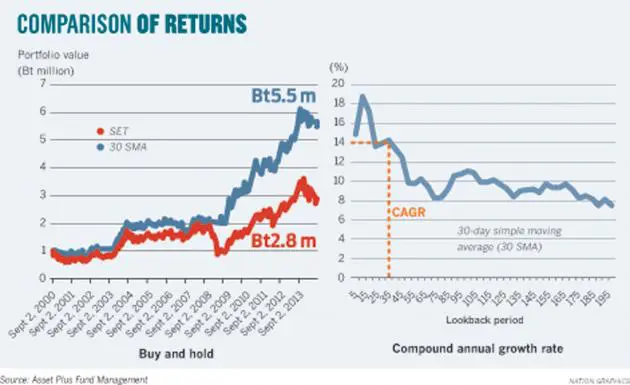
For example, graphics shows the backtesting result by comparing the returns of two models: “trend following” and “buy and hold”. The trend-following model is buying a unit of an index fund when its latest price exceeds the 30-day simple moving average (30 SMA) and to sell when the index fund’s latest price is lower than 30 SMA from 2000-13. The buy and hold model is buying the unit in 2000 and holding it until 2013.
The backtesting result shows that if you invest based on the trend-following model (blue line), you will get a higher return than what the buy-and-hold model indicates.
Optimisation is finding the best set of parameters from the model. In this process, investors can adjust the parameters to maximise returns or minimise risks. In this way, investors can ensure optimal results before the actual application.
For example, set your target ROI (return on investment) for the index fund at 14 per cent per year and find the optimal moving average price to buy and sell. To do this, find the optimal moving average price period by plotting the number of days in the past (lookback period) on the horizontal axis and the returns on the vertical axis to find the target return on investment.
Yields: an optimisation target of 14 per cent by using the 30 SMA of the index fund.
Evaluation: assessing the model’s outcomes based on its performance, that is, risks and returns, at two levels:
_ Portfolio: Assess the overall portfolio, such as CAGR (compound annual growth rate), volatility and maximum drawdown.
_ Individual stock: Assess each stock, such as the number of trades, percentage of winning and losing trades.
By using statistical analysis to create models on the computer, quant investment can improve investment efficiency. If a fund management company uses the model to manage mutual funds to help fund managers make decisions to buy or sell securities, the fund performance may improve.
Asset Plus Fund Management’s Investment Risk Department contributed this article.
